Atomic Structure
Principles of Chemistry
- (Z): the number of in the nucleus of an atom
- Each element has its own unique atomic number — no two elements share one
- In a neutral atom, the number of electrons also equals Z
- (A): the total number of protons + in the nucleus
Counting subatomic particles
-
Number of protons = Z
-
Number of electrons = Z (for a neutral atom)
-
Number of neutrons = A − Z
-
Example. An atom of beryllium has atomic number 4 and mass number 9, so it has:
- 4 protons
- 4 electrons
- 9 − 4 = 5 neutrons
Common exam question
Atomic number, mass number and counting the particles
Question: State what is meant by atomic number or mass number, or give the number of protons, neutrons and electrons in an atom from its symbol or from its name with a mass number (1–2 marks).
Asked in 4 of the 23 papers. Atomic number is the number of protons in the nucleus; mass number is the number of protons plus neutrons. Mentioning electrons in the atomic-number definition is ignored rather than penalised, so it earns nothing: that mark is for protons, and the mass-number mark is for protons plus neutrons.
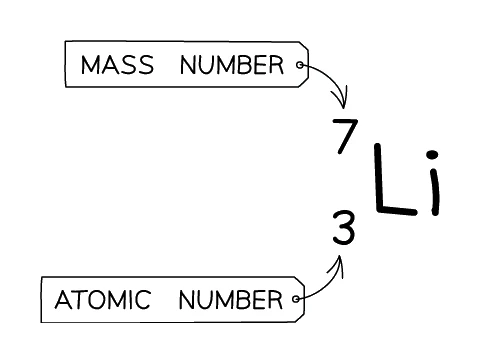
From a symbol, the smaller number is the atomic number: protons equal it, and so do electrons in a neutral atom; neutrons are mass number minus atomic number. One mark is for the protons (with the electrons), the other for the neutrons. Most multiple-choice versions hide a wrong option built from the electron count: a mass number counts the nucleus only.
Reading the periodic table
- Both Z and A are given alongside every element on the periodic table
- The larger of the two numbers is the mass number
- The smaller is the atomic number
Common exam question
Using a table of proton, neutron and electron counts
Question: From a table of the numbers of protons, neutrons and electrons in several lettered species, pick out an atom, a positive or negative ion, an element in a given group, or a mass number (1 mark each).
Set in 4 of the 23 papers, always as question 1 or 2. An atom has equal numbers of protons and electrons. Fewer electrons than protons makes a positive ion with a charge of protons minus electrons, so three fewer electrons means 3+; more electrons than protons makes a negative ion. The mass number is protons plus neutrons whatever the electrons are, and a species whose atomic number equals its mass number has no neutrons.
Rows with the same number of protons are the same element, so they are isotopes when the neutrons differ. For an atom's group, turn its electron count into a configuration (7 electrons is 2,5, so group 5); a full outer shell means 2, 10 or 18 electrons.