Transport in Humans
Structures and Functions in Living Organisms · 6 question types
When a blood vessel is cut, the body has to act fast to stop blood escaping and to seal off the wound before bacteria can enter. The system that does this involves and a chain of plasma proteins.
The steps of blood clotting:
- Platelets at the site of the wound release chemicals that trigger the clotting cascade.
- A soluble plasma protein called fibrinogen is converted into long insoluble fibres of fibrin.
- The fibrin fibres form a tangled mesh across the wound.
- get trapped in the mesh, forming a blood clot.
- The clot dries out at the surface to form a scab, which stays in place while new skin grows underneath.
The clot does two things: it stops further blood loss, and it provides a physical barrier that keeps bacteria out of the wound while it heals.
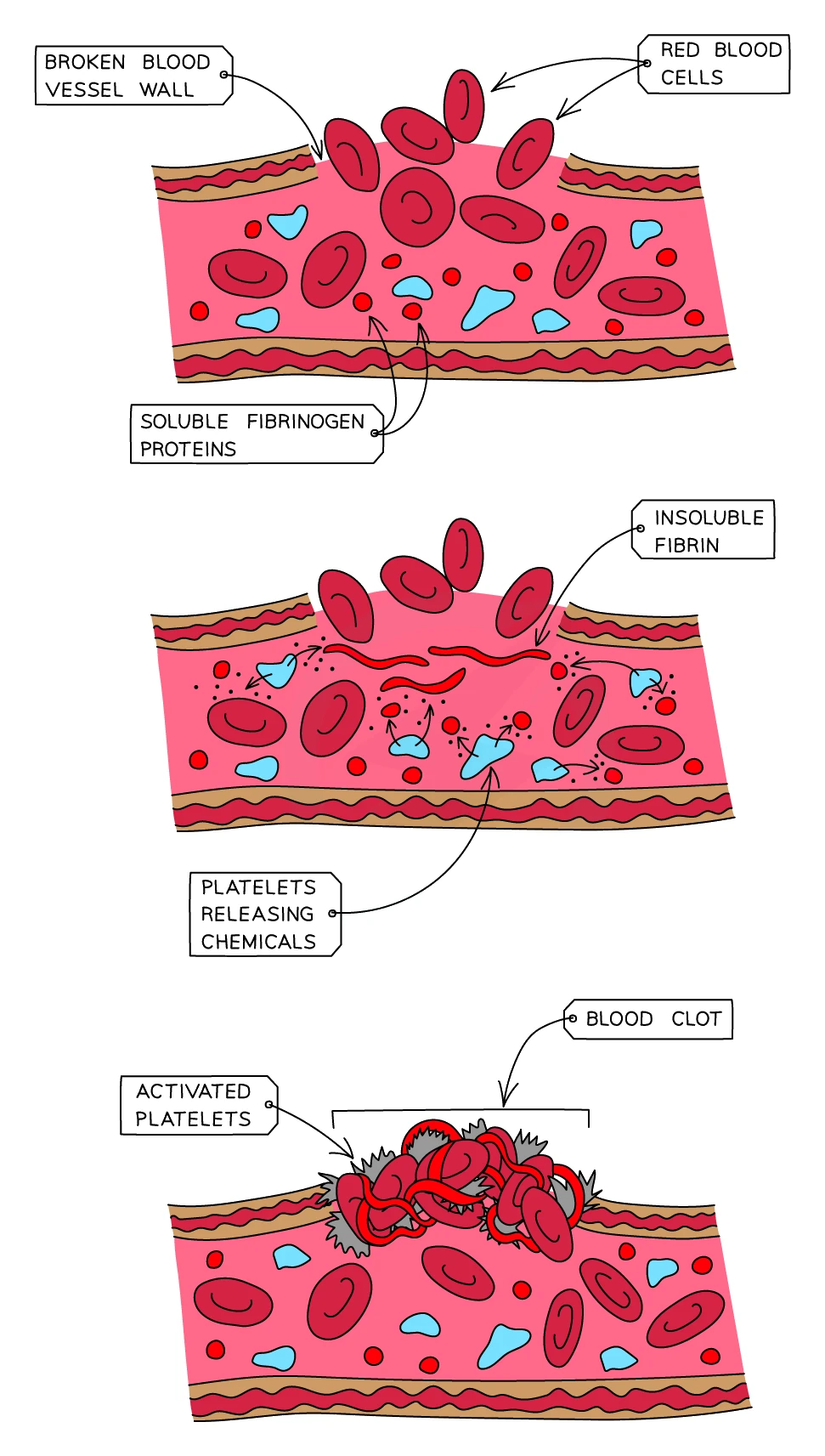
A condition called haemophilia is caused by inheriting a defective version of one of the clotting proteins. People with haemophilia bleed for much longer than normal after even minor cuts, because their clots form very slowly.
Describing the role of platelets
What comes up: "describe the role of platelets in the body" (3 marks).
Write (three marks): (1) Platelets help blood to clot at a wound (for example by triggering the conversion of fibrinogen to fibrin) (1). (2) Clotting prevents further blood loss / stops bleeding (1). (3) The clot acts as a physical barrier that prevents pathogens / bacteria from entering the wound (1).
Watch out: a vague answer such as "platelets seal wounds" scores at most one mark. You need to name at least one consequence of clotting (stops blood loss) and the infection-prevention role to reach full marks.