Transport in Humans
Structures and Functions in Living Organisms · 6 question types
An adult human carries around 5 litres of blood. It is made up of four main components:
| Component | What it looks like | Roughly what fraction of blood |
|---|---|---|
| Plasma | Pale yellow watery liquid | About 55% by volume |
| Red blood cells | Tiny biconcave discs, no nucleus, red colour | About 45% by volume |
| White blood cells | Larger cells with a nucleus, less than 1% by volume | A small fraction |
| Platelets | Tiny fragments of cells, no nucleus | A small fraction |
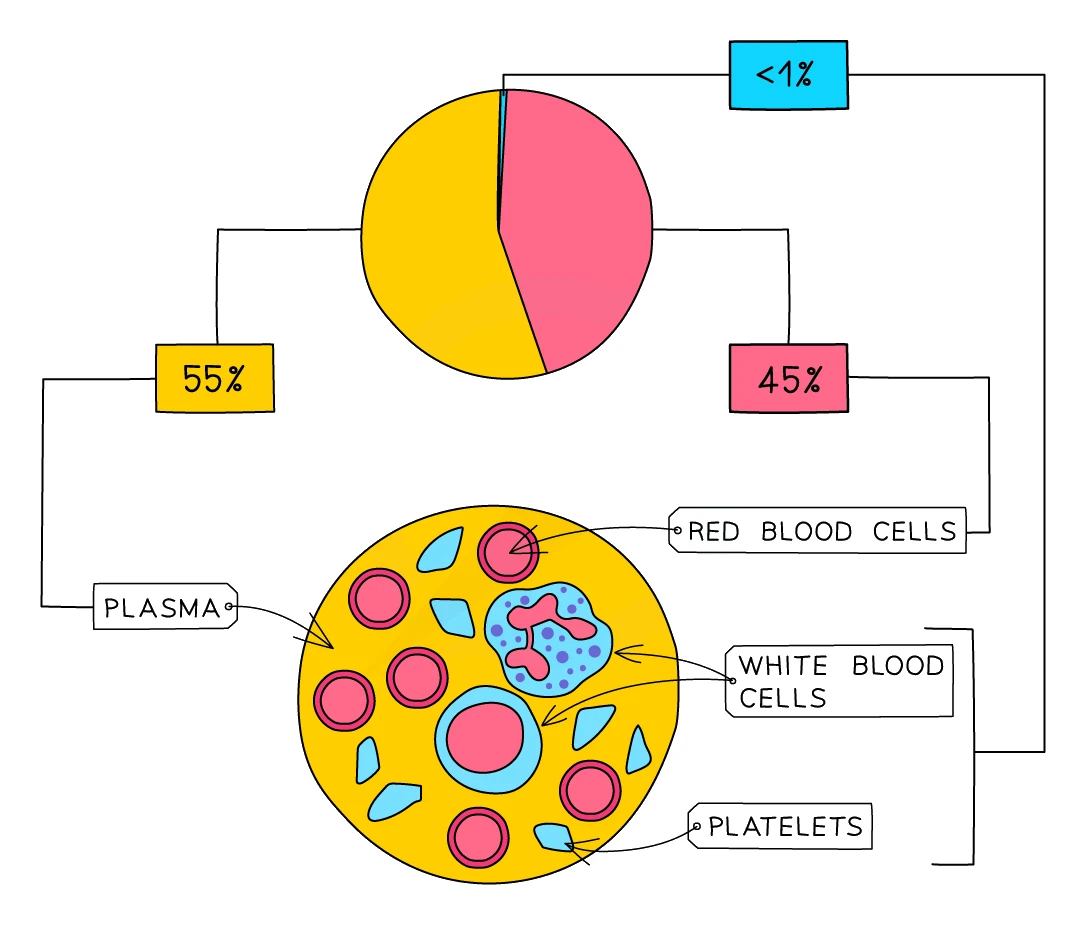
Plasma
Plasma is the watery fluid the other components are suspended in. About 90% of it is water, with all sorts of useful substances dissolved in it:
- Carbon dioxide dissolved from respiring cells, being carried to the lungs to be breathed out
- Digested food molecules (glucose, amino acids, mineral ions) absorbed from the small intestine and being delivered to every cell
- Urea, a nitrogen-containing waste from the liver, being carried to the kidneys for excretion
- Hormones (chemical messengers) released by endocrine glands, being delivered to their target organs
- Heat energy released by respiring cells, being moved to cooler parts of the body or to the skin
Red blood cells (erythrocytes)
Red blood cells are highly specialised for one job: carrying oxygen from the lungs to every respiring cell in the body. Three adaptations make them excellent at this:
- Packed with , an iron-containing protein that binds reversibly with oxygen. In the oxygen-rich environment of the lungs, haemoglobin combines with oxygen to form . In the low-oxygen environment of a respiring tissue, oxyhaemoglobin releases its oxygen back to haemoglobin and the oxygen diffuses into the tissue.
- No nucleus, which leaves more room inside the cell for haemoglobin. One mature red blood cell holds about 250 million haemoglobin molecules.
- Biconcave disc shape (pinched in the middle on both sides). This gives a large surface-area-to-volume ratio for oxygen to diffuse in and out quickly, and lets the cells be flexible enough to squeeze through narrow capillaries.
A red blood cell only lives for about 4 months. Old ones are broken down in the liver, and new ones are made constantly in the bone marrow.
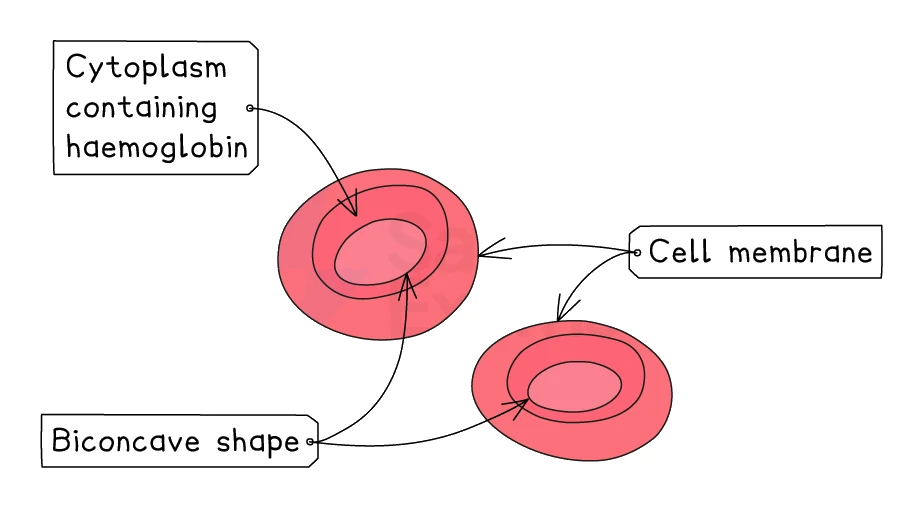
Red vs white blood cells
Giving structural differences between red and white blood cells comes up (3 marks), so you need to know: red cells have no nucleus, a biconcave disc shape, and haemoglobin; white cells have a nucleus, an irregular shape, and no haemoglobin. The nucleus and haemoglobin points are the most reliable.
White blood cells (leucocytes)
belong to the immune system. Their job is to defend the body against pathogens. Two main types exist:
- Phagocytes carry out non-specific immunity. They engulf and digest any pathogen they meet.
- carry out specific immunity. They produce antibodies, proteins that recognise one particular pathogen.
A typical white blood cell is much larger than a red blood cell and has a prominent nucleus when viewed under a microscope. Both types are covered in detail in section 6.
Platelets
Platelets are not whole cells but tiny fragments broken off from much larger cells in the bone marrow. They have no nucleus. Their job is to make the blood clot at a wound, which seals the cut, prevents excessive blood loss, and stops bacteria getting in. Covered in section 8.