Diffusion, Osmosis & Active Transport
Structures and Functions in Living Organisms · 6 question types
Diffusion
What diffusion is
Diffusion is the net movement of particles from a region of higher concentration to a region of lower concentration, down a
Several things to notice about the definition:
- Net movement, not just movement. Individual particles bounce around randomly in all directions. The reason a substance appears to spread out is that, on average, more particles happen to move from the crowded side to the empty side than the other way around.
- Down a concentration gradient, which means from a high concentration to a low concentration. Diffusion never moves particles "uphill" against the gradient.
- It is a passive process, so it does not need any energy from the cell. The particles' own kinetic energy does all the work.
- Diffusion stops being net once the concentrations on the two sides are equal. The particles keep bouncing around after that, but with no net flow.
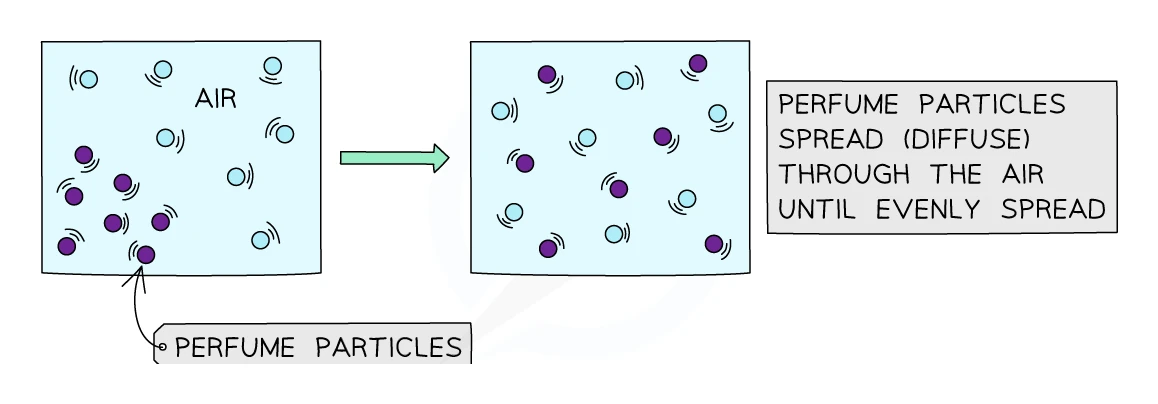
Why it happens
Every particle in a fluid is in constant, random motion. The more crowded a region is, the more particles in it bouncing around per second, and the more particles per second that happen to bump across into the neighbouring (less crowded) region. The reverse traffic is smaller because fewer particles live in the lower-concentration region in the first place. Over time, the imbalance evens out.
Diffusion across cell membranes
The cell membrane is partially permeable (sometimes called selectively permeable). It lets some substances cross freely but blocks others:
- Small, uncharged molecules like oxygen, carbon dioxide, water, urea and small lipid-soluble molecules diffuse across the membrane with no help
- Large molecules like starch, glucose and proteins cannot diffuse across on their own
- Charged ions also struggle to cross the lipid membrane without help
Important examples of diffusion in living organisms
| Where | What diffuses | Why a gradient exists |
|---|---|---|
| Alveoli in the lungs | Oxygen in to the blood; carbon dioxide out | Air in alveoli is rich in O₂ and poor in CO₂; blood arriving in the capillaries is the opposite |
| Photosynthesising leaf | Carbon dioxide diffuses into the leaf; oxygen diffuses out | Chloroplasts use up CO₂ and produce O₂, keeping the gradient steep |
| Liver to bloodstream | Urea leaves the liver cells and enters the surrounding blood by diffusion | The liver produces urea continuously, so its concentration inside the cells stays high while the blood washes it away |
| Plant root | Water and dissolved gases | Wet soil has higher concentrations than the inside of the root |