Diffusion, Osmosis & Active Transport
Structures and Functions in Living Organisms
Aim
To investigate how surface area to volume ratio affects the rate of diffusion.
Principle
Cubes of agar jelly are coloured pink using sodium hydroxide (an alkali) and phenolphthalein (an indicator that is pink in alkaline conditions and colourless below pH 8.3). When placed into dilute hydrochloric acid, the acid diffuses inwards through the agar and neutralises the alkali. As it does, the indicator turns colourless. The time it takes for the cube to become completely colourless is a measure of how long it took the acid to diffuse to the centre.
Cubes of different sizes have different surface area to volume ratios, so they decolourise at different rates.
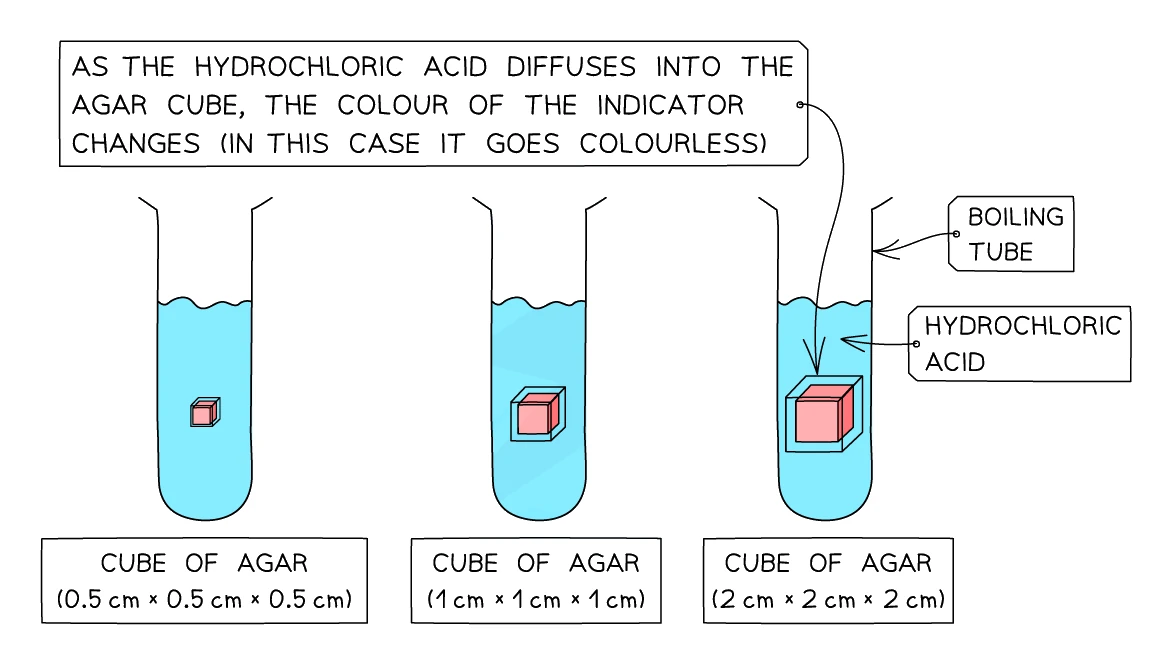
Apparatus
- Block of pink agar (already made up with sodium hydroxide and phenolphthalein)
- White tile (to provide a clean cutting surface and contrast)
- Sharp scalpel
- Ruler
- Forceps
- Dilute hydrochloric acid (around 1 mol/dm³)
- Boiling tubes, one per cube size
- Stopwatch
Method
- On the white tile, use the scalpel and ruler to cut three cubes of pink agar of different side lengths. A useful set of sizes is 1 cm, 2 cm and 3 cm.
- For each cube, calculate the surface area, the volume and the SA:V ratio. Record these in a table.
- Pour the same volume of dilute hydrochloric acid into each boiling tube (around 30 ml).
- Using forceps, place the smallest cube into one boiling tube and start the stopwatch at the same time.
- Watch the cube. Stop the stopwatch when the cube has turned completely colourless. Record the time.
- Repeat steps 4 and 5 for the medium and large cubes, using a fresh tube of acid each time.
- Repeat the whole experiment at least twice more so a mean time can be calculated for each cube size.
Variables
- Independent variable: cube size (SA:V ratio)
- Dependent variable: time taken for the cube to turn colourless
- Control variables: acid concentration, acid volume, temperature of the acid, type of indicator, shape of the cubes (all cubes), how thoroughly each cube is submerged
Sample results and analysis
Typical results would show:
| Cube side length (cm) | Surface area (cm²) | Volume (cm³) | SA:V ratio | Mean time to turn colourless (s) |
|---|---|---|---|---|
| 1 | 6 | 1 | 6:1 | shortest (e.g. 40 s) |
| 2 | 24 | 8 | 3:1 | medium (e.g. 110 s) |
| 3 | 54 | 27 | 2:1 | longest (e.g. 220 s) |
The smaller the cube, the higher its SA:V ratio, the shorter the distance from the surface to the centre, and so the faster the acid diffuses through to neutralise all the alkali.
Limitations
- It is hard to judge the exact moment a cube is "fully colourless", which introduces human error in timing. A measurable alternative is to leave each cube in acid for a fixed time (say 60 seconds), then cut it open and measure how far in (in mm) the pink colour has disappeared.
- It is hard to cut perfectly equal-sided cubes with a scalpel. Small differences in side length change the SA:V ratio noticeably.
- The cubes should be made of the same batch of agar so that the porosity is identical.