Diffusion, Osmosis & Active Transport
Structures and Functions in Living Organisms · 6 question types
Four factors set how fast diffusion happens. Each one shows up in real exchange surfaces in the body.
Concentration gradient
The steeper the difference in concentration between the two sides, the faster the rate of diffusion. If you double the concentration on the high side (and keep the other side the same), you roughly double the net rate of particles crossing.
Real-world example: blood flow through the alveoli is continuous, so blood low in oxygen is always arriving. This keeps the oxygen gradient between the alveolar air and the blood steep, maintaining a fast rate of oxygen diffusion into the blood.
Temperature
When a substance is hotter, its particles carry more kinetic energy and zip around at higher speeds. Faster particles produce more collisions per second against any boundary, which means a faster rate of diffusion.
This is why a teaspoon of sugar dissolves much faster in hot tea than in cold water.
Surface area
The larger the surface area of the membrane through which particles can diffuse, the more particles can cross per second.
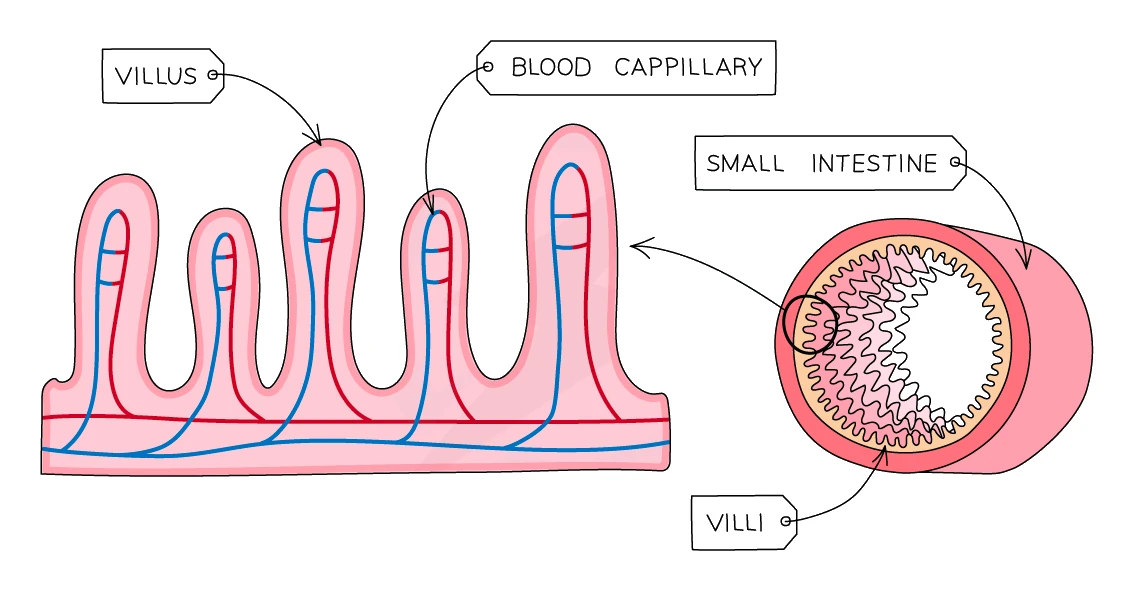
Real-world example: the human small intestine has its inner surface folded into villi, and each villus is covered with microvilli, giving a total surface area of around 250 m² (the size of a tennis court) packed inside the abdomen. This enormous surface area maximises the rate at which digested food can be absorbed.
Diffusion distance
The thinner the layer the particles have to cross, the faster they finish the journey. Rate of diffusion is roughly inversely proportional to the thickness of the barrier.
Real-world example: the wall of an alveolus is just one cell thick, and the wall of the surrounding capillary is also just one cell thick. The total gas-exchange distance is therefore only about 0.5 μm, which is short enough for gases to cross in a fraction of a second.
Surface area to volume ratio
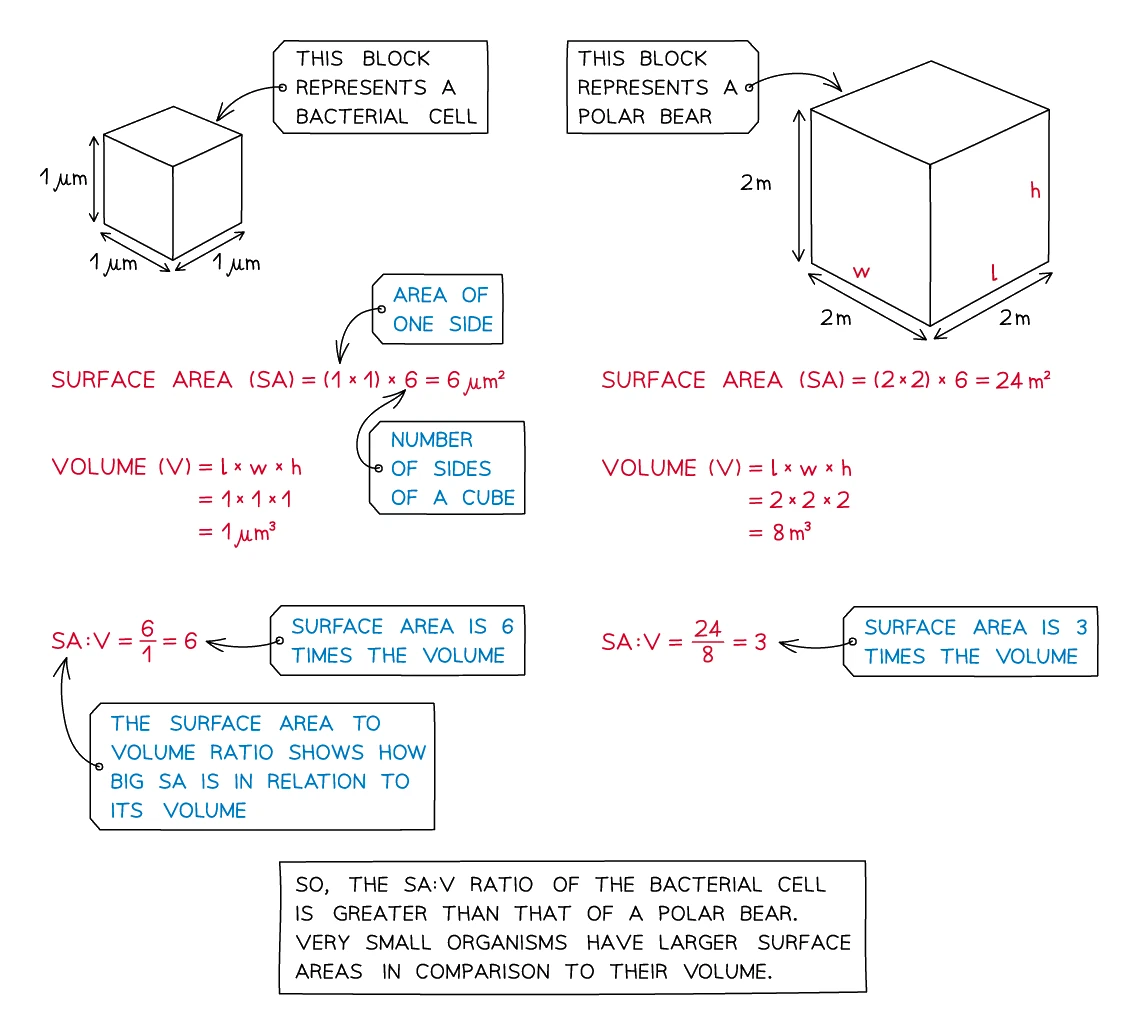
When considering whole cells or whole organisms, all four factors combine into one big principle: surface area to volume ratio (SA:V). As an object gets larger:
- Its volume grows with the cube of its linear size
- Its surface area grows with the square of its linear size
- So its SA:V ratio falls as it gets bigger
A larger object has less surface per unit of volume to take in supplies and get rid of waste. Single-celled organisms (bacteria, amoebas) can live on diffusion alone because they are so small that their SA:V ratio is huge. Larger organisms need specialised exchange surfaces (alveoli, villi, root hairs, gills) to overcome the falling SA:V ratio.