Diffusion, Osmosis & Active Transport
Structures and Functions in Living Organisms · 6 question types
What active transport is
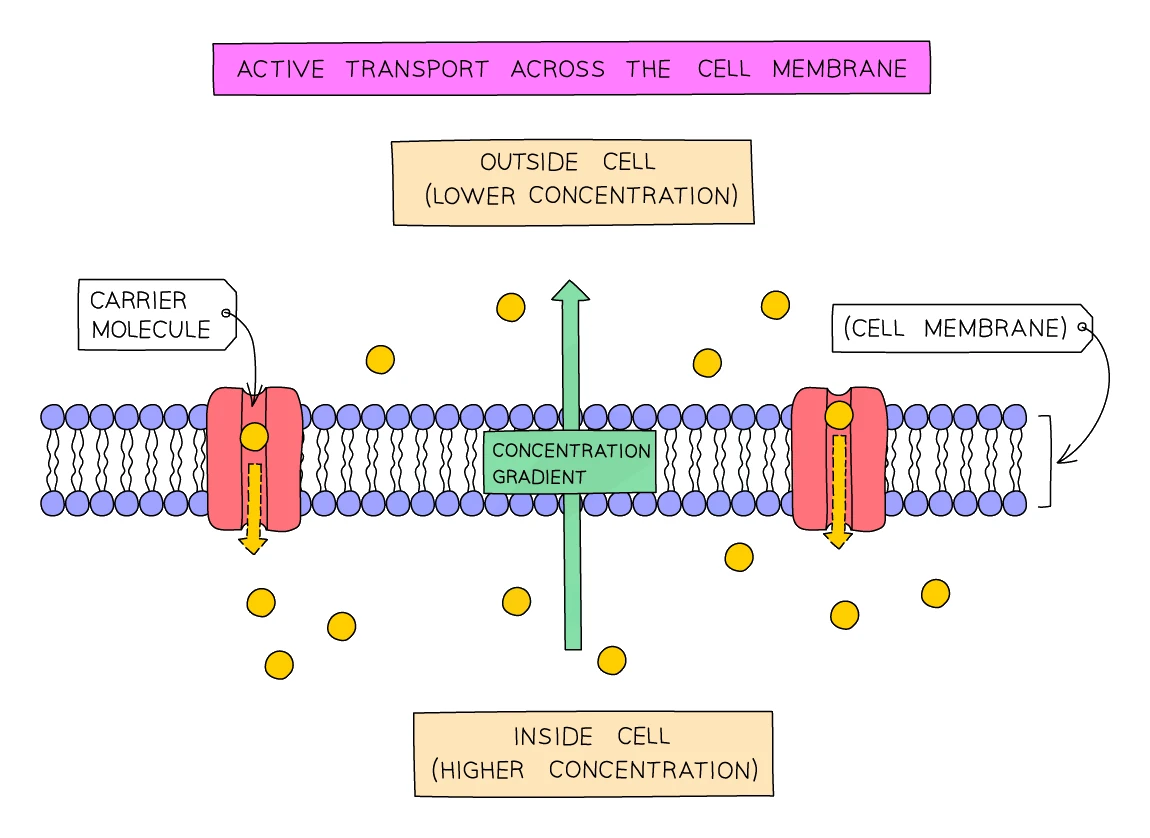
Active transport is the movement of particles across a cell membrane from a region of lower concentration to a region of higher concentration, against the concentration gradient, using energy released by respiration
Two things make active transport different from diffusion and osmosis:
- The direction is against the . Particles are being moved "uphill" from a place where they are scarce to a place where they are already concentrated.
- This needs energy from respiration (specifically, energy carried by ATP produced in the mitochondria). Cells that do a lot of active transport (root hair cells, gut lining cells, kidney tubule cells) are packed with mitochondria.
How it works at the molecular level
Active transport relies on protein pumps embedded in the cell membrane. Each pump:
- Binds the specific particle it transports on one side of the membrane
- Uses energy from ATP to change shape
- Releases the particle on the other side of the membrane (the high-concentration side)
A single pump can move thousands of particles per second when supplied with enough ATP.
Important examples of active transport
- Root hair cells in plants absorb mineral ions (nitrate, magnesium, potassium, etc.) from the soil. Soil water typically has very low ion concentrations, while the root cells have much higher concentrations inside. The plant cannot rely on diffusion; it has to pump the ions in against the gradient.
- Cells lining the small intestine absorb glucose and amino acids from digested food. By the end of digestion, the gut contents have a lower concentration of these molecules than the blood, but the body still needs to take in every last molecule. Active transport pumps them in.
- Kidney tubule cells reabsorb glucose from the filtrate back into the blood by active transport, even though the glucose in the filtrate is at a lower concentration than in the blood.
Active transport vs diffusion — what the mark scheme needs
What comes up: questions ask why mineral ions are absorbed by active transport rather than diffusion, or ask you to explain reabsorption of glucose in the kidney tubule.
Write (two marks): (1) active transport moves particles against the concentration gradient (from low to high concentration); (2) this requires energy from respiration / ATP. Both points are needed — naming active transport alone without the gradient direction or energy source typically scores only one mark.
Watch out: saying active transport uses energy "from photosynthesis" or "from food" rather than "from respiration" will not be credited. Also, confusing the direction (writing "from high to low" as if it were diffusion) scores zero for that mark point.
Side-by-side comparison
| Diffusion | Osmosis | Active transport | |
|---|---|---|---|
| What moves | Any particles (gases, small molecules) | Water only | Specific particles (often ions, glucose, amino acids) |
| Direction | High to low concentration | High to low water concentration (high to low water potential) | Low to high (against the gradient) |
| Needs a membrane? | No (happens anywhere) | Yes (partially permeable) | Yes (carries the protein pumps) |
| Energy required? | No (passive) | No (passive) | Yes (from respiration, via ATP) |
| Speed | Slows as gradient narrows | Slows as gradient narrows | Steady, set by the rate the pumps work |
| Example | O₂ into the blood at the alveoli | Water into root cells from wet soil | Mineral ions into root hair cells from soil |