Diffusion, Osmosis & Active Transport
Structures and Functions in Living Organisms · 6 question types
Aim
To investigate how the concentration of an external sucrose solution affects osmosis in plant cells.
Principle
Cylinders of fresh potato contain plant cells with cytoplasm at some particular water concentration. If a cylinder is placed into a solution of higher water concentration (dilute sucrose, or distilled water), water moves into the potato by osmosis, and the cylinder gains mass. If it is placed in a solution of lower water concentration (concentrated sucrose), water moves out, and the cylinder loses mass. Somewhere in the middle there is a sucrose concentration that exactly matches the water concentration inside the potato cells, and the cylinder shows no change in mass.
Apparatus
- A fresh potato
- Cork borer (to cut equal-diameter cylinders)
- Scalpel and ruler
- Five or six sucrose solutions of known concentration (typically 0.0, 0.2, 0.4, 0.6, 0.8 and 1.0 mol/dm³)
- Test tubes (one per solution) and a rack
- Mass balance, accurate to at least 0.01 g
- Paper towels
- Forceps
Method
- Use the cork borer to cut 6 equal-diameter cylinders of potato from the same potato.
- Use the scalpel and ruler to trim each cylinder to the same length (around 3 cm works well).
- Blot each cylinder dry on a paper towel.
- Weigh each cylinder on the balance and record its initial mass.
- Place one cylinder into each test tube containing a different sucrose concentration. Note carefully which cylinder is in which tube.
- Leave the tubes for at least an hour (longer is better; 24 hours gives the cleanest results).
- Remove each cylinder, blot it dry with a paper towel, and reweigh it.
- Calculate the percentage change in mass for each cylinder using:
percentage change in mass = ((final mass − initial mass) ÷ initial mass) × 100
Variables
- Independent variable: sucrose concentration (mol/dm³)
- Dependent variable: percentage change in mass of the potato cylinder
- Control variables: type of potato, age of potato, length and diameter of cylinder, volume of solution in each tube, time left in solution, temperature, how each cylinder is blotted before weighing
Plotting and using the results
Plot percentage change in mass on the y-axis against sucrose concentration on the x-axis. The result is a straight-ish line falling from positive values on the left (low sucrose, water gained) through zero (no change) and on to negative values on the right (high sucrose, water lost).
The point where the line crosses the x-axis (zero change in mass) gives the sucrose concentration that matches the water concentration inside the potato cells. This is a clever way of measuring something you cannot weigh directly.
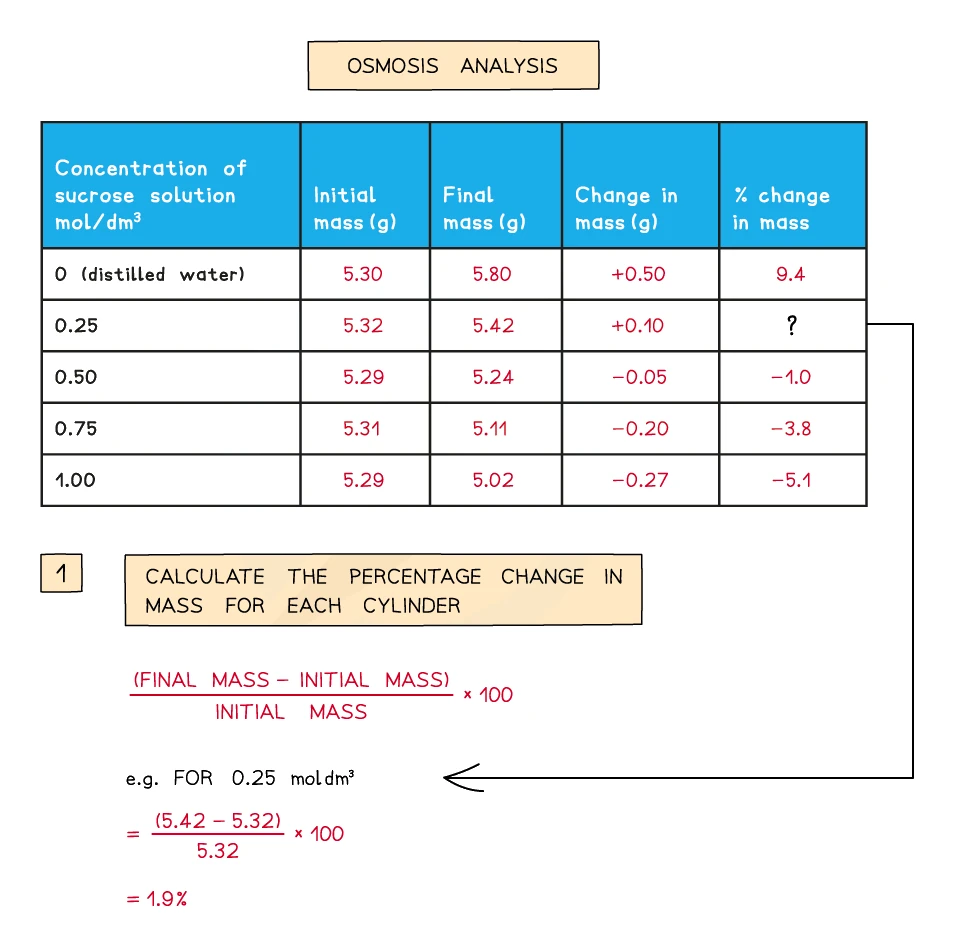
Why use percentage change rather than absolute change?
Different cylinders start at slightly different masses no matter how carefully you cut them. Using percentage change cancels out those starting differences and lets you compare cylinders fairly.
Calculating percentage change in mass of a potato cylinder
A potato cylinder has an initial mass of 5.0 g. After sitting in a concentrated sucrose solution for one hour, its final mass is 4.4 g. Calculate the percentage change in mass.
Solution:
- Change in mass = final mass − initial mass = 4.4 − 5.0 = −0.6 g
- Percentage change = (change in mass ÷ initial mass) × 100
- = (−0.6 ÷ 5.0) × 100 = −12%
The negative sign shows the cylinder lost mass: water moved out by osmosis into the more concentrated sucrose solution. A positive answer would mean the cylinder gained mass (water moved in). Always carry the negative sign through — dropping it loses a mark.
Limitations
- Cylinders may differ slightly in dimensions, which affects how much water can be exchanged. Solution: cut several cylinders for each sucrose concentration and take a mean.
- Blotting before weighing has to be consistent. If one cylinder is more thoroughly dried than another, the mass reading is misleading.
- The potato has to be the same age and freshness throughout. Older potatoes have already lost water and behave differently.