Photosynthesis
Structures and Functions in Living Organisms
What Photosynthesis Is
Photosynthesis is the process by which green plants use light energy absorbed by to combine carbon dioxide and water into glucose, releasing oxygen as a by-product
Photosynthesis is what makes plants autotrophs: they manufacture their own food rather than eating it. This is also why plants sit at the base of every food chain. Almost all the energy flowing through living things on Earth started as sunlight captured by chlorophyll.
The two equations
The word equation:
carbon dioxide + water → glucose + oxygen
(in the presence of sunlight and chlorophyll)
The balanced symbol equation:
6 CO₂ + 6 H₂O → C₆H₁₂O₆ + 6 O₂
In plain English: six molecules of carbon dioxide combine with six molecules of water to produce one molecule of glucose and six molecules of oxygen. The reaction is endothermic: it absorbs light energy from the sun and stores it as chemical energy in the glucose.
Common exam question
Writing the balanced symbol equation for photosynthesis
Question: Give, or fill the gaps in, the balanced chemical symbol equation for photosynthesis (2 marks).
Asked in 4 of the 23 papers. The equation is 6CO₂ + 6H₂O → C₆H₁₂O₆ + 6O₂. When only the 6O₂ is printed, one mark is for the reactant side (6CO₂ and 6H₂O, in either order) and one for glucose, C₆H₁₂O₆. Otherwise the equation is marked as a whole: correct formulae with wrong balancing numbers still earn one of the two marks, so check that every coefficient is a 6. The word equation earns nothing in this question.
Compare this to aerobic respiration:
glucose + oxygen → carbon dioxide + water (releases energy)
The two equations look like mirror images: the reactants of one are the products of the other. That makes them a useful pair to learn together. They are not literally the reverse reaction, though. Photosynthesis and respiration happen by different pathways, using different enzymes, in different parts of the cell, so one is not simply the other run backwards.
What the plant does with the glucose
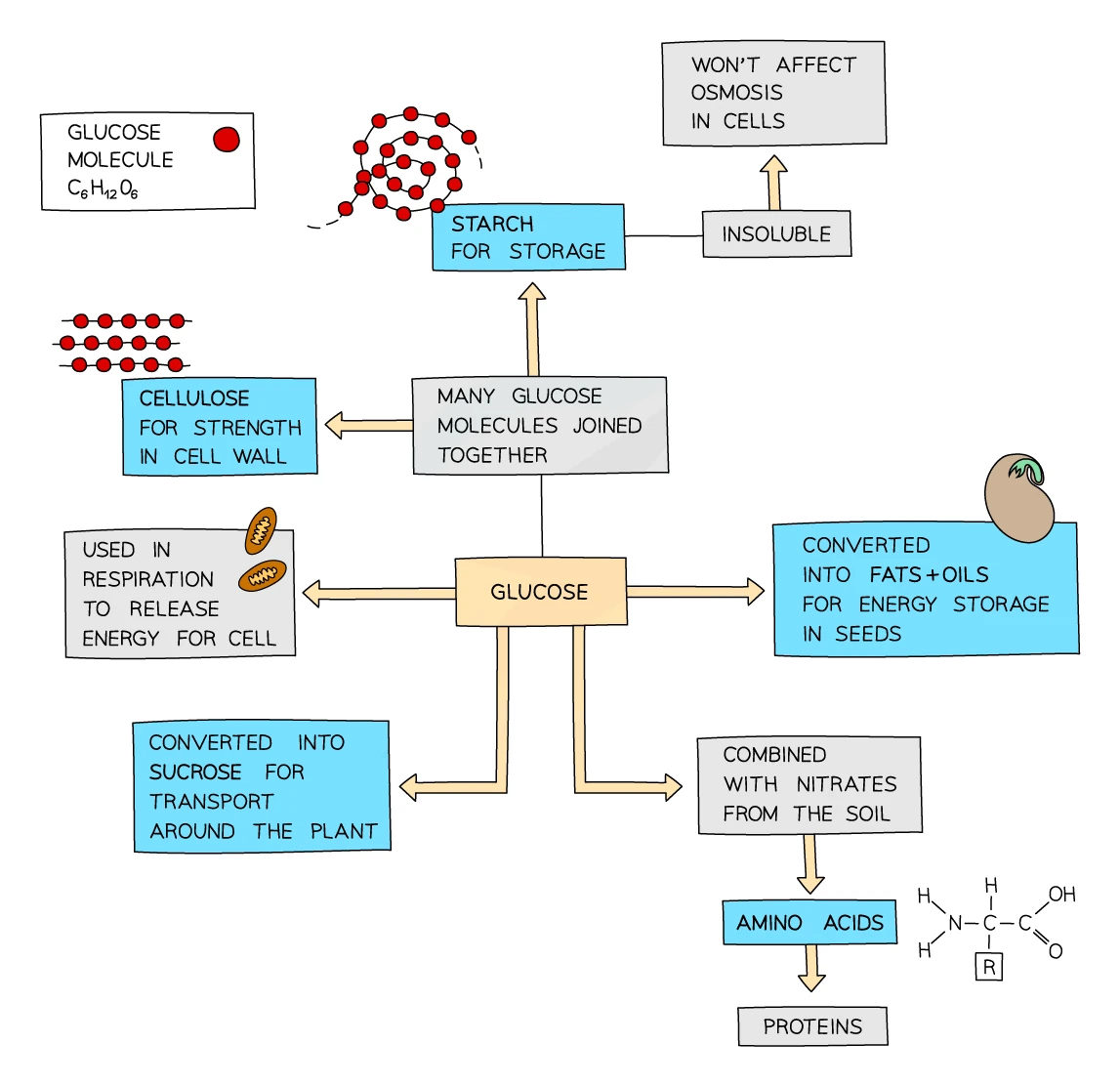
Glucose has many uses inside the plant:
- Respiration: glucose is broken down to release energy for the plant's own life processes (transport, growth, reproduction).
- Sucrose for transport: glucose is converted into sucrose, the soluble sugar in which food is transported around the plant through the phloem.
- Starch storage: glucose is converted into the polysaccharide and stored in roots, tubers and seeds. Starch is insoluble, so it does not affect the cell's water balance.
- Cellulose: glucose is built into long chains of cellulose for new cell walls as the plant grows.
- Lipids: glucose can be converted into lipids for energy-dense storage in seeds (think of the oil in sunflower seeds or nuts).
- Amino acids and proteins: when glucose is combined with nitrogen from nitrate ions absorbed by the roots, the plant builds amino acids, which are then joined to form proteins.
Common exam question
Explaining why less photosynthesis means slower growth
Question: Explain why a plant whose cells stop making chloroplasts grows more slowly, or why the plants in a growth experiment are kept in sunlight (2–3 marks).
Asked in 2 of the 23 papers, and the marks follow one chain with a link per mark. Less light energy is absorbed (fewer chloroplasts, less chlorophyll), so there is less photosynthesis, so less glucose is made. Then say what the glucose was needed for: starch and cellulose, amino acids and protein, or respiration to release energy (ATP) for growth. Write every link, because each is a separate mark. "Less energy produced" is ignored, so say less glucose for respiration and less energy for growth.
Raw materials, products, and what each needs
| Where it comes from | Where it goes | |
|---|---|---|
| Carbon dioxide (raw material) | The air, diffuses in through stomata | Used in photosynthesis |
| Water (raw material) | Absorbed from soil by root hair cells, carried up through the xylem | Used in photosynthesis |
| Light energy (not a raw material, but required) | Sunlight, absorbed by chlorophyll | Provides the energy for the reaction |
| Glucose (product) | Made in the chloroplasts | Stored as starch, used for respiration, converted to other molecules |
| Oxygen (product) | Made in the chloroplasts | Released into the air through stomata |
A quick exam note: light is not a raw material. The exam mark scheme only counts CO₂ and water as raw materials, because they are the substances that combine in the reaction. Light is the energy source.