Photosynthesis
Structures and Functions in Living Organisms · 5 question types
Photosynthesis makes glucose, but plants also need other elements to build amino acids, proteins, chlorophyll and nucleic acids. They obtain these as mineral ions dissolved in soil water, absorbed by root hair cells through active transport (because the soil normally has much lower ion concentrations than the cells).
Two mineral ions are particularly important and tested in exams:
Nitrate ions (NO₃⁻)
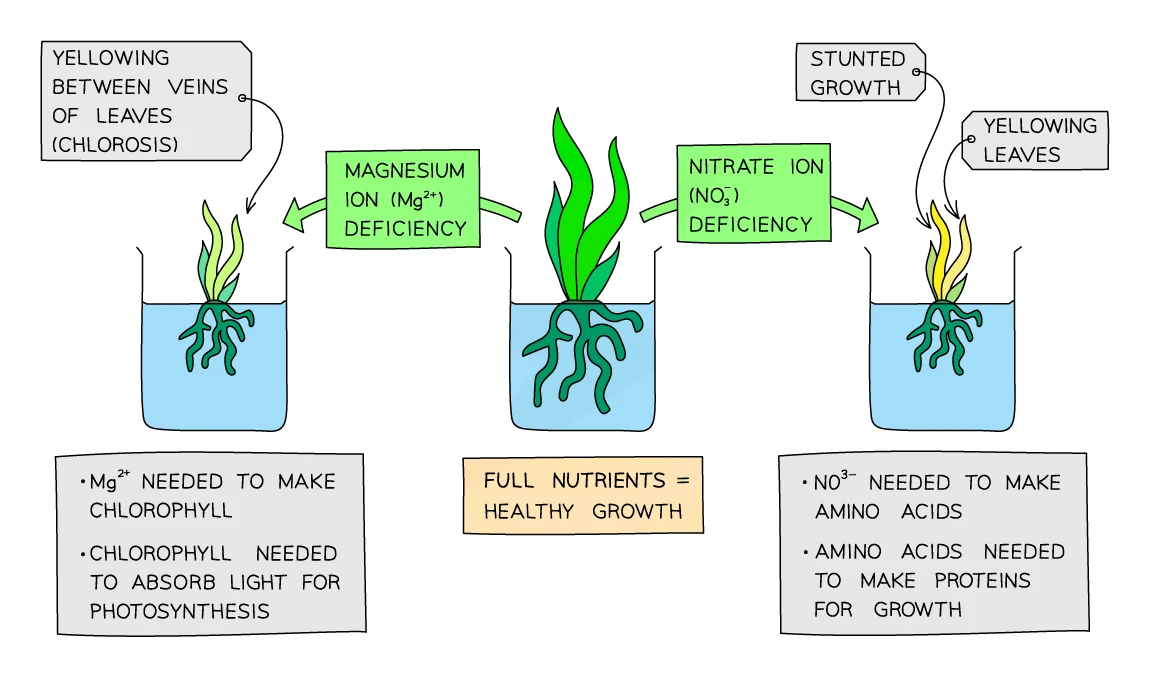
- Function: plants combine glucose with nitrogen from nitrate ions to build amino acids. The amino acids are then joined to form proteins, which are needed for growth, enzymes, and many other roles.
- Deficiency symptoms: stunted growth (without enough nitrogen, the plant cannot make new proteins to build new tissues) and yellowing of older leaves (the plant breaks down proteins in older leaves to recycle the nitrogen into new growth).
Magnesium ions (Mg²⁺)
- Function: magnesium is part of every molecule (right in the middle of the porphyrin ring). Without magnesium, the plant cannot make chlorophyll.
- Deficiency symptoms: yellow leaves (the technical term is ), often starting between the veins. Without chlorophyll the leaves cannot photosynthesise properly, so the plant grows slowly.
| Mineral ion | Used for | Deficiency symptom |
|---|---|---|
| Nitrate | Making amino acids and proteins | Stunted growth; older leaves yellow first |
| Magnesium | Making chlorophyll | Leaves turn yellow (chlorosis), especially between veins |
Farmers and gardeners add these (and other nutrients) to soil as fertiliser. Most commercial fertilisers are NPK (nitrogen as nitrate, phosphorus and potassium), often with added magnesium and trace elements.
Nitrate and magnesium in plants
The function or deficiency of nitrate or magnesium comes up (2 marks), so you need to know: nitrate → makes amino acids/proteins (deficiency = stunted growth); magnesium → makes chlorophyll (deficiency = yellow leaves / chlorosis). Name the ion before the symptom, and don't swap the two.