4BI1
Photosynthesis
Structures and Functions in Living Organisms · 5 question types
The leaf is the plant's solar panel. Its structure is finely tuned to absorb as much light as possible, get carbon dioxide to every photosynthesising cell, and ship water and glucose in and out.
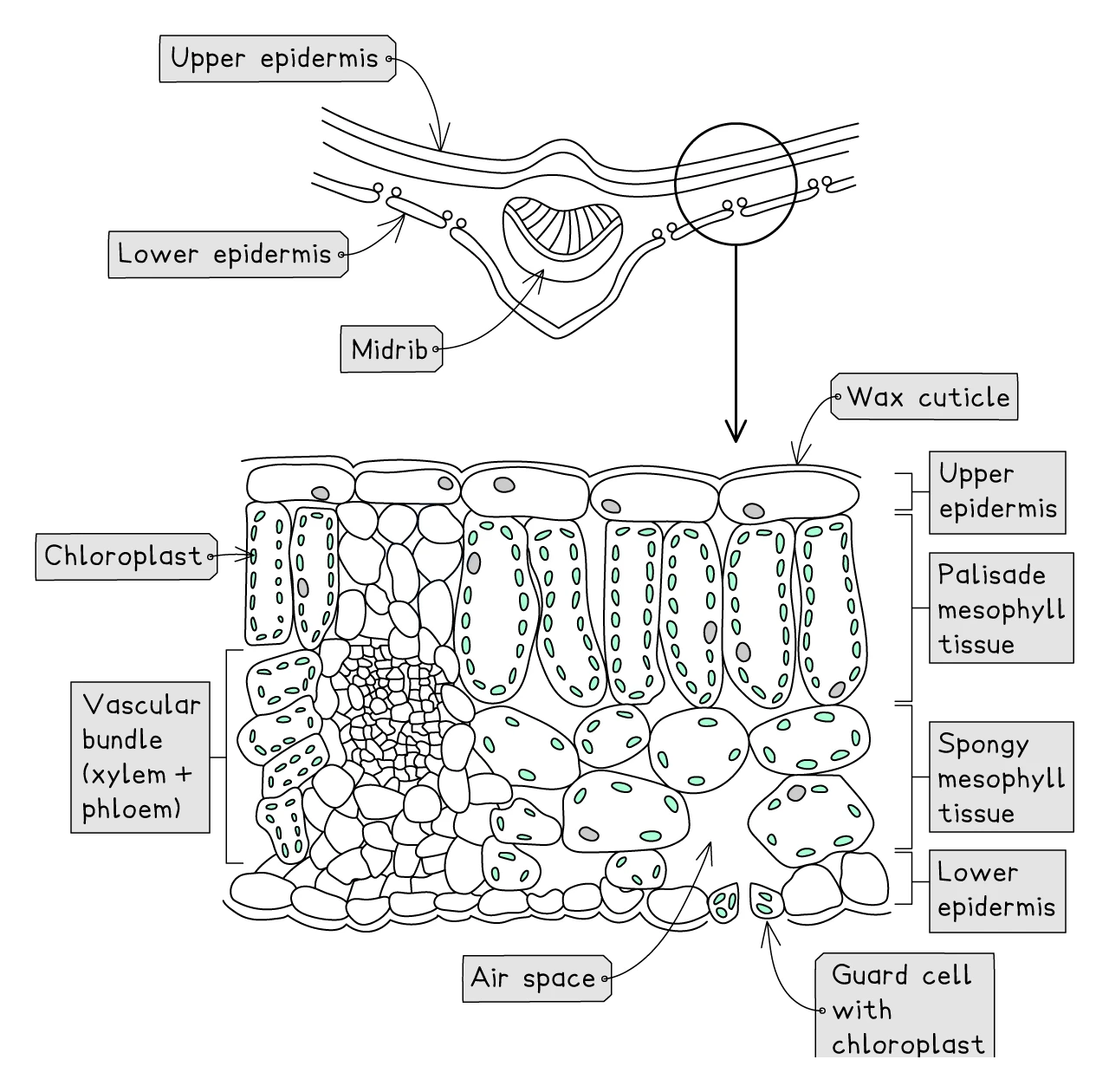
The layers of a leaf in cross-section
Going from the top surface of the leaf downwards:
| Layer | Structure | What it does |
|---|---|---|
| Waxy cuticle | A thin waterproof wax coating on the upper surface | Stops water evaporating away from the leaf; protects the leaf without blocking light because it is transparent |
| Upper epidermis | A single layer of flat, transparent cells with no chloroplasts | Lets light pass through to the layers below |
| Palisade mesophyll | Column-shaped cells packed tightly side by side, full of chloroplasts | The main site of photosynthesis. Positioned at the top of the leaf so they catch the most light |
| Spongy mesophyll | Loosely-packed cells with air spaces between them, fewer chloroplasts than palisade | Provides a large internal surface area for gas exchange (CO₂ in, O₂ out) |
| Lower epidermis | A single layer of cells, mostly transparent. Contains the guard cells | Forms the underside of the leaf and houses the stomata |
| Stomata (plural; stoma = singular) | Tiny pores between pairs of guard cells, mostly on the lower epidermis | Allow CO₂ in and O₂ out; also where water vapour leaves (transpiration) |
| Guard cells | Pairs of bean-shaped cells around each stoma | Change shape to open or close the stoma. Open in the day for gas exchange, closed at night to save water |
| Xylem | Hollow tubes inside the leaf veins | Bring water from the roots up to the photosynthesising cells |
| Phloem | Living tubes inside the leaf veins | Carry the manufactured sugars (mostly as sucrose) away to the rest of the plant |
Why the leaf is shaped the way it is
Almost every part of the leaf is an adaptation for fast photosynthesis. Specifically:
- Large flat surface area so the leaf intercepts as much light and absorbs as much CO₂ as possible.
- Thin (typically less than a millimetre) so CO₂ can diffuse quickly from the air spaces to every chloroplast, and so light can reach every layer easily.
- Transparent cuticle and upper epidermis so light passes through to the palisade cells without loss.
- Palisade cells at the top, packed with chloroplasts so the densest concentration of chloroplasts is exactly where the light is brightest.
- Air spaces in the so the inside of the leaf has a huge surface area for CO₂ and O₂ to diffuse across the cell membranes.
- on the lower epidermis so that gas exchange can happen but water loss is reduced (the underside of a leaf is shaded and cooler, so less evaporation).
- Network of veins carrying xylem and phloem, so water reaches every cell and sugar is shipped out promptly.