4BI1
Photosynthesis
Structures and Functions in Living Organisms · 5 question types
Principle
A water plant such as Elodea (Canadian pondweed) is placed underwater in bright light. As photosynthesis happens, oxygen is released from the cut end of the stem and rises through the water as visible bubbles. The bubbles can be collected and tested with a glowing splint.
Method
- Cut a fresh piece of pondweed and place it upside-down in a beaker of water.
- Cover the pondweed with an upturned glass funnel.
- Fill a boiling tube completely with water, place a thumb over the opening, invert it, and lower it over the stem of the funnel so that no air is trapped.
- Place the apparatus in bright light. Bubbles of oxygen rise up the funnel and collect at the top of the boiling tube, gradually displacing the water.
- After the boiling tube has filled with gas, remove it carefully (keeping the opening pointing downwards under the water) and quickly insert a glowing splint.
- The splint relights, confirming the gas is oxygen.
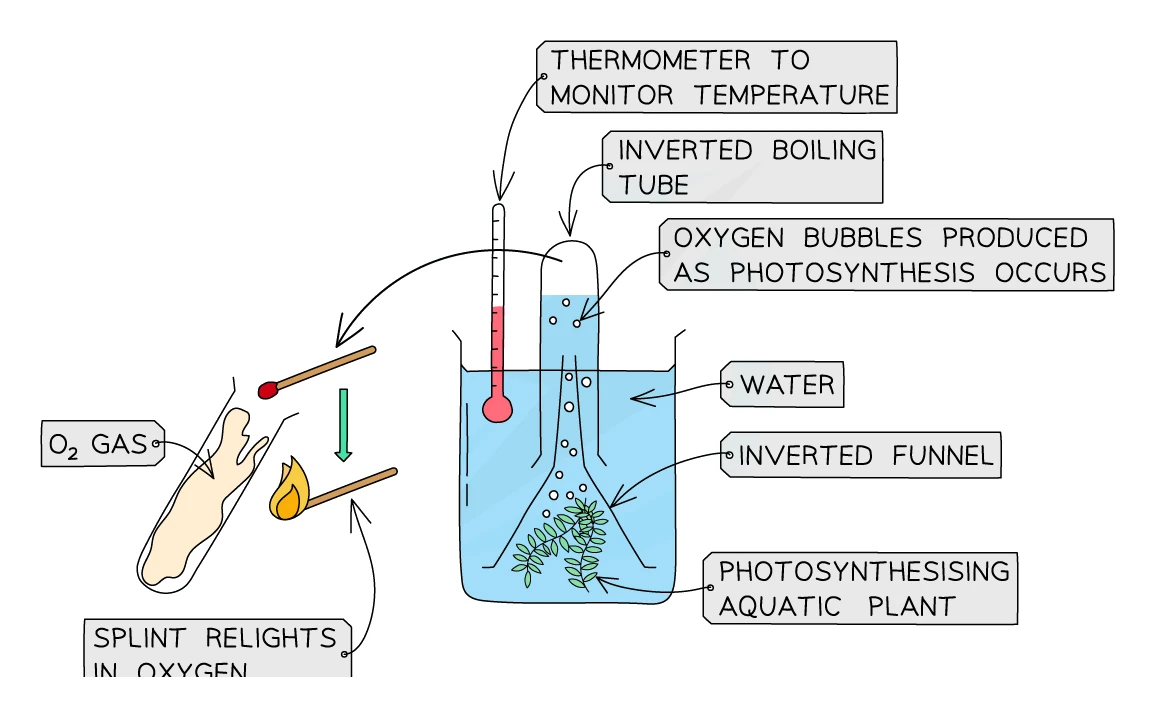
Measuring the rate of photosynthesis
- Counting the number of bubbles per minute at different light intensities (or distances from a lamp) gives a quick measure of the rate.
- More accurately, the volume of gas collected in a fixed time can be measured. This avoids the problem that bubble sizes can vary.