4BI1
Cell Structure
Structures and Functions in Living Organisms · 6 question types
Cells, Organelles and the Building Blocks of Life
Cells are the basic unit of life
All living organisms are built from one or more . A single-celled organism such as an amoeba is one cell on its own. A multicellular organism such as a human is built from trillions of cells working together.
Inside every cell is a jelly-like substance called the , surrounded by a thin that separates the cell from the outside world. Eukaryotic cells contain small sub-cellular structures called suspended in the cytoplasm; each organelle does a specific job.
The five levels of organisation
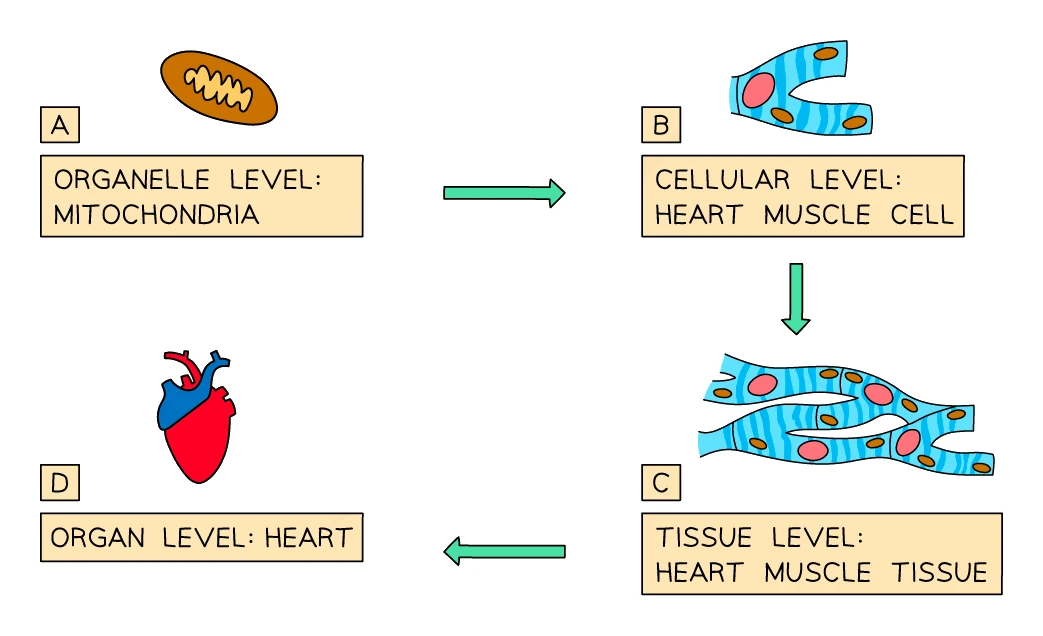
In a complex multicellular organism, structure is built up in five tidy levels:
| Level | What it is | Example |
|---|---|---|
| Organelle | A specialised sub-cellular structure inside a cell | Mitochondrion (site of aerobic respiration) |
| Cell | The basic structural and functional unit of life | Red blood cell |
| Tissue | A group of similar cells working together to perform one function | Muscle tissue, xylem tissue |
| Organ | Different tissues working together to perform a particular function | Heart, leaf, kidney |
| Organ system | A group of organs working together to perform a major function | Circulatory system, digestive system |
A handy way to remember the order: organelles → cells → → → .