Cell Structure
Structures and Functions in Living Organisms · 6 question types
The main organelles found in eukaryotic cells, with what each one actually does:
| Organelle | Function |
|---|---|
| Nucleus | Contains the cell's genetic material as chromosomes. Controls all of the cell's activities by switching genes on and off |
| Cytoplasm | A jelly-like fluid that fills the cell. The site of most chemical reactions, including the first stage of respiration. Contains water with many dissolved substances |
| Cell membrane | A thin layer of lipids and proteins. Controls what enters and leaves the cell. Partially permeable |
| Mitochondria | The site of aerobic respiration. Cells with high energy demand (muscle, liver, sperm) contain many mitochondria |
| Ribosomes | The site of protein synthesis. Tiny dots scattered through the cytoplasm or attached to membranes |
| Cell wall (plants only) | Made of cellulose. Gives the cell a fixed shape and stops it bursting when full of water |
| Chloroplasts (plants only) | The site of photosynthesis. Contain the green pigment chlorophyll that absorbs light energy. Found in leaf and stem cells, not in roots |
| Permanent vacuole (plants only) | A large fluid-filled sac containing cell sap (water + dissolved sugars and salts). Its outward pressure squashes the cytoplasm up against the inside of the cell wall, leaving the cell firm and turgid, which helps the plant stand upright |
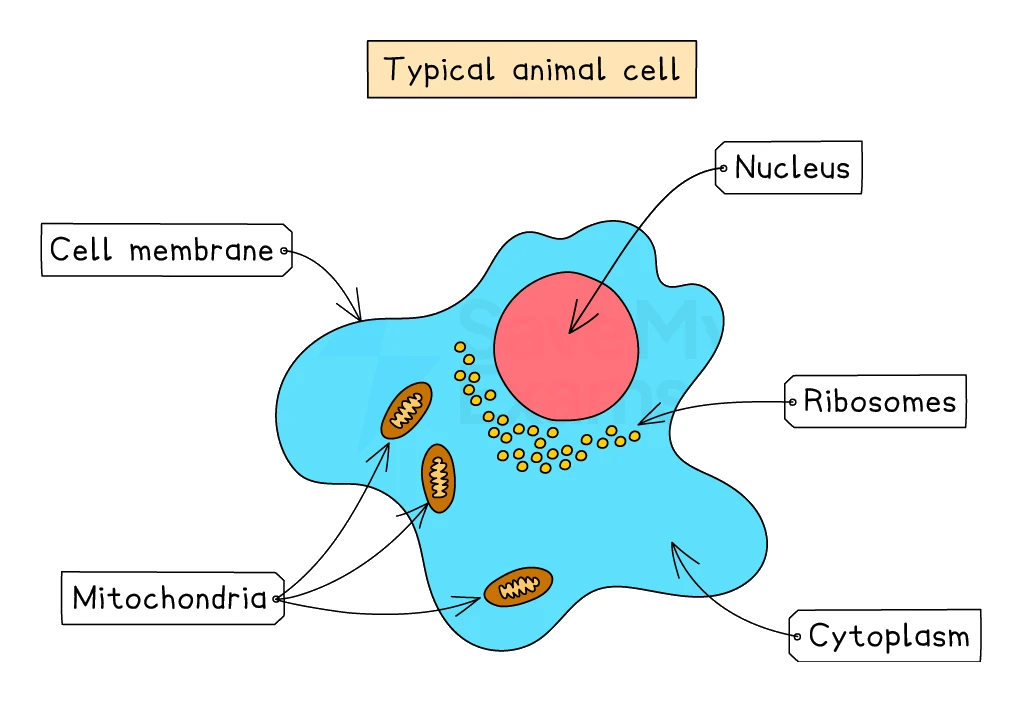
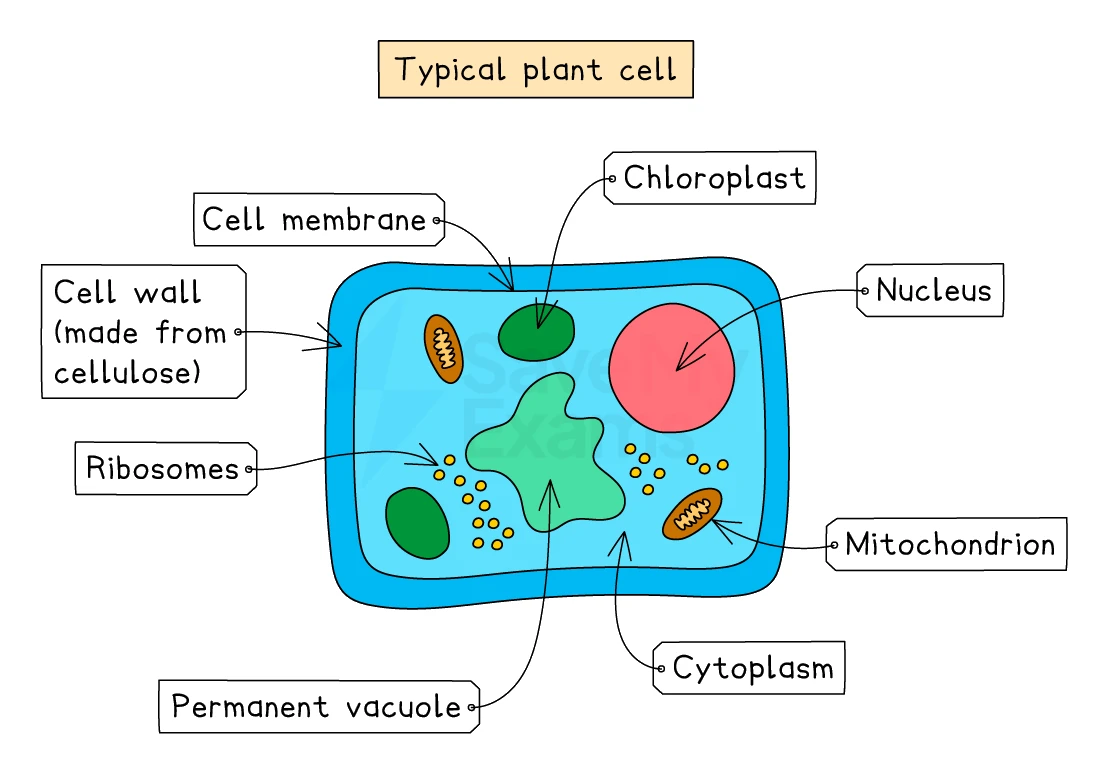
A quick note on terminology: mitochondrion is the singular (one organelle), mitochondria is the plural. The same pattern applies to / nuclei. Chloroplast / chloroplasts is different: it just takes a regular English plural by adding -s.
Organelle functions
Identifying an organelle or stating its function comes up (1–2 marks), so you need to know the pairings: ribosome = protein synthesis; mitochondrion = aerobic respiration; chloroplast = photosynthesis; nucleus = holds DNA and controls the cell; cell membrane = controls what enters/leaves; vacuole = holds cell sap. Don't confuse the chloroplast (photosynthesis) with the mitochondrion (respiration).