Cell Structure
Structures and Functions in Living Organisms
Why microscopes are needed
Most cells are far too small to see with the naked eye. A human red blood cell is only about 8 μm across; a bacterium is around 2 μm. A microscope uses lenses (or a beam of electrons) to magnify the image so structures invisibly small can be seen.
Light microscope vs electron microscope
| Light microscope | Electron microscope | |
|---|---|---|
| Source used to see the sample | Visible light through glass lenses | A beam of electrons through magnetic lenses |
| Maximum useful magnification | About ×1500 | Up to ×500 000 or more |
| Resolution (smallest detail visible) | About 200 nm | Down to 0.2 nm |
| Living specimens? | Yes, can view living cells in colour | No, the sample must be in a vacuum and is killed |
| Cost and size | Cheap and benchtop-sized | Very expensive, room-sized |
| What you can see | Cell wall, cell membrane, nucleus, chloroplasts, large vacuole | Also small organelles such as ribosomes and mitochondria in detail |
A light microscope is what you use in a school biology lab. An electron microscope is needed to see the smallest organelles (ribosomes, the internal structure of mitochondria, individual viruses).
The magnification equation
The relationship between the actual size of an object, the size of its image, and the magnification of the microscope is:
= image size ÷ actual size
Rearranged forms:
actual size = image size ÷ magnification
image size = actual size × magnification
Always make sure both sizes are in the same unit before dividing. Useful conversions:
1 mm = 1000 μm
1 μm = 1000 nm
1 mm = 1 000 000 nm
Common exam question
Calculating the magnification of a drawing or photograph
Question: The actual size of a cell, organism or virus is given in micrometres or millimetres; measure the printed image, often along a marked line, and calculate or determine its magnification (2–3 marks).
Set in 9 of the 23 papers. A 3-mark version usually follows the method: one for measuring the line with a ruler (a millimetre or two either side is allowed, and some schemes want the unit written with the reading), one for converting so both lengths share a unit (millimetres × 1000 gives micrometres), and the last for dividing image size by actual size. A 2-mark version gives one mark for the measurement or the division. A correct answer inside the accepted range earns full marks even with no working, and a wrong measurement carried correctly through the method still collects the method marks.
Magnification is a ratio: write it as "× 400", with no unit. Units written after it are ignored rather than penalised.
Worked example
Calculating magnification from a diagram
A diagram shows a palisade cell. You measure the line A–B on the diagram and find it is 30 mm long. The actual length of the cell from A to B is 150 μm. Calculate the magnification of the diagram.
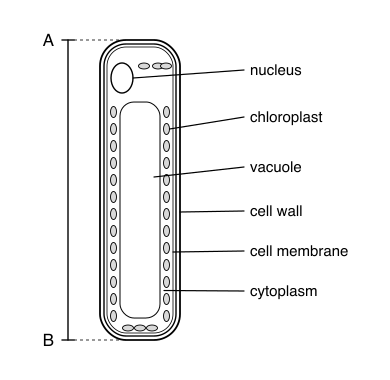
Solution:
- Convert the image measurement to the same unit as the actual size: 30 mm × 1000 = 30 000 μm
- Apply the formula: magnification = image size ÷ actual size
- magnification = 30 000 μm ÷ 150 μm = × 200