4BI1
Cell Structure
Structures and Functions in Living Organisms · 6 question types
A side-by-side comparison
| Feature | Animal cell | Plant cell |
|---|---|---|
| Nucleus | Yes | Yes |
| Cytoplasm | Yes | Yes |
| Cell membrane | Yes | Yes |
| Mitochondria | Yes | Yes |
| Ribosomes | Yes | Yes |
| Cell wall | No | Yes (cellulose) |
| Chloroplasts | No | Yes (in leaf and stem cells) |
| Permanent vacuole | No (only small temporary vacuoles) | Yes, large and central |
| Overall shape | Irregular, flexible | Fixed shape (rectangular or "box-like") because of the cell wall |
| Storage carbohydrate | Glycogen | Starch (in roots and tubers) or sucrose (in fruit) |
Why plants have what they have
Plants need three extra structures that animals do not:
- A cell wall: plants do not have a skeleton, so each individual cell has to be rigid. The cellulose wall gives the plant body its shape and stops the cell from bursting when water rushes in.
- Chloroplasts: plants make their own food by photosynthesis, so they need an organelle that contains chlorophyll to capture light energy. Animals are heterotrophs and eat ready-made food, so they have no need for chloroplasts.
- A large permanent vacuole: plants control their support hydraulically. A full vacuole pushes outwards on the cell wall, making the cell turgid and keeping the plant standing up. When the vacuole loses water, the cell becomes flaccid and the plant wilts.
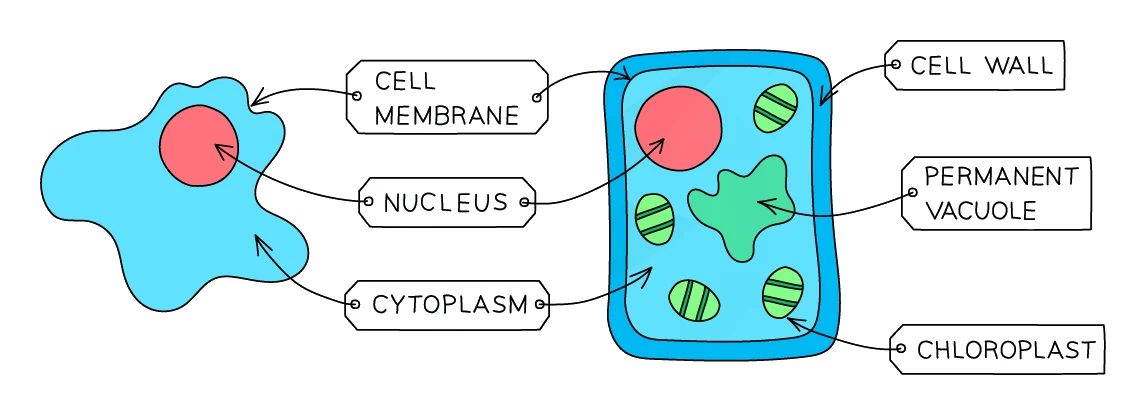
Exam tip
Animal vs plant cells
Stating which structures are in plant cells but not animal cells comes up, so you need to know plant cells have a cell wall (cellulose), a large permanent vacuole, and chloroplasts, while animal cells have none of these three. Chloroplasts are absent from root cells, so qualify with "leaf/stem cells" if asked about plant cells in general.