Transport in Humans
Structures and Functions in Living Organisms · 6 question types
Two types, two strategies
Phagocytes are the rapid-response part of the immune system. They patrol the blood and tissues looking for anything that does not belong (bacteria, viruses, fungi). When they find a pathogen they engulf it whole (a process called ) and digest it inside themselves using digestive enzymes. This is a non-specific response: a phagocyte will engulf any pathogen it meets, not just one type.
Lymphocytes are the targeted-response part of the immune system. They produce antibodies: proteins that exactly fit a specific feature on the surface of one type of pathogen. This is a specific response, since each lymphocyte makes antibodies against only one type of pathogen.
Antigens and antibodies
- An antigen is a molecule (usually a protein) found on the surface of a cell or pathogen. The body recognises antigens that belong to itself as "self", and any antigen that doesn't match as "foreign".
- An antibody is a Y-shaped protein, made by a lymphocyte, that has a complementary shape to one specific antigen. The antibody locks on to its matching antigen like a key fits its lock.
When antibodies bind to pathogens, they:
- Clump pathogens together (agglutination), making them easier for phagocytes to engulf in batches
- Mark pathogens for destruction, by giving the phagocytes a clear signal of what to engulf
- Neutralise toxins released by some bacteria, by binding to the toxin so it can no longer harm body cells
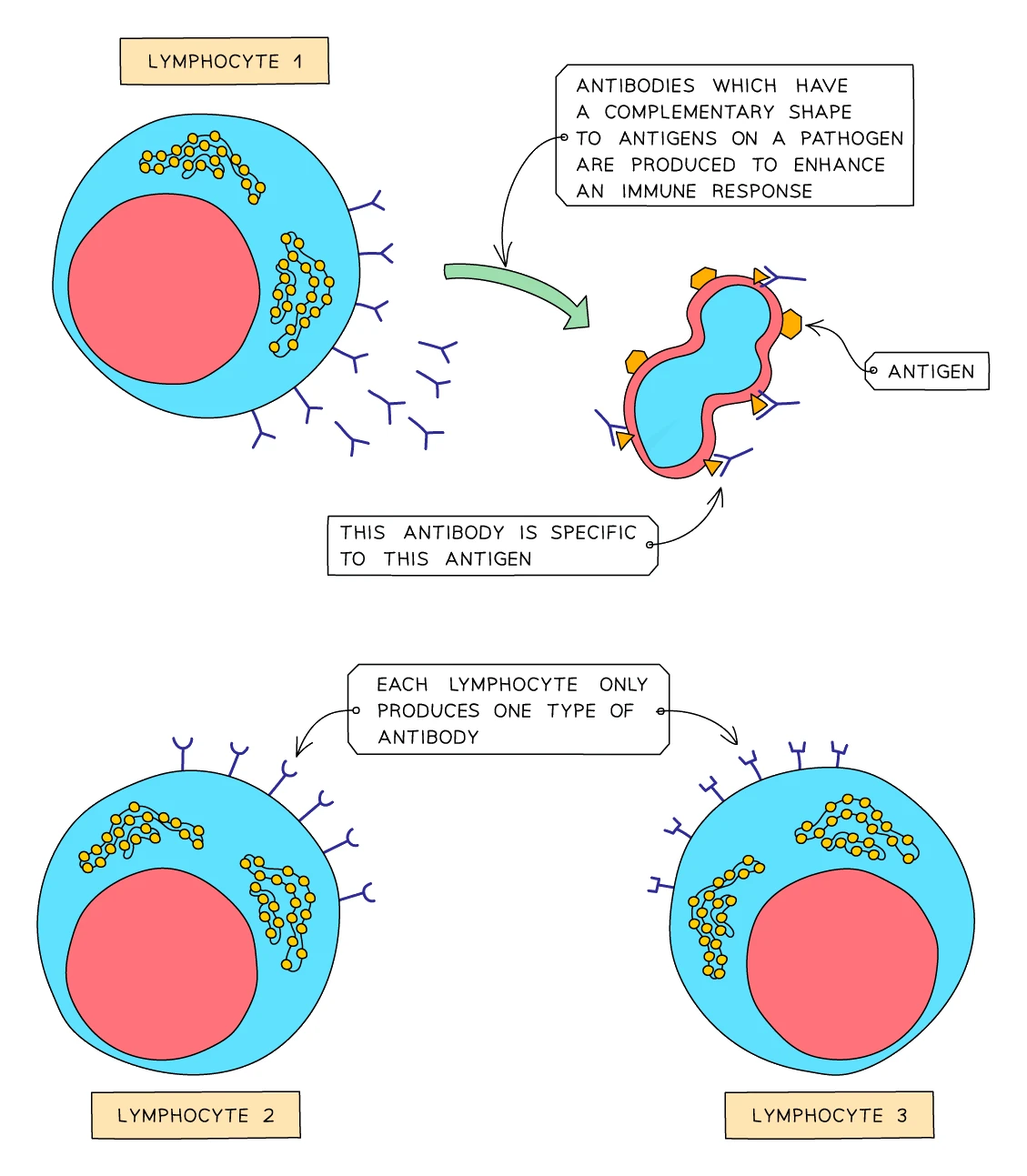
How the immune system fights an infection
- A pathogen enters the body and starts to multiply, releasing toxins and damaging cells.
- Phagocytes are the first to respond. They engulf and digest pathogens they encounter (non-specific phase).
- Eventually a meets a pathogen whose antigens match its receptors.
- That lymphocyte begins making specific antibodies against that antigen and divides rapidly, producing many identical lymphocytes that all churn out the same antibody.
- The antibodies bind to the antigens on the pathogens, clumping them and tagging them for destruction.
- Phagocytes engulf the tagged pathogens in bulk and digest them.
- Some of the lymphocytes remain in the body afterwards as memory cells, ready to mount a faster response if the same pathogen ever attacks again.
Describing how a phagocyte destroys a pathogen
What comes up: a "describe how a phagocyte destroys a bacterium" question (often 4 marks, awarded for distinct stages).
Write (four marks): (1) The phagocyte engulfs the bacterium / surrounds it with pseudopodia (1). (2) The bacterium ends up inside a vesicle within the phagocyte (1). (3) Vesicles containing digestive enzymes fuse with the vesicle holding the bacterium (1). (4) The enzymes digest / break down the bacterium (1).
Watch out: simply writing "the phagocyte engulfs and digests the bacterium" scores only 1–2 marks. You need to include the vesicle and the enzyme-fusion step to reach full marks.
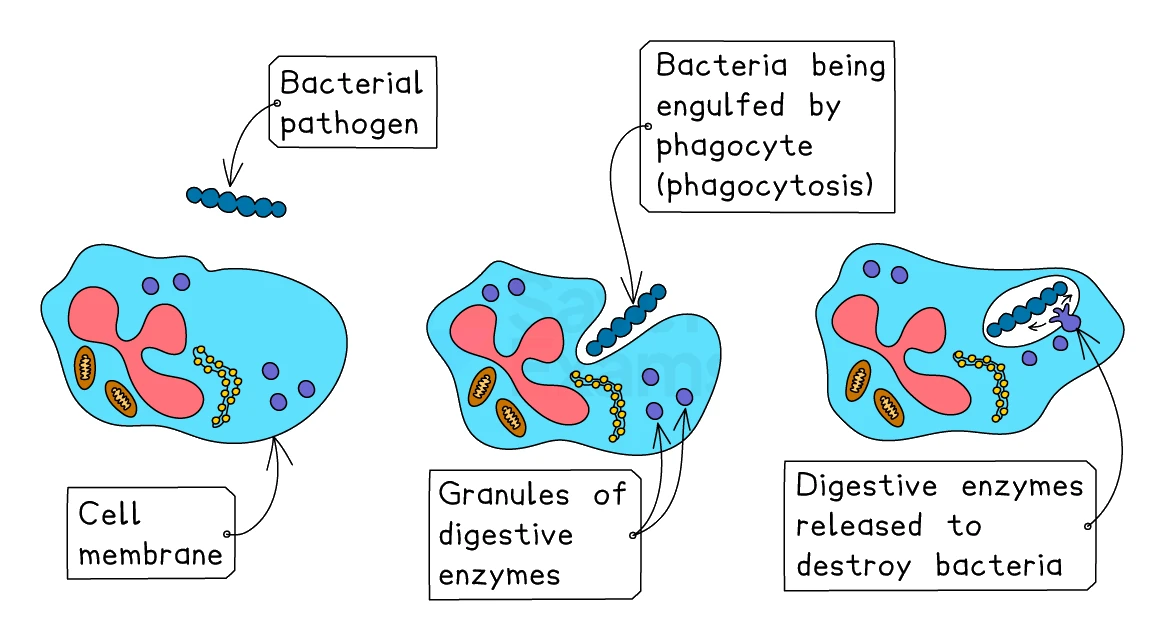
Immunity and memory cells
The first time you meet a new pathogen, the immune response is slow (it takes the lymphocytes time to find the right one and multiply), and you feel ill. By the time the pathogen is cleared, the body has a stock of memory cells specific to that pathogen.
If the same pathogen invades a second time, the memory cells recognise it immediately and produce more antibodies, faster, and in greater quantities than the first time around. The pathogen is destroyed before it has a chance to cause symptoms. You are now immune to that pathogen.
Vaccination
Vaccination is a way of getting the memory-cell benefit without ever needing to suffer the disease. A vaccine contains a harmless version of a pathogen, prepared in one of three ways:
- Killed pathogens (e.g. the older type of flu vaccine)
- Weakened (attenuated) live pathogens (e.g. the MMR vaccine for measles, mumps, rubella)
- Pieces of pathogen such as surface antigens (e.g. the hepatitis B vaccine)
The vaccine carries the pathogen's without being able to cause the disease. The body responds as if it has been infected:
- Lymphocytes recognise the antigens.
- They produce specific antibodies and divide.
- Memory cells are formed and remain in the bloodstream.
If the real pathogen ever attacks later, the memory cells trigger a fast, strong antibody response and the person remains symptom-free. Vaccination has dramatically reduced or eradicated diseases including smallpox (eradicated worldwide), polio (almost eradicated), measles, rubella, tetanus and many others.