4BI1
Transport in Humans
Structures and Functions in Living Organisms · 6 question types
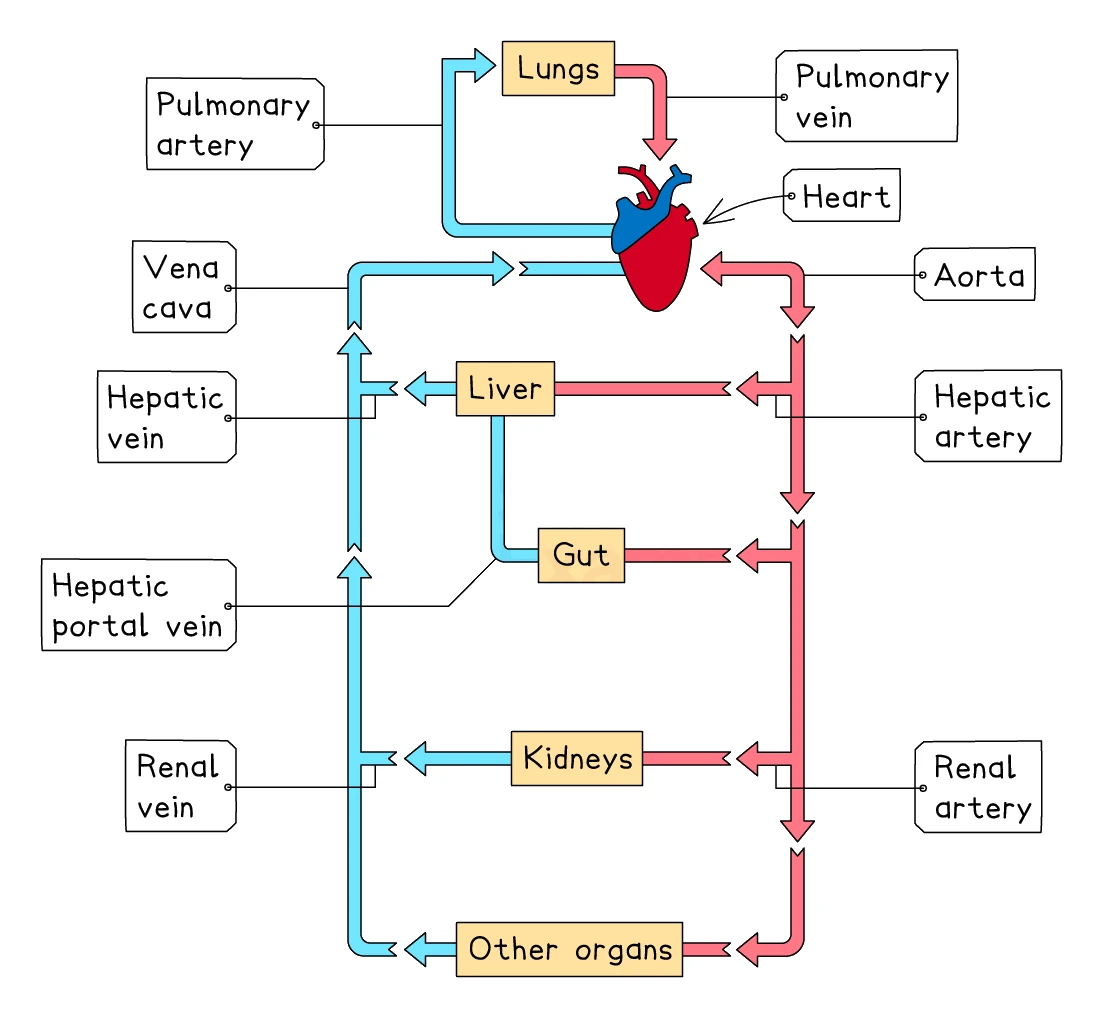
The mammalian circulation is a double circulation: blood passes through the heart twice for every complete journey around the body. The two halves of the loop are called the pulmonary circuit and the systemic circuit:
- Pulmonary circuit (heart → lungs → heart): the right side of the heart pumps deoxygenated blood out to the lungs through the pulmonary artery. Blood picks up oxygen and drops off CO₂ in the lungs, then returns to the left side of the heart through the pulmonary vein.
- Systemic circuit (heart → body → heart): the left side of the heart pumps oxygenated blood out to every other organ through the aorta. Cells take the oxygen and add their waste CO₂; the now-deoxygenated blood returns to the right side of the heart through the vena cava.
Why a double circulation is so useful
In a single circulation (like in a fish), blood passes through the heart only once and slows right down in the gills' capillaries before being pumped on to the rest of the body. By the time it reaches the muscles it is moving sluggishly. In a double circulation, the blood is re-pressurised between the lungs and the rest of the body, so it can be delivered fast to every tissue. This allows mammals to be much more active than fish of comparable size.
The main blood vessels of the major organs
| Organ | Vessel taking blood TO the organ | Vessel taking blood AWAY |
|---|---|---|
| Heart | Vena cava, pulmonary vein (these bring blood to the heart's chambers, not its muscle) | Aorta, pulmonary artery |
| Heart muscle itself | Coronary artery | Cardiac vein |
| Lungs | Pulmonary artery (deoxygenated) | Pulmonary vein (oxygenated) |
| Liver | Hepatic artery (oxygenated) and hepatic portal vein (from gut) | Hepatic vein |
| Kidneys | Renal artery | Renal vein |