Stellar Evolution
Astrophysics
Stars come in different colours
- Look at the night sky carefully and you can pick out different colours: Betelgeuse in Orion looks distinctly orange-red; Rigel in the same constellation is a brilliant blue-white; the Sun is yellow; many faint stars look a quiet red
- A star's colour is set by the temperature of its surface. Hot objects glow blue-white; cooler objects glow red. This is exactly the same physics as a piece of metal heated in a furnace: at moderate heat it glows red, at higher heat it turns orange, then yellow, then white-hot, then blue-white
Colour ↔ surface temperature
Hotter star → bluer colour
Cooler star → redder colour
| Star colour | Surface temperature (K) | Examples |
|---|---|---|
| Blue | ≈ 30 000 K | Spica, Mintaka |
| Blue-white | ≈ 10 000 K | Rigel, Sirius, Vega |
| White | ≈ 7500 K | Deneb |
| Yellow | ≈ 6000 K | The Sun, Alpha Centauri A |
| Orange | ≈ 4500 K | Aldebaran, Arcturus |
| Red | ≈ 3000 K | Betelgeuse, Proxima Centauri |
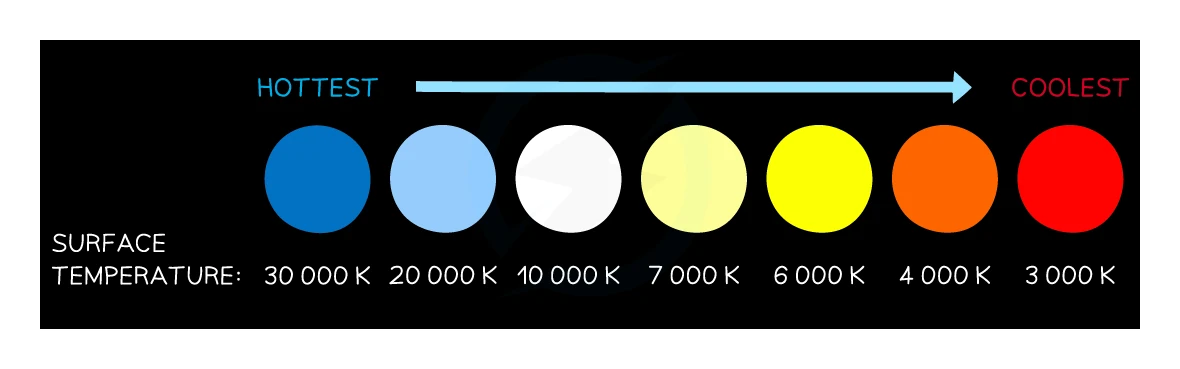
- Be careful: in everyday life we associate red with hot (red-hot iron, red flames) and blue with cold (cold water taps, ice). For stars it is the other way around: blue is the hottest, red is the coolest. The flame analogy is closer to the truth than the tap one, since a Bunsen burner's blue cone is hotter than its yellow tip
Common exam question
Comparing star temperatures from their colours
Question: Put a table of stars in order of increasing surface temperature from their colours, or explain which star (or which side of an HR diagram) is hottest (1–3 marks).
Asked in 7 of the 24 papers. One fact does all the work: colour is set by surface temperature, with blue hottest, then blue-white, white, yellow and orange, and red coolest. In the ordering tables one star in its correct place earns a mark, two earn two and the full order earns three; one scheme also accepts colours instead of star names.
In an explain question, one mark is for picking the blue star and the second for saying that colour depends on surface temperature; "the Sun is hotter than Betelgeuse" earns both on its own. Leave mass out of it, since the mark scheme ignores any link between mass and temperature. For the hottest side of an HR diagram say the left (blue) side: "white" alone is ignored.
What sets a star's temperature?
- A star's surface temperature depends on its mass and the stage of its life it is in
- Massive young stars on the main sequence are blue-white and very hot
- Lighter main-sequence stars (like the Sun) are yellow
- Aging stars that have swelled into red giants or red supergiants are cool and red, even though they may be very large and very bright
- As a star expands, its surface cools; as a star contracts, its surface heats up. So when the Sun eventually becomes a red giant, its outer layers swell out and cool to red; when it then collapses to a white dwarf, those layers contract again and heat to white-hot