4PH1
Motion in the Universe
Astrophysics
Definition
Orbital period (T) = the time taken for an object to complete one full orbit
- Units: seconds (s) in SI, but in practice often expressed in minutes, hours, days or years depending on the orbit
- Examples:
- International Space Station: T ≈ 90 minutes
- The Moon around Earth: T ≈ 27.3 days
- Earth around the Sun: T = 1 year
- Halley's Comet around the Sun: T ≈ 76 years
Orbital speed equation
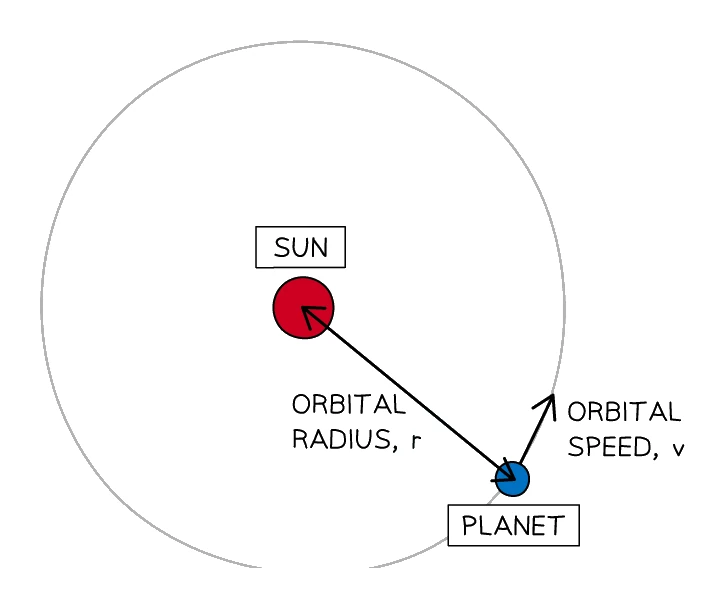
- In one complete orbit, the body sweeps out a path whose length is the circumference of the orbit (treating it as a circle):
distance per orbit = 2πr
- where r is the average orbital radius (measured from the centre of the body being orbited to the orbiting body, not from the surface)
- Combine this with speed = distance / time to get the orbital speed equation:
v = 2πr / T
- Where:
- v = orbital speed (m/s)
- r = orbital radius (m)
- T = orbital period (s)
Watch out for the radius
- r is from centre to centre, not from the planet's surface
- For a satellite in low Earth orbit at a height h above the surface, the orbital radius is:
r = R_Earth + h
- where R_Earth ≈ 6400 km. Forgetting to add R_Earth is the single most common mistake in this calculation
Why faster-orbiting bodies are closer in
- Looking at v = 2πr / T together with the fact that gravity falls off with distance, you can see the pattern:
- Close to the central body, gravity is strong, needs high speed to balance, period is short
- Far from the central body, gravity is weak, only slow speed needed to balance, period is long
- That is why Mercury has a year of 88 days and Neptune has a year of 165 years; and why low satellites zip around the Earth in 90 minutes while geostationary satellites take 24 hours
- Quantitatively, Kepler's third law says T² ∝ r³, but the qualitative rule "closer = faster" is enough here
Worked example
Calculating orbital speed from radius and period
A moon orbits its planet with an orbital radius of 600 000 km and a period of 4 days. Calculate the orbital speed of the moon in m/s.
Solution:
- Convert the period to seconds: 4 days × 24 × 60 × 60 = 345 600 s
- Convert the orbital radius to metres: 600 000 km × 1000 = 6.0 × 10⁸ m
- Apply v = 2πr / T: v = (2 × π × 6.0 × 10⁸) / 345 600
- v = 10 900 m/s (to 3 s.f.)