Motion in the Universe
Astrophysics
Why orbits happen
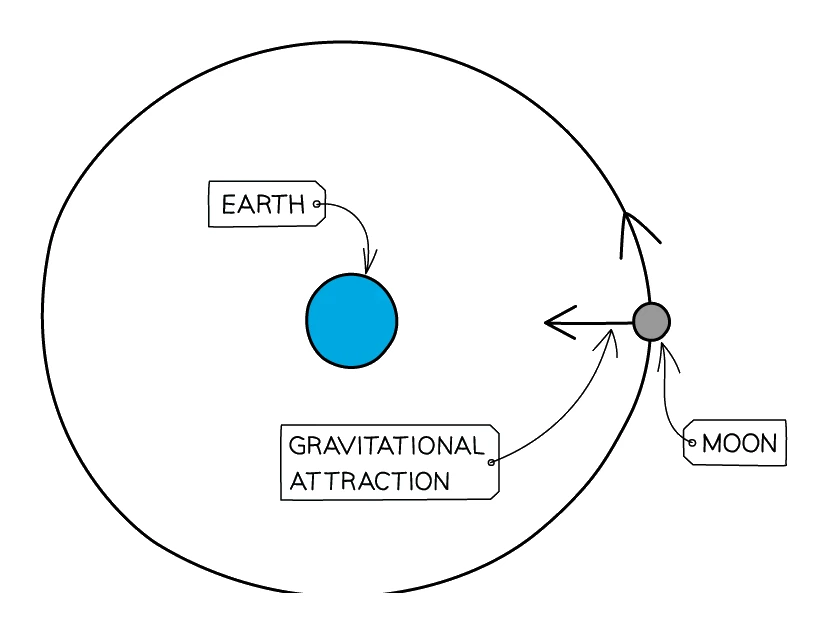
- The Moon does not fly off into space, and it does not crash into the Earth. Instead it keeps going around at a roughly constant distance
- The reason is gravity:
- The Moon is pulled towards the Earth by gravitational attraction
- But the Moon is also moving sideways (tangentially) very fast
- The two effects combine to keep the Moon moving in a near-circular path around the Earth
- For a stable circular orbit:
- The gravitational pull from the central body acts as a centripetal force, always pointing towards the centre of the orbit
- This force constantly changes the direction of the orbiting body's velocity, but not its speed
- The orbiting body falls towards the central body forever, but always misses, because its sideways motion carries it past the centre
Properties of any orbit
For any object in a stable orbit:
- The gravitational force always points towards the centre of the larger body
- The orbiting body moves in a roughly circular path (or, for some comets, a very stretched ellipse)
- The speed is constant for a circular orbit (varies for an elliptical one, see below)
- The orbiting body is always accelerating, because its direction is changing even when its speed is not
Common exam question
Naming or drawing the force that keeps a body in orbit
Question: Give the name of the force that keeps a satellite, moon or planet in orbit, or draw an arrow on a diagram to show that force (1–2 marks).
Asked in 7 of the 24 papers as a one-word answer, a multiple-choice item or an arrow to draw. The answer is the gravitational force (gravity is accepted). "Weight" is allowed by two schemes but ignored by a third, "centripetal" and "centrifugal" are ignored, and "gravitational potential" and "gravitational field strength" are rejected outright, so write "gravitational" every time.
The arrow points from the orbiting body towards the centre of the body it orbits: comet to star, moon to planet, star to the centre of its galaxy. It need not start on the body as long as its line passes through both, but a second, contradictory arrow loses the mark. A labelled arrow earns a second mark for the label "gravitational".
Orbits of planets, moons and comets
All three are caused by gravity, but they look quite different:
around the Sun
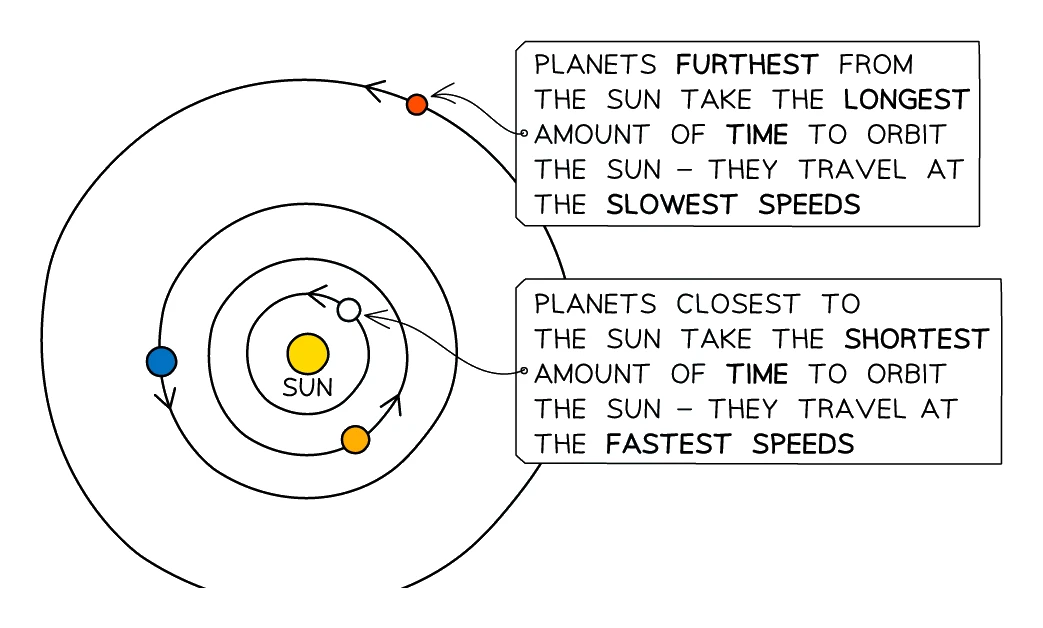
- Each planet moves in a slightly elliptical orbit (close to circular) with the Sun at one focus
- All eight planets orbit in the same direction and in roughly the same plane (the plane of the Solar System)
- Each planet has a different orbital radius and therefore a different orbital speed and period:
- Mercury is closest to the Sun, fastest, period ≈ 88 days
- Earth has a period of 1 year (365.25 days)
- Jupiter has a period of ≈ 12 years
- Neptune is the furthest planet, slowest, period ≈ 165 years
- The closer a planet is to the Sun, the faster it orbits (because the Sun's gravitational pull is stronger near in), and the shorter its year
Moons around their planets
- Moons travel in near-circular orbits around their parent planet
- The closer the moon to the planet, the faster it orbits and the shorter its period, for the same reason
- The Moon takes about 27.3 days to orbit the Earth
Comets around the Sun
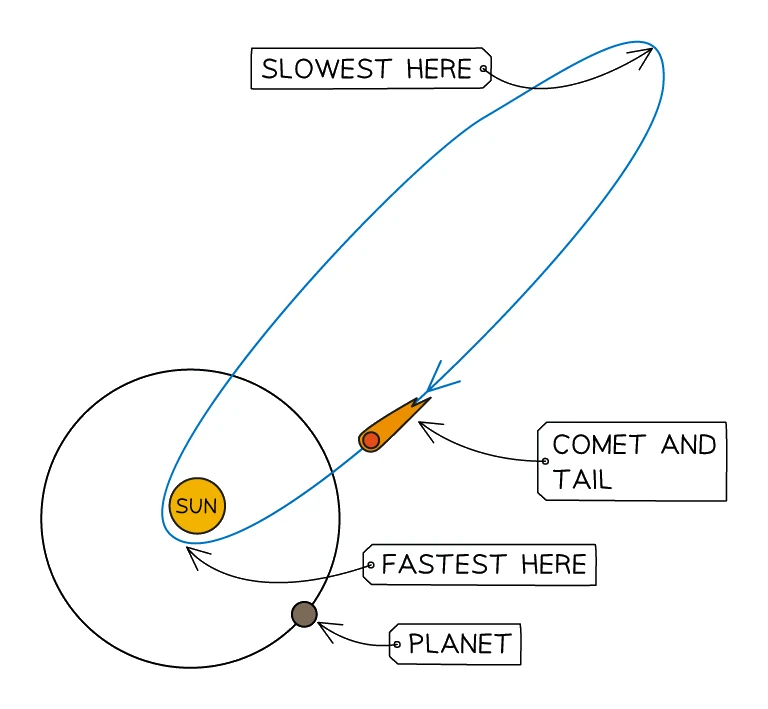
- Comets follow highly elliptical orbits, which are very stretched ovals
- They spend most of their time in the outer , moving slowly. When they swing close to the Sun they accelerate to very high speeds, then slow again as they head back out
- Many comets travel through space at a steep angle to the flat disc the planets occupy, and a few even loop round the Sun backwards (in the opposite sense to the planets)
- Comet Halley has a period of 76 years; some comets have periods of millions of years; some never come back at all (they are on hyperbolic trajectories that take them out of the Solar System)
- The speed of a comet changes a lot during one orbit: fastest at the closest point to the Sun, slowest at the furthest point
Common exam question
Drawing the orbit of a moon or a comet
Question: On a diagram showing a star and a planet, draw the orbit of a moon around the planet, or the orbit of a comet around the star (2 marks).
Asked in 4 of the 24 papers. A moon's orbit earns one mark for being any orbit around the planet (not around the star) and the second for being circular and centred on the planet, judged by eye. A comet's orbit earns one mark for a stretched ellipse around the star and the second for placing the star at one focus, towards one end of the ellipse; a star drawn at the centre of the ellipse loses that mark. If you are asked where the comet moves fastest, mark the point on its orbit closest to the star.
Common exam question
Comparing a comet's orbit with a planet's or a moon's
Question: Describe the differences between the orbit of a comet and the orbit of a planet or a moon (1–3 marks).
Asked in 3 of the 24 papers. Every mark needs a clear comparison, so write both halves of each point: the comet's orbit is highly elliptical while the planet's or moon's is almost circular; the comet's speed varies around its orbit while the planet's stays constant; the comet's distance from the star changes while the planet's orbital radius does not. Also credited: the star sits at the centre of a planet's orbit but not of a comet's, the comet's orbit can lie in a different plane, and a moon orbits a planet whereas a comet orbits a star. Saying the comet's orbit is longer or takes more time is accepted by two schemes but ignored by a third, so do not rely on it.