Motion in the Universe
Astrophysics
What gravity does
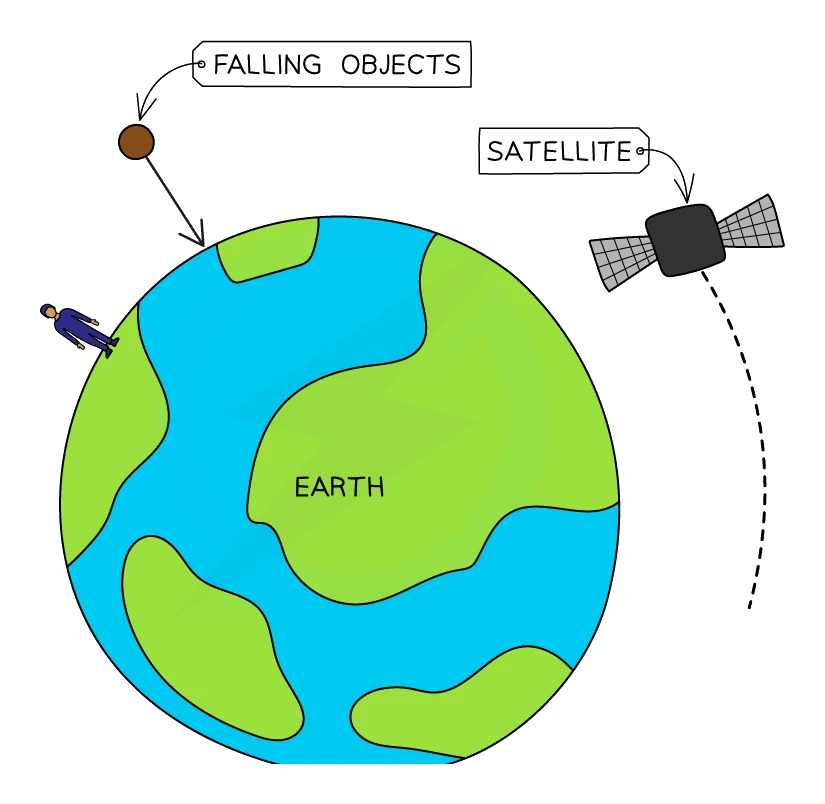
- Every object with mass attracts every other object with mass. This pull is the gravitational force
- The bigger the masses, the bigger the pull. The Sun pulls on planets; planets pull on moons; the Earth pulls on everything on its surface, including you
- On a planet's surface, the force pulling everything towards the centre is what we call weight:
= the force on an object due to gravitational attraction
Definition of gravitational field strength
- The , given the symbol g, is defined as:
g = the gravitational force per unit acting on an object placed in the field
- Units: N/kg (newtons per kilogram)
- The relationship between weight and mass is:
weight W = mass m × gravitational field strength g
W (N) = m (kg) × g (N/kg)
- On Earth's surface, g ≈ 10 N/kg. So a 50 kg pupil has a weight of 50 × 10 = 500 N
Mass vs weight: keep them separate
| Mass | Weight | |
|---|---|---|
| What it measures | How much matter an object contains | The force that gravity exerts on it |
| Unit | kilogram (kg) | newton (N) |
| Type of quantity | Scalar | Vector, points downwards |
| Changes with location? | No, same everywhere | Yes, depends on local g |
| Measured with | Balance | Newtonmeter (or scale calibrated for the local g) |
- A 70 kg astronaut is always 70 kg, whether on Earth, on the Moon, or in deep space. But the astronaut weighs 700 N on Earth, only about 112 N on the Moon (70 × 1.6), and zero N in deep space far from any planet
How g varies around the Solar System
- The larger the planet's mass and the smaller its radius, the stronger the gravitational field at its surface
| Body | g at surface (N/kg) | Compared to Earth |
|---|---|---|
| Moon | ≈ 1.6 | About 1/6 of Earth's |
| Mercury | ≈ 3.7 | About 1/3 |
| Mars | ≈ 3.7 | About 1/3 |
| Earth | ≈ 10 | 1 (baseline) |
| Saturn | ≈ 10.4 | Similar to Earth |
| Neptune | ≈ 11.0 | Slightly higher |
| Jupiter | ≈ 25 | About 2.5× Earth's |
| The Sun | ≈ 270 | About 27× Earth's |
- On the Moon, gravity is weak. The Apollo astronauts could bounce in long, slow strides. Lifting a 100 kg lump of rock there feels like lifting 16 kg on Earth
- On Jupiter, gravity is so strong that a person standing on the cloud-tops (if they could) would weigh more than 2.5 times what they do on Earth. Human leg muscles cannot push against that much force, so a person on Jupiter would collapse to the floor and could not get back up
Why g varies with height
- The strength of a gravitational field falls with distance from the centre of the planet
- On the surface of Earth, g is about 10 N/kg
- At the height of the International Space Station (about 400 km up), g has only dropped to about 8.9 N/kg, only 11% less than at the surface. Astronauts on the ISS are not weightless because gravity has vanished; they appear weightless because they are in free-fall, falling around the Earth at the same rate as the station
- For ordinary problems at this level, treat g as constant at the surface of any given planet. It does not change appreciably between the top and bottom of a mountain
Why gravitational field strength is smaller on the Moon than on Earth
What comes up: a multiple-choice question asks which statement correctly explains why g on the Moon is less than g on Earth.
Write: the Moon has less mass than the Earth. A smaller mass produces a weaker gravitational field at its surface, so g is lower and an object weighs less there.
Watch out: the mark scheme rejects the ideas that atmosphere, distance from the Sun, or greater density cause the difference. Only mass (and radius) determine surface g — the Moon's lower mass is the key reason.