4PH1
Stellar Evolution
Astrophysics · 1 question type
Classifying Stars by Colour and Temperature
Stars come in different colours
- Look at the night sky carefully and you can pick out different colours: Betelgeuse in Orion looks distinctly orange-red; Rigel in the same constellation is a brilliant blue-white; the Sun is yellow; many faint stars look a quiet red
- A star's colour is set by the temperature of its surface. Hot objects glow blue-white; cooler objects glow red. This is exactly the same physics as a piece of metal heated in a furnace: at moderate heat it glows red, at higher heat it turns orange, then yellow, then white-hot, then blue-white
Colour ↔ surface temperature
Hotter star → bluer colour
Cooler star → redder colour
| Star colour | Surface temperature (K) | Examples |
|---|---|---|
| Blue | ≈ 30 000 K | Spica, Mintaka |
| Blue-white | ≈ 10 000 K | Rigel, Sirius, Vega |
| White | ≈ 7500 K | Deneb |
| Yellow | ≈ 6000 K | The Sun, Alpha Centauri A |
| Orange | ≈ 4500 K | Aldebaran, Arcturus |
| Red | ≈ 3000 K | Betelgeuse, Proxima Centauri |
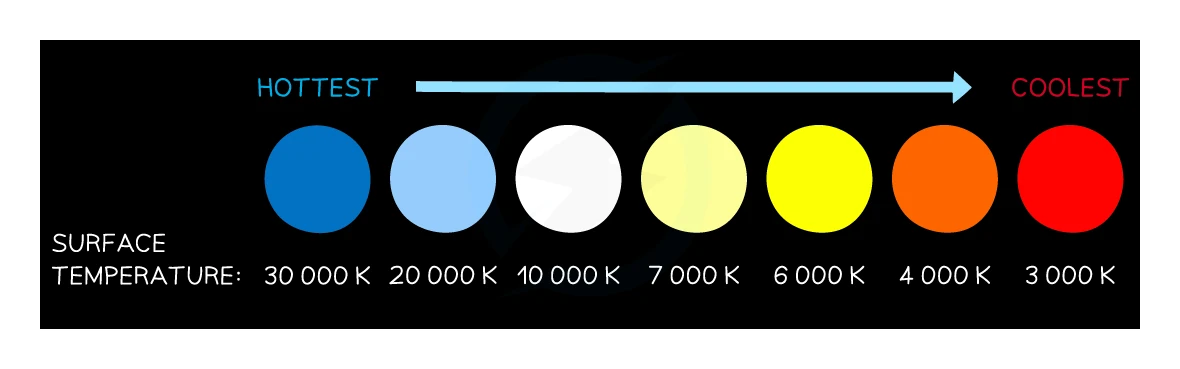
- Be careful: in everyday life we associate red with hot (red-hot iron, red flames) and blue with cold (cold water taps, ice). For stars it is the other way around: blue is the hottest, red is the coolest. The flame analogy is closer to the truth than the tap one, since a Bunsen burner's blue cone is hotter than its yellow tip
What sets a star's temperature?
- A star's surface temperature depends on its mass and the stage of its life it is in
- Massive young stars on the main sequence are blue-white and very hot
- Lighter main-sequence stars (like the Sun) are yellow
- Aging stars that have swelled into red giants or red supergiants are cool and red, even though they may be very large and very bright
- As a star expands, its surface cools; as a star contracts, its surface heats up. So when the Sun eventually becomes a red giant, its outer layers swell out and cool to red; when it then collapses to a white dwarf, those layers contract again and heat to white-hot