Stellar Evolution
Astrophysics
Luminosity: how bright a star actually is
- The of a star is:
the total amount of light energy the star emits per second
- Units: watts (W). Luminosity is a measure of the star's power output
- Luminosity is an intrinsic property and does not depend on where you are looking from. The Sun has a luminosity of about 4 × 10²⁶ W, whether you are standing on Earth or on Pluto
- Astronomers often express luminosity in solar units, where the Sun's luminosity = 1. So a star with luminosity 100 emits 100 times as much energy per second as the Sun
Apparent magnitude: how bright a star looks
- The of a star is:
a measure of how bright the star looks from Earth
- Apparent magnitude depends on two things:
- The star's luminosity, because a more luminous star looks brighter
- The star's distance from Earth, because a closer star looks brighter (light spreads out with distance, so a distant star looks fainter than the same star nearby)
- A bright nearby star and a luminous but very far star can have the same apparent magnitude
The reversed scale: lower number = brighter
- The apparent magnitude scale is back to front from what you might expect:
- The brighter the star looks, the smaller (or even negative) the magnitude
- The dimmer the star looks, the larger the magnitude
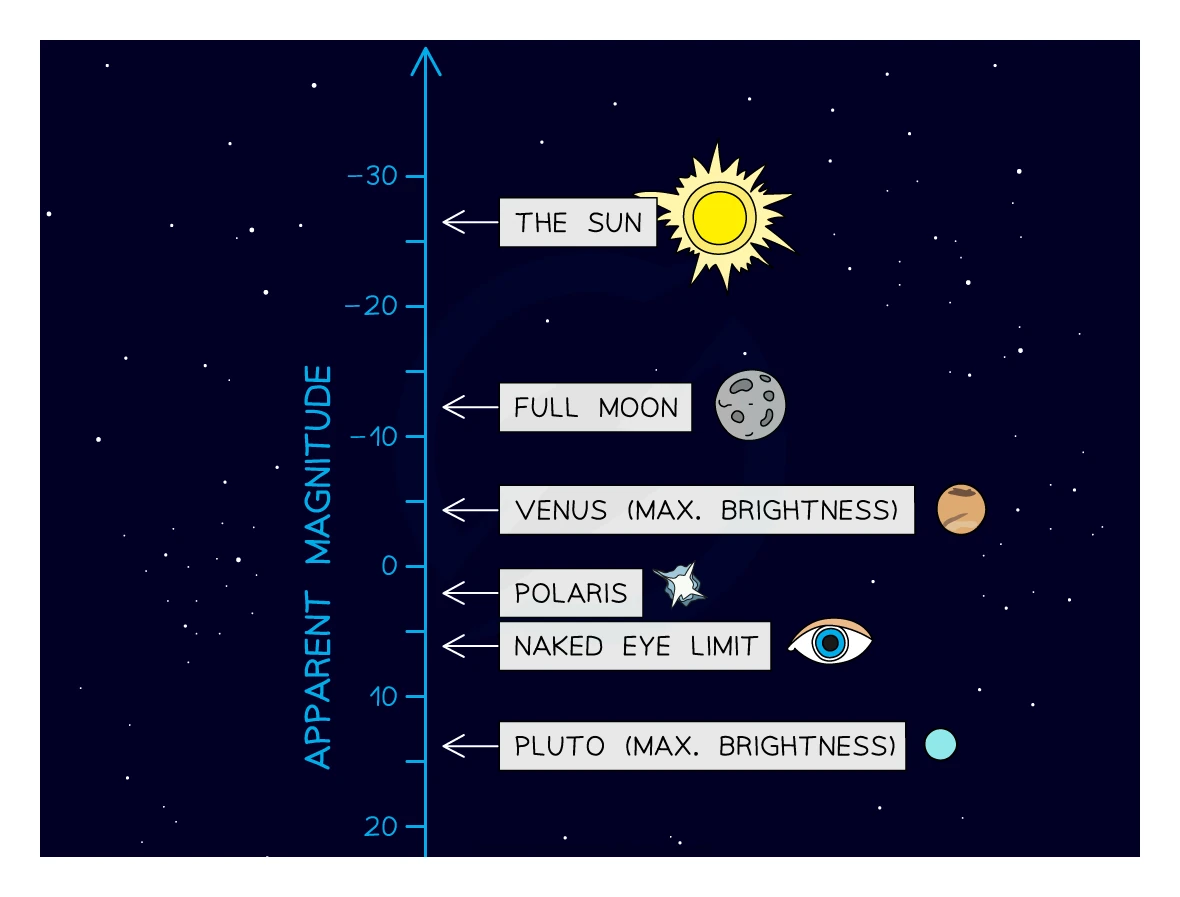
- Examples of apparent magnitude:
| Object | Apparent magnitude |
|---|---|
| Sun | −26.7 (brightest object in the sky) |
| Full Moon | −12.6 |
| Venus at brightest | −4.6 |
| Sirius (brightest star at night) | −1.5 |
| Polaris | +2.0 |
| Faintest stars visible to the naked eye | +6 |
| Faintest objects seen with Hubble Space Telescope | +31 |
- Each step of 5 magnitudes is exactly a factor of 100 in brightness. So a magnitude 1 star is 100 times brighter than a magnitude 6 star
Exam tip
A lower absolute magnitude means a brighter star
The magnitude scale runs backwards, so read tables and HR axes with care: a star at −5 is far brighter than one at +10, and on an HR diagram the negative values sit at the top, where the red giants are. Asked which star in a table is in its supernova stage, pick the one with a mass much larger than the Sun's, backed by its much lower absolute magnitude; each reason scores only if you name the right star, which is the first mark, and bringing in colour or temperature caps the answer at two of the three marks.
Absolute magnitude: putting all stars at the same distance
- To compare two stars fairly, you have to remove the distance effect. does exactly that:
absolute magnitude = how bright the star would look if it were placed at a standard distance of 10 parsecs (about 32.6 light-years, or 3 × 10¹⁴ km) from Earth
- This puts every star on the same footing. A star with a low absolute magnitude is truly very luminous; a star with a high absolute magnitude is truly dim, regardless of where they actually are
- The Sun's absolute magnitude is +4.8. From 10 parsecs away the Sun would be a dim naked-eye star, confirming that the Sun is a fairly modest star intrinsically; it looks bright only because it is so close
Common exam question
Absolute magnitude and why distance changes brightness
Question: Define absolute magnitude, or explain how two stars can look equally bright (or one brighter) from Earth whatever their true brightness (1–2 marks).
Asked in 4 of the 24 papers, all on Paper 2. The definition has two halves, one mark each: a measure of a star's brightness (power, luminosity or intensity accepted) at a standard distance (fixed, set or the same distance count, as does 10 parsecs or 32.6 light years). Describing the scale does not earn the brightness half.
The explaining part is one idea: the stars are not at the same distance from Earth, so the nearer one looks brighter. Say which is nearer: the brighter-looking star (that alone scores both marks) or, for two stars that look equally bright, the less powerful one. Apparent magnitude is how bright a star looks from Earth and depends on distance; absolute magnitude removes that, which is why it is the vertical axis of an HR diagram.
Why both scales are useful
- answers "what will I see in the sky?", useful for navigation, for telescopes, for finding objects
- (and luminosity) answers "what is this star really like?", useful for classifying stars and understanding their life cycles