Stellar Evolution
Astrophysics
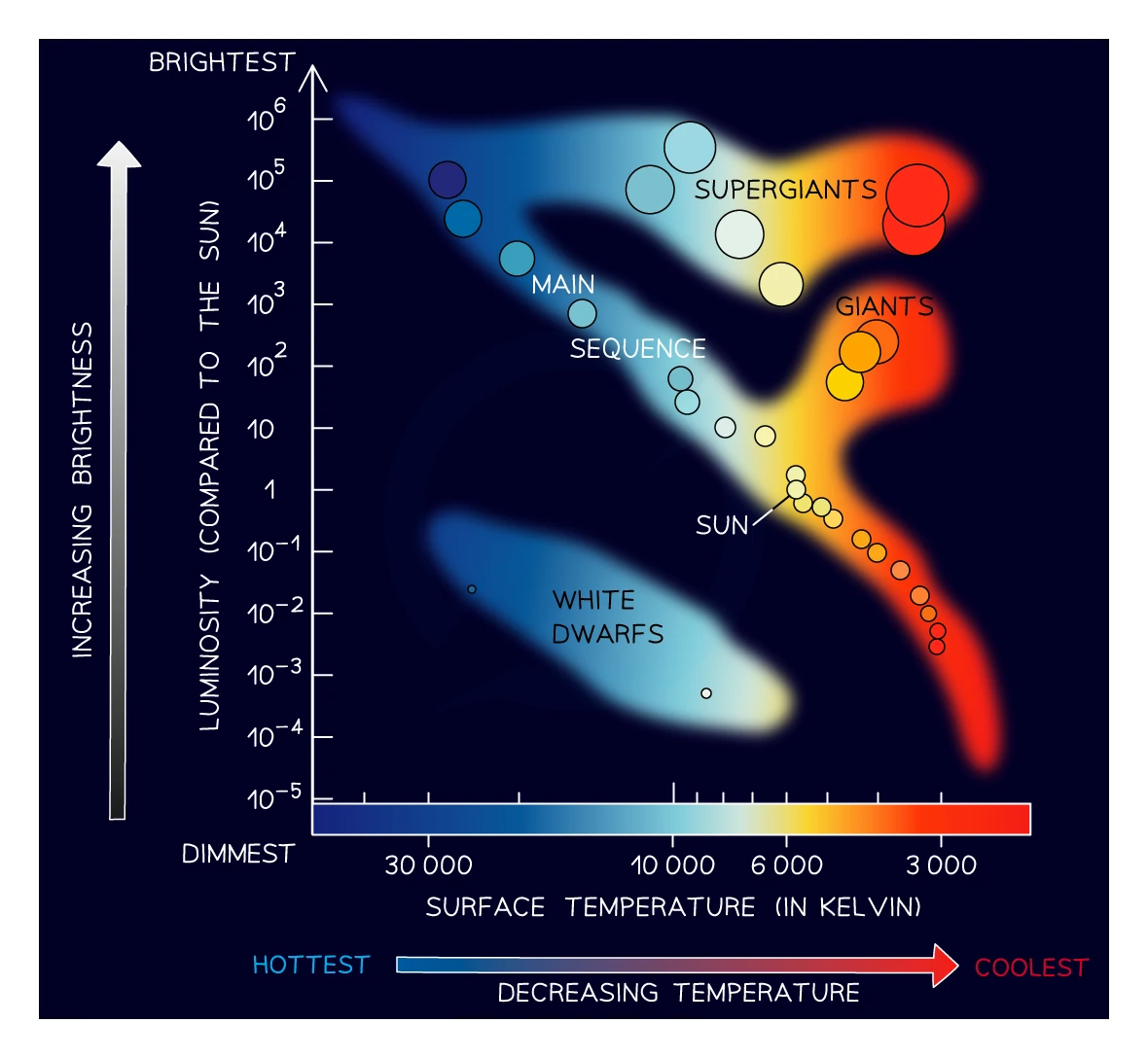
What an HR diagram is
- A Hertzsprung–Russell (HR) diagram is a plot that arranges stars by their two most important properties:
- on the vertical axis (more luminous stars near the top, less luminous near the bottom). Often plotted on a log scale, with the Sun's luminosity = 1 as a reference point
- Surface temperature on the horizontal axis, plotted backwards, with the hottest (blue) stars on the left, the coolest (red) stars on the right
- The diagram is named after the two astronomers who discovered it independently in the early 20th century
The reversed temperature axis
- The horizontal axis runs from high temperature on the left to low temperature on the right, the opposite way round from a normal physics graph. This is a historical convention you just have to remember
- The colour of each region of the diagram matches the temperature scale: blue on the left, white-yellow in the middle, orange-red on the right
The four key regions
A scatter plot of all stars in the night sky reveals four clusters:
- The main sequence is a long, diagonal band of stars running from the top-left (hot, luminous, blue) to the bottom-right (cool, dim, red). About 90% of all stars lie on the main sequence at any given time. The Sun sits on the main sequence in the middle of the band
- form a clump of stars in the bottom-left, which are hot (which would normally mean blue) but dim (because they are tiny). They lie below the main sequence
- form a cluster in the upper-right, which are cool (red) but bright (because they are huge). They sit above the main sequence
- sit at the very top-right, even cooler and even more luminous than red giants. They are the brightest stars known by sheer luminosity
What a star's position tells you
| Region | Temperature | Luminosity | Size |
|---|---|---|---|
| Top-left main sequence | Hot (blue) | Very high | Large hot blue stars |
| Middle main sequence | Yellow | Moderate | Sun-like stars |
| Bottom-right main sequence | Cool (red) | Low | Red dwarf stars |
| Bottom-left of diagram | Hot but dim | Very low | White dwarfs (very small) |
| Upper-right of diagram | Cool but bright | High | Red giants (very large) |
| Top-right of diagram | Cool but extremely bright | Very high | Red supergiants (huge) |
Common exam question
Identifying the regions of an HR diagram
Question: Name the star type in each labelled region of an HR diagram (or join regions to types), mark the Sun's position, or circle where it will be at its next stage (1–4 marks).
Asked in 4 of the 24 papers, all on Paper 2. The regions are always the same: the diagonal band is the main sequence, the clump at the bottom left the white dwarfs, the group at the top right the red giants; a very bright blue star sits top left on the main sequence, a Sun-like star in its middle. The word box's distractors (black holes, supernovae, neutron stars, nebulae) have no region on the diagram.
Give one answer per region: two names or two lines lose its mark. The Sun's cross goes on the main sequence; its next stage is the red giant region at the top right, and the circle must overlap that area only. The vertical axis is absolute magnitude, not apparent magnitude.
Common exam question
Describing or comparing types of star
Question: Describe the stars in one corner of an HR diagram, or discuss the differences between a red giant and a white dwarf (2–4 marks).
Asked in 2 of the 24 papers. Each mark is a separate property, so work through the list: surface temperature, brightness (luminosity or power), colour, size, mass, density and whether fusion is still happening. The stars at the top left are hot, very bright, blue or white and high in mass. Compared with a white dwarf, a red giant is brighter, far larger, cooler and still fusing, while the white dwarf is denser and has a planetary nebula around it. Each point can be made from either side, so "the white dwarf is hotter" is as good as "the red giant is cooler". Write "bright" or "high luminosity" rather than a bare reference to absolute magnitude, which one scheme ignores.
Reading the life cycle off an HR diagram
- A star's position on the HR diagram changes over its lifetime as it evolves through the stages described in sections 3 and 4
- For a solar-mass star:
- Main sequence: sits at the Sun's position for billions of years
- Red giant: moves up and to the right (cooler surface, much higher luminosity because the star is huge)
- White dwarf: moves down and to the left (much hotter exposed core, much lower total luminosity because the star is tiny)
- For a massive star:
- Main sequence: top-left of the diagonal band (hot, blue, very luminous)
- Red supergiant: moves all the way across to the upper-right (cools as it expands, stays extremely luminous)
- Supernova → neutron star or black hole: leaves the HR diagram altogether; the remnants are too small and dark to plot