Stellar Evolution
Astrophysics · 1 question type
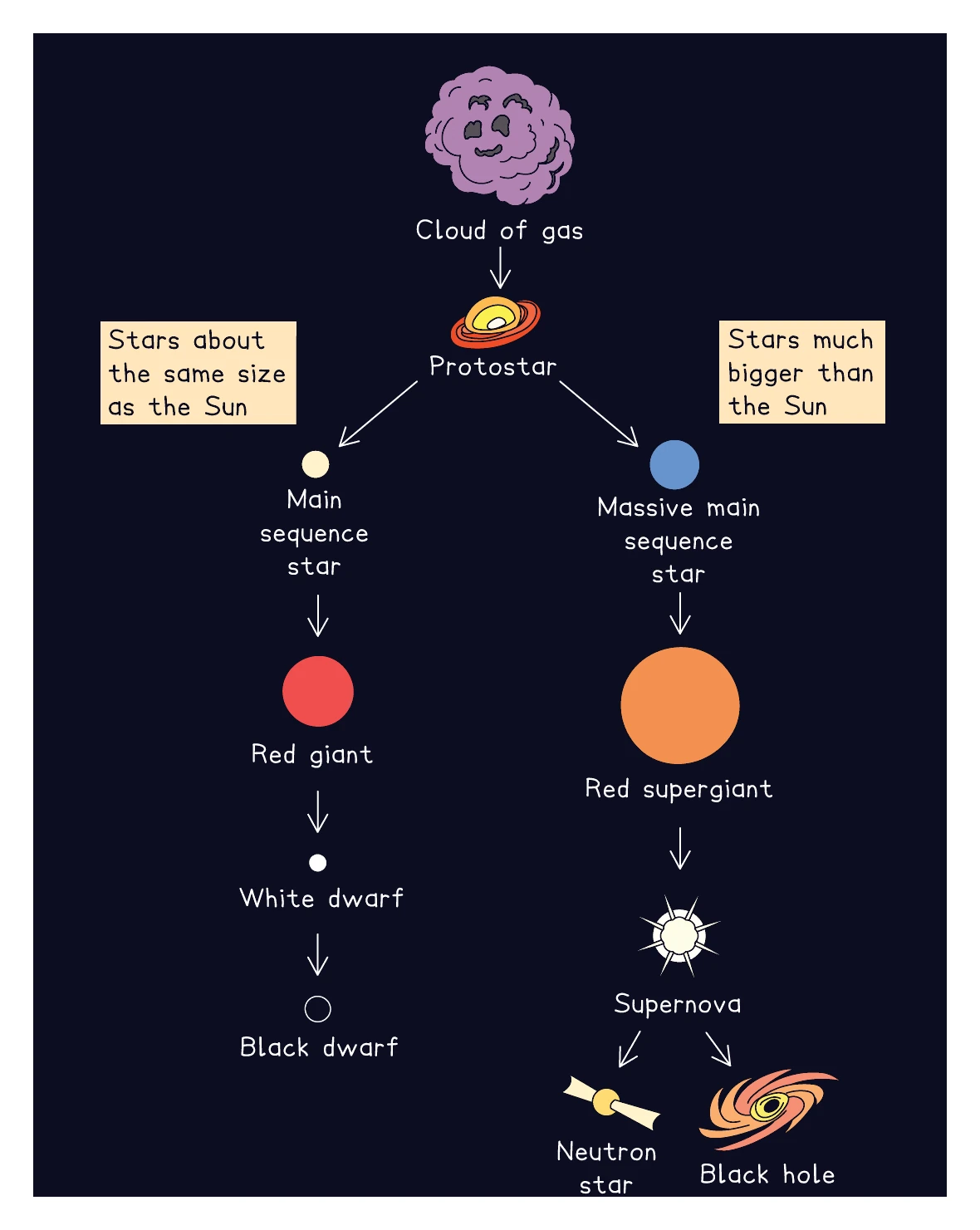
Stars much more massive than the Sun (typically more than about 8 solar masses) live faster and die more violently. Their life cycle is:
nebula → protostar → main sequence → → → or
A faster main sequence
- A more massive star has much more fuel to burn, but it burns it far faster because the core is hotter and denser
- A 10-solar-mass star spends only about 20 million years on the main sequence, compared to 10 billion for the Sun
Red supergiant
- When the core hydrogen runs out, the same expansion happens as for a solar-mass star, but on a much grander scale. The star swells to enormous size, far bigger than a red giant
- A red supergiant can be hundreds of times the diameter of the Sun. Betelgeuse, for example, would extend out past Jupiter's orbit if placed where the Sun is
- A massive star can fuse much heavier elements than a solar-mass star. It can build up successive layers of fusion all the way to iron in its core. Iron is the most tightly bound nucleus, so fusing it does not release energy
Supernova
- Once the core is iron, fusion can no longer support the star against gravity. The core collapses suddenly, in less than a second, to about the size of a city
- The infalling outer layers bounce off the collapsed core in a colossal explosion called a supernova
- A supernova is, for a few weeks, the brightest object in its host galaxy, outshining all the other hundreds of billions of stars combined
- The supernova:
- Hurls most of the star's mass out into space, enriching the surrounding gas
- Forges all of the elements heavier than iron (gold, lead, uranium and everything else) and scatters them through space
- Leaves behind a tiny, ultra-dense remnant
- The dust and gas thrown out by a supernova eventually mixes back into interstellar space and may become part of a new , from which the next generation of stars and planets will form. The carbon in your body, the oxygen you breathe and the iron in your blood were all forged in stars that exploded as supernovae billions of years ago
Neutron star
- For most massive stars, the collapsed core left behind is a neutron star, an object of roughly 20 km diameter containing more mass than the Sun
- The matter in a neutron star is so dense that protons and electrons have been squeezed together into neutrons. A sugar-cube-sized lump of neutron-star material would weigh as much as a mountain
Black hole
- For the most massive stars (above about 25 solar masses), even the neutron-star stage cannot stop the collapse. Gravity wins, and the core continues to contract to a point of effectively zero size, a black hole
- A black hole is a region of space where gravity is so overwhelmingly strong that nothing, including light itself, can get back out once it has crossed the boundary (the event horizon). Anything that falls in is gone forever
Ordering the stages of a massive star's life cycle
What comes up: a question showing 4–5 stages of a massive star's development in a scrambled table, asking you to give the correct order (numbered 1 to 5).
Write: the correct sequence is: core runs out of hydrogen (1) → star becomes a red supergiant (2) → heavier elements are fused in the core (3) → star explodes as a supernova (4) → neutron star or black hole forms (5).
Watch out: "heavier elements made in the core" comes after the red supergiant stage, not before — a common ordering error. Also note that a black hole only forms from the most massive stars; for most massive stars the remnant is a neutron star.
Quick comparison of the two paths
| Solar-mass star | Massive star | |
|---|---|---|
| Time on main sequence | ≈ 10 billion years | ≈ 1 to 100 million years |
| Heaviest element fused | Carbon, oxygen | Iron |
| Late stage | Red giant | Red supergiant |
| Death event | Quiet; outer layers drift off as a planetary nebula | Violent supernova explosion |
| End-state core | White dwarf (Earth-sized) | Neutron star (~20 km) or black hole (size of a point) |
| Recycles material? | Yes, mildly | Yes, dramatically; also creates heavy elements |