Stellar Evolution
Astrophysics · 1 question type
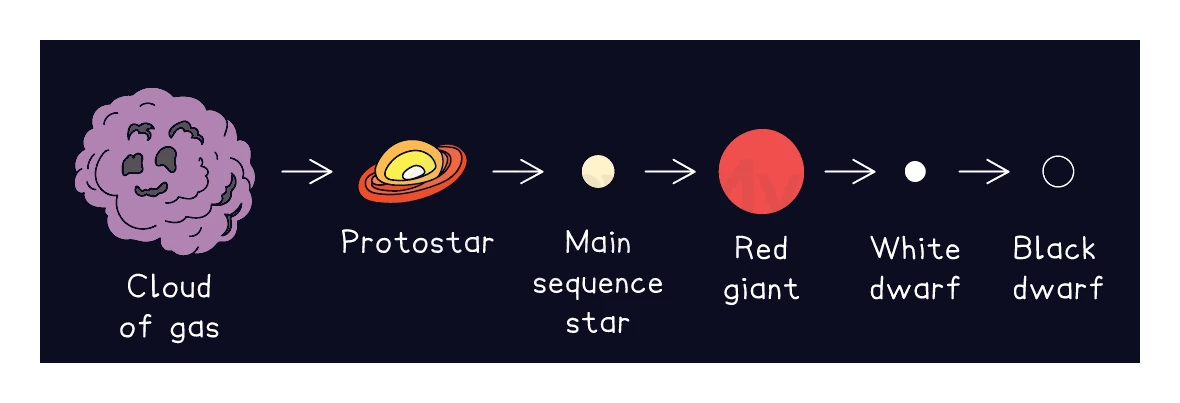
Stars roughly the same mass as the Sun (or smaller) finish their lives differently from much heavier stars. The full life cycle of a solar-mass star is:
nebula → protostar → main sequence → → →
Red giant
- Once the star has spent billions of years on the main sequence, the hydrogen fuel inside its core is used up. Core fusion slows and then stops altogether
- With no outward pressure to oppose it, gravity squeezes the core, which contracts and heats up
- The intense heat reaches a fresh shell of hydrogen around the dead core; this shell begins to fuse, and the core gets hot enough to fuse helium → carbon and oxygen
- The new burst of energy pushes the outer layers of the star outwards by a huge factor. The Sun, for example, will swell out to roughly the orbit of Earth
- As the outer layers expand they cool, glowing red. The star is now a red giant
Planetary nebula
- After the helium runs out, the red giant becomes unstable. Its outer layers drift off into space, forming a glowing shell of gas around the exposed hot core. This shell is called a planetary
- The name is misleading, since planetary nebulae have nothing to do with planets. Early astronomers thought they looked vaguely like planets through small telescopes, and the name stuck
White dwarf
- The exposed core left behind is a white dwarf, a small, very hot, very dense object roughly the size of the Earth but containing most of the Sun's mass
- A white dwarf has no fusion happening inside it. It simply cools and dims over billions of years, fading from white through yellow to orange and eventually red
- Eventually it becomes a black dwarf (cold, dark, no longer emitting light). The Universe is too young for any black dwarfs to exist yet, because white dwarfs take far longer to cool than the age of the Universe
Describing how a main-sequence star becomes a white dwarf
What comes up: a 4-mark "describe" question asking how a solar-mass main-sequence star ends its life as a white dwarf.
Write (four marks, any four of): (1) Hydrogen fusion stops in the core (hydrogen runs out). (2) The core collapses and the core temperature increases. (3) The star expands into a red giant (surface temperature decreases). (4) Helium fusion begins in the core. (5) When helium runs out, the outer layers drift off as a planetary nebula, leaving the exposed core as a white dwarf.
Watch out: the mark scheme rejects supernova as a step in the solar-mass path — a supernova is only for massive stars. Also, do not confuse "planetary nebula" (the drifting shell of gas around a white dwarf) with the original nebula the star formed from.