4PH1
Cosmology
Astrophysics · 1 question type
The Big Bang Theory
The origin of the Universe
- The currently accepted scientific model for how the Universe began is the Big Bang theory:
Around 14 billion years ago, all matter and energy in the Universe was concentrated in a single very small, extremely hot and dense point. From this point the Universe began to expand rapidly in every direction at once. As it expanded, it cooled and matter eventually clumped together under gravity to form the stars, galaxies and planets we see today
- The "Big Bang" was not an explosion of matter into empty space. It was an expansion of space itself, because there was no space outside the early Universe to explode into. Every point that exists today was inside that hot, dense beginning
- The Universe has been expanding ever since, and is still expanding today
- "The Big Bang" gives a starting point for the Universe but does not say what (if anything) caused it, or what was "before" it. Those questions sit outside what physics can currently answer
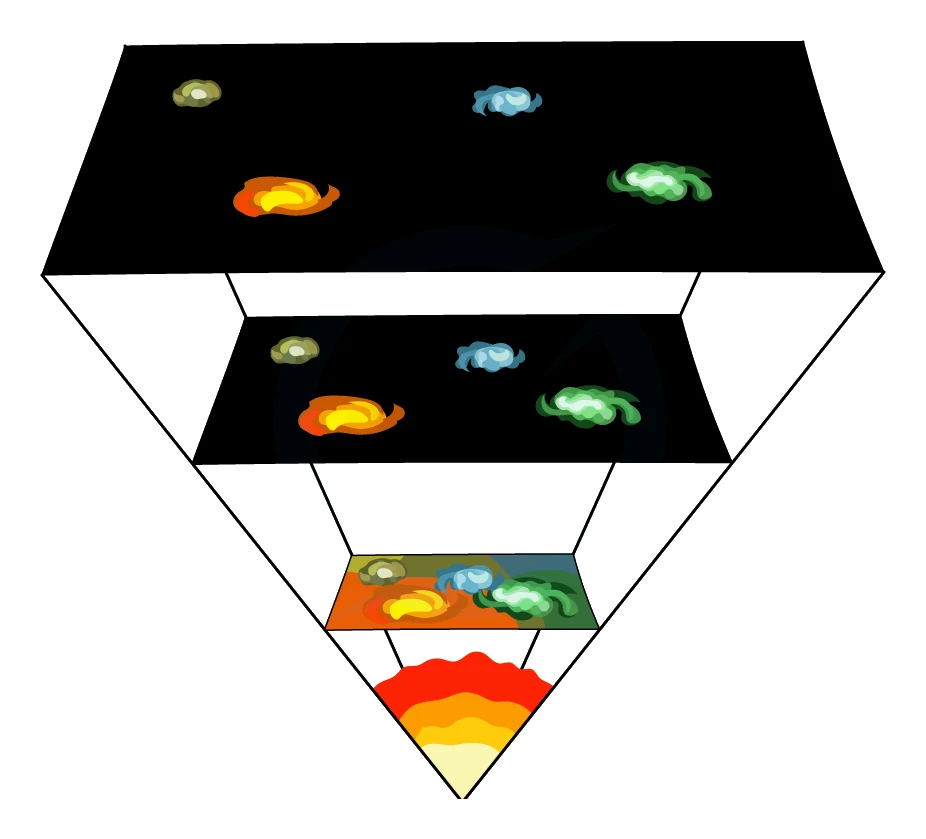
The expansion is observed today
- When astronomers look at the light from distant galaxies, they find that:
- Every galaxy is moving away from every other galaxy
- The further away a galaxy is, the faster it is moving away from us
- This is exactly what you would expect if the entire Universe had been expanding from a hot, dense early state. Tracing the expansion backwards in time leads to a single starting point, the Big Bang
The balloon analogy
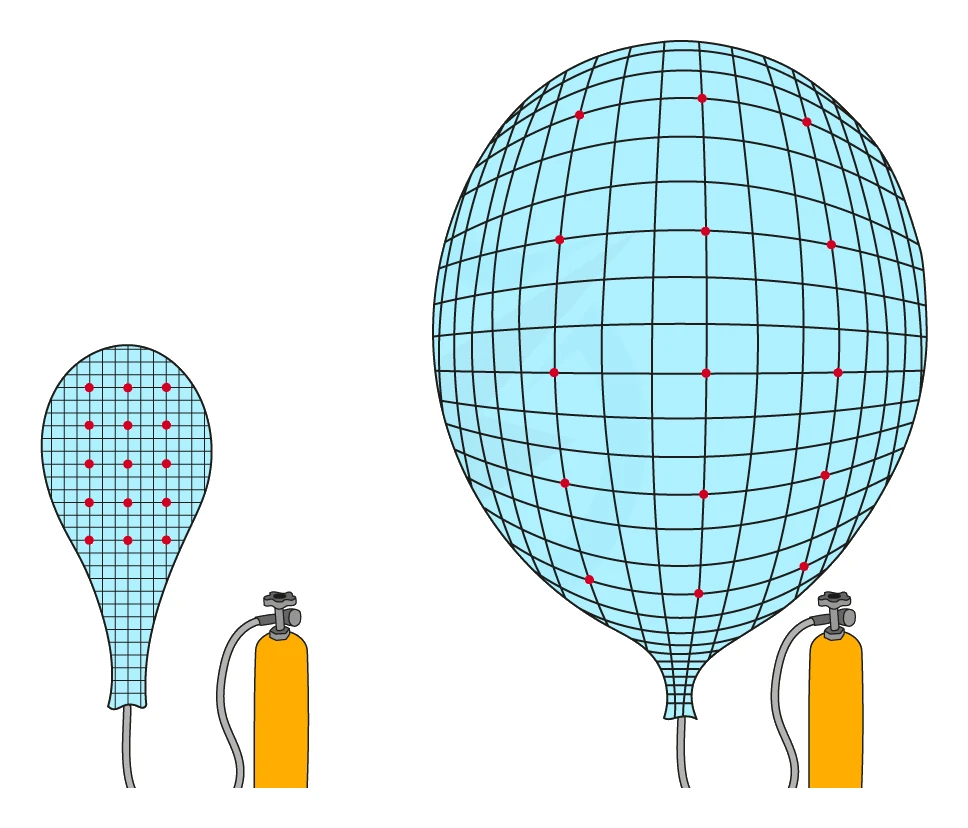
- Imagine drawing dots on a deflated balloon. Each dot represents a galaxy. The rubber of the balloon represents the space between galaxies
- Now blow the balloon up:
- Every dot moves further from every other dot
- The dots are not moving across the rubber, because the rubber itself is stretching
- There is no centre of the expansion on the surface of the balloon. From any dot, all other dots look as if they are moving away
- This is what is happening in the real Universe. Space itself is stretching, carrying galaxies further apart. There is no special centre of the expansion; every galaxy sees every other galaxy receding
- A direct consequence: galaxies become more thinly spread with time, since the same number of galaxies occupy an ever-larger volume of space, so the average galaxies-per-cubic-megaparsec number is dropping
The Universe was very different early on
- Right after the Big Bang, the Universe was a fireball of pure energy and elementary particles at billions of degrees
- As space expanded, it cooled enough for protons and neutrons to form, then for hydrogen and helium atoms to form (a few hundred thousand years later)
- Gravity slowly pulled the gas together into clumps. The denser clumps collapsed into the first stars and galaxies
- The Universe is now far cooler (the average temperature of space is about 2.7 K) and far less dense than it was, but it is still continuing to spread out