Cosmology
Astrophysics
There are two main pieces of evidence that astronomers point to. Both fit the Big Bang theory and neither is well explained by any alternative theory (such as the older Steady State theory, which proposed that the Universe always existed in roughly the same state).
Evidence 1 — Galactic redshift
- Light from distant galaxies is observed to be redshifted, with its wavelength stretched towards the red end of the visible spectrum
- The redshift means the galaxies are moving away from us
- The amount of redshift increases with distance, so distant galaxies are receding faster than nearby ones
- This is exactly what an expanding Universe should look like (covered in detail in sections 4 and 5)
Evidence 2 — Cosmic Microwave Background radiation
- In 1964, two American radio engineers (Penzias and Wilson) discovered a faint signal coming from every direction in the sky at exactly the same intensity
- The signal turned out to be microwave radiation with a temperature of about 2.7 K, the (CMB) radiation:
the CMB is electromagnetic radiation, in the microwave part of the spectrum, coming from every direction in space at almost exactly the same intensity and temperature (≈ 2.7 K)
Why the CMB supports the Big Bang
- According to the Big Bang theory, the very early Universe was extremely hot, and any hot body emits thermal radiation. So a hot early Universe should have produced enormous amounts of high-energy radiation
- As the Universe expanded, that radiation was stretched out along with the expansion of space. Its wavelength has grown over the last 14 billion years, from short, high-energy gamma rays at the beginning, to long, low-energy microwaves today
- The wavelength of the CMB peaks at around 1 mm, squarely in the microwave region, and its overall spectral shape matches the prediction for a once-hot Universe that has been expanding (and therefore stretching its radiation) for ~14 billion years
- The fact that the CMB:
- Fills the entire sky uniformly
- Has exactly the wavelength and spectrum predicted by the Big Bang model
- Is observed to be the same in every direction
...makes it the single most convincing piece of evidence for the Big Bang. Other theories (such as Steady State) cannot account for it
Exam tip
Turning the CMB into an argument for the Big Bang
The one paper to ask for two pieces of evidence (6 marks) capped each at four, so red-shift alone cannot carry it. For the CMB half: name it, say it comes from every direction and is the same in all of them, so all parts of the universe were once in contact (a single point is accepted); the universe was hotter long ago, and the radiation's wavelength has increased as the universe expanded (a fall in frequency also counts). Its two-mark opener, how the universe's size and temperature have changed, wants two ideas: expanded and cooled.
Why the CMB was discovered so late
- The atmosphere absorbs microwaves, so the CMB cannot easily be measured from the ground
- The discovery only became possible once radio astronomy had developed and once space telescopes could be placed above the atmosphere
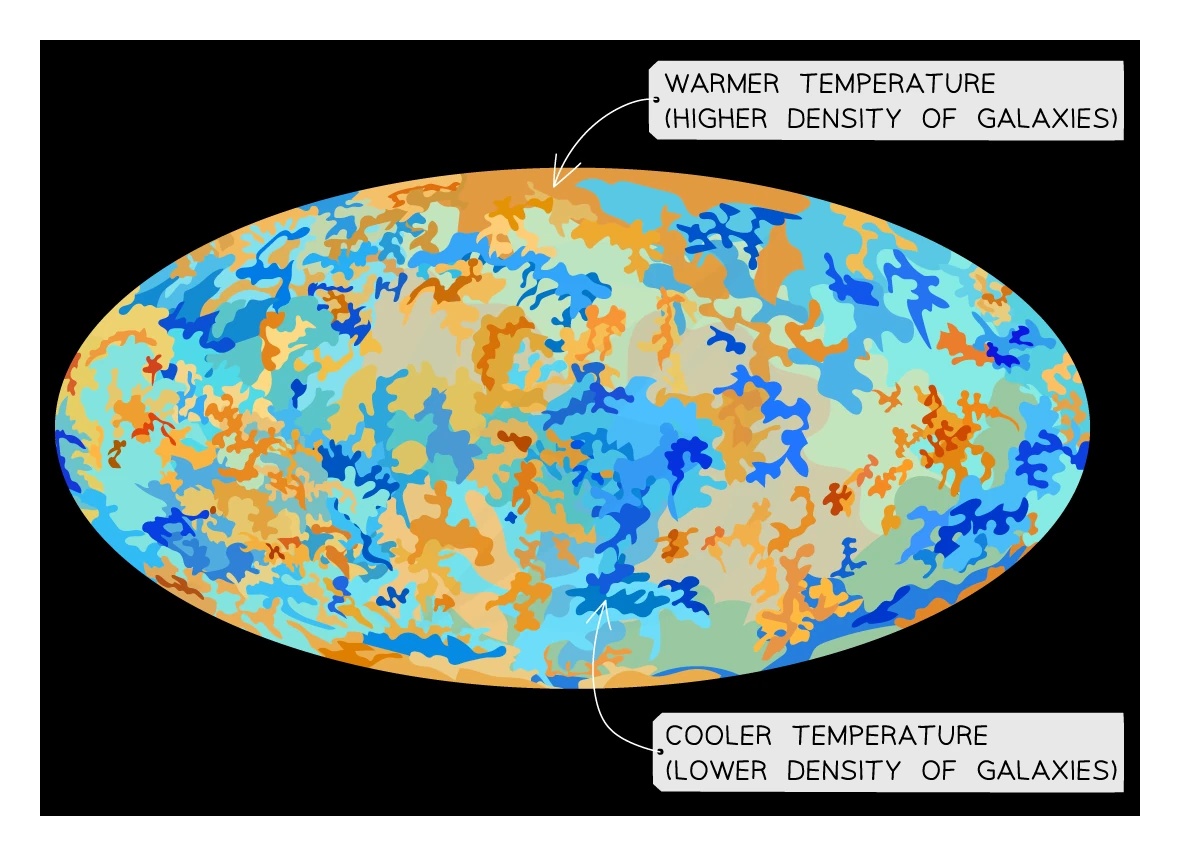
- Detailed maps of the CMB (from satellites like COBE, WMAP and Planck) show that it is extremely uniform, but with tiny temperature ripples of about 1 part in 100 000. These ripples are the seeds of the structures (galaxies, clusters) that grew under gravity into the Universe we see today