Cosmology
Astrophysics
Definition of redshift
- The Doppler effect applies to all waves, including light from stars and galaxies
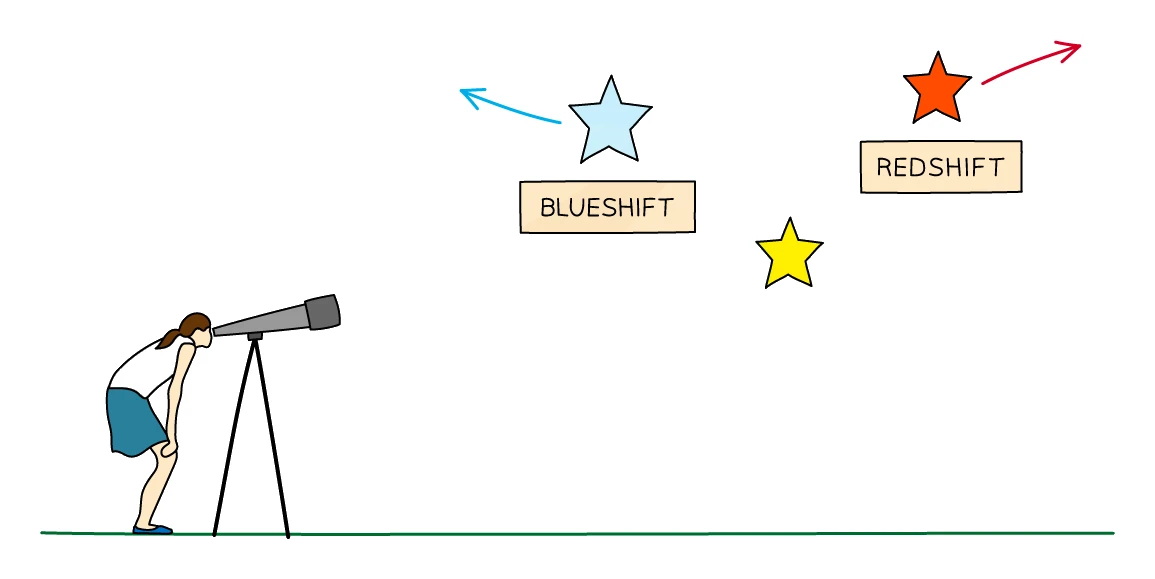
- When a galaxy is moving away from us, the light we receive from it has its wavelength stretched, pulled towards the red end of the visible spectrum:
redshift is the apparent increase in wavelength of light when the source is moving away from the observer
- All distant galaxies show redshift in their spectra; every one of them is moving away from the Earth
Definition of blueshift
- The opposite happens when a source is moving towards us:
blueshift is the apparent decrease in wavelength of light when the source is moving towards the observer
- Light from an approaching source is pushed towards the blue end of the spectrum
- Most galaxies show redshift, but a few nearby galaxies (most famously the Andromeda galaxy) are actually moving towards us, and their light is blueshifted. These local motions are caused by the galaxies' own gravitational attraction to each other, on top of the overall expansion
How to spot redshift in a spectrum
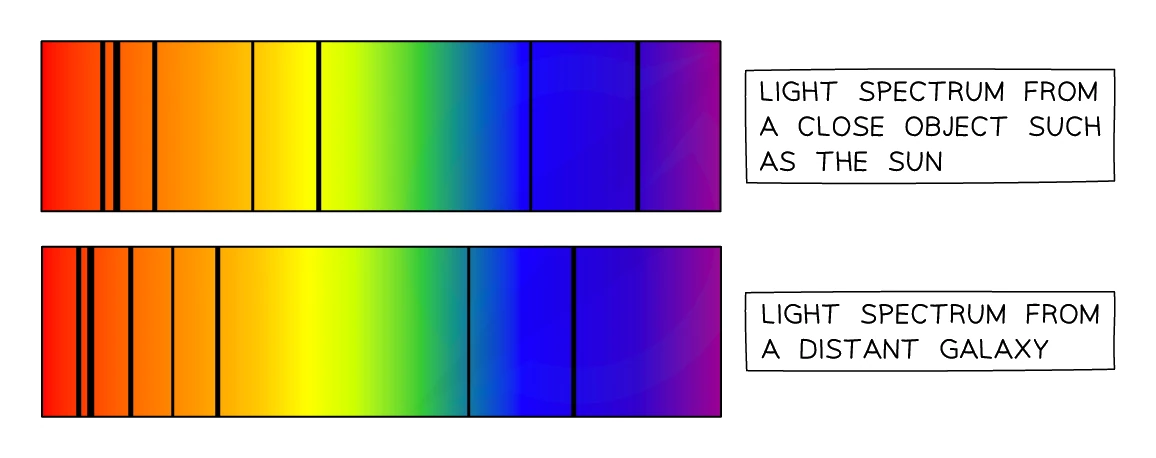
- Every chemical element produces a unique pattern of spectral lines, which are narrow bright lines in an emission spectrum, or narrow dark lines in an absorption spectrum
- The pattern of lines is fixed by the physics of the atom; the position of each line on the wavelength axis can shift if the source is moving
- When astronomers compare the spectrum of a distant galaxy with the same element's spectrum measured in a laboratory:
- The pattern is the same: same number of lines, same spacing
- The whole pattern is shifted towards longer wavelengths for a receding galaxy (redshift)
- The whole pattern is shifted towards shorter wavelengths for an approaching one (blueshift)
Remembering which way is which
- Red light has the longest wavelength and lowest frequency in the visible spectrum
- Blue light has the shorter wavelength and higher frequency
- So moving towards longer wavelength = moving towards the red end = redshift = source moving away
- And moving towards shorter wavelength = moving towards the blue end = blueshift = source moving towards you
- Or use the sound analogy: a motorbike speeding away from you sounds lower-pitched (longer wavelength) than when it is standing still. Same with light from a galaxy moving away: the wavelength is longer, hence redshifted
Exam tip
Defining red-shift and where it is greatest
When asked what red-shift means (2 marks), give both halves: the light's wavelength has increased (a fall in frequency, or a stretched wavelength, also counts) because the source is moving away from the observer (or the observer moving away from the source). The mark is for the wavelength change itself, not for the colour. Red-shift comes from motion along the line of sight, so a star in orbit is most red-shifted at the one point where it moves directly away from Earth: when a paper asked for that position, the cross had to be within a star's radius of it.