Cosmology
Astrophysics
To understand galactic redshift, you first need the Doppler effect, which is the apparent change in the wavelength (and frequency) of a wave when its source is moving relative to the observer.
What the Doppler effect is
- Imagine a stationary source emitting waves. The waves spread out in a series of evenly spaced spherical wavefronts in every direction
- Now make the source move. The wavefronts are still produced at the same rate, but the source is catching up with the wavefronts ahead of it and moving away from the wavefronts behind it
- In front of the moving source:
- The wavefronts are bunched closer together
- The wavelength is shorter (λ − Δλ)
- The frequency is higher
- Behind the moving source:
- The wavefronts are stretched apart
- The wavelength is longer (λ + Δλ)
- The frequency is lower
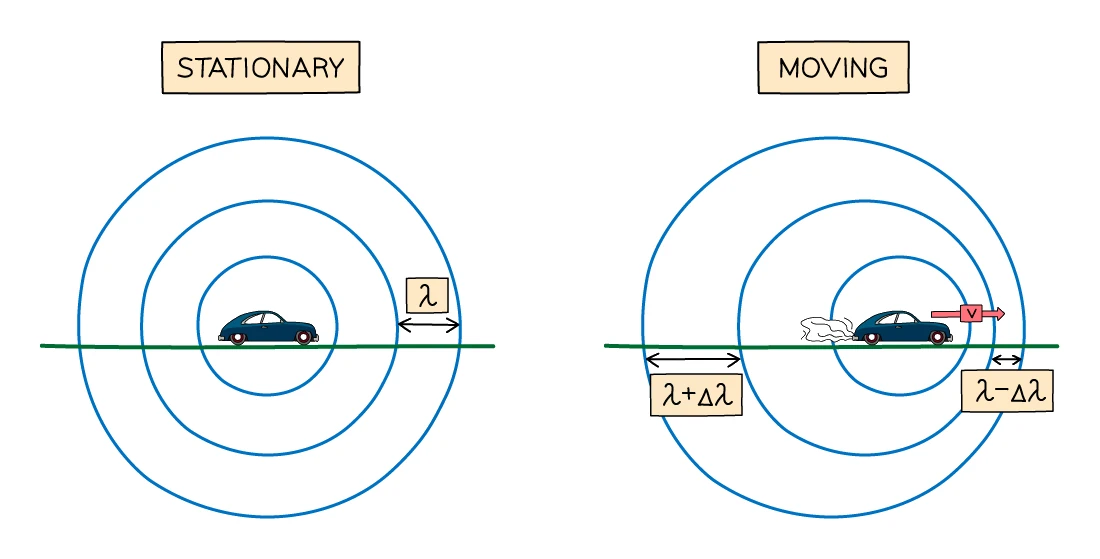
An everyday example: ambulance sirens
- An ambulance siren has a higher pitch when the ambulance is coming towards you (wavelengths bunched up in front, higher frequency, higher pitch)
- The pitch then suddenly drops as the ambulance passes and starts moving away (wavelengths stretched behind, lower frequency, lower pitch)
- The change in pitch is obvious to the ear. Light waves do exactly the same thing, but the change is invisible to your eyes; you need a spectrometer to detect it
The Doppler equation for light
- The fractional change in wavelength is equal to the speed of the source divided by the speed of light:
Δλ / λ₀ = v / c
- Where:
- λ₀ = the reference wavelength, the wavelength the source would emit if it were not moving (often measured in a laboratory on Earth)
- λ = the observed wavelength, what arrives at your detector
- Δλ = λ − λ₀, the change in wavelength
- v = the speed of the source away from (or towards) the observer (m/s). Positive for moving away (redshift), negative for moving towards (blueshift)
- c = the speed of light = 3 × 10⁸ m/s
- Both sides of the equation are dimensionless, since it is wavelength divided by wavelength, speed divided by speed. So the Doppler shift itself has no units
- Rearranging for v:
v = c × (λ − λ₀) / λ₀
Common exam question
Calculating a galaxy's speed from its red-shift
Question: Calculate the speed of a galaxy from its emitted and observed wavelengths, given the speed of light (3–4 marks).
Set in 4 of the 24 papers. Usually one mark each for the change in wavelength, the substitution into Δλ/λ₀ = v/c, the rearrangement and the evaluation; one scheme fully credited a correct answer with no working, and a wrong Δλ carried through correctly still earns the later marks when your working shows it.
The λ₀ you divide by is the reference (laboratory) wavelength, never the observed one: using the observed value cost a mark in two papers and left only one mark in a third. A power-of-ten slip costs one mark. The wavelengths can stay in nm, but the answer takes the units of the speed of light you are given: one paper gave c in km/s, made you read Δλ off a line of best fit on a graph against distance, and wanted the velocity in km/s.
Worked example
Recession speed from a Doppler-shifted spectral line
A particular spectral line is emitted at a rest wavelength of 500 nm in a laboratory on Earth. The same line observed in a distant galaxy has a wavelength of 512 nm. Calculate the recession speed of the galaxy.
Solution:
- Δλ = 512 − 500 = 12 nm
- λ₀ = 500 nm, the reference wavelength (not the observed 512 nm)
- Δλ / λ₀ = v / c, so v = c × Δλ / λ₀
- Both wavelengths are in nm, so the ratio is simply 12 / 500 = 0.024
- v = 3.0 × 10⁸ × 0.024 = 7.2 × 10⁶ m/s