Crude Oil
Organic Chemistry · 1 question type
Why cracking is needed
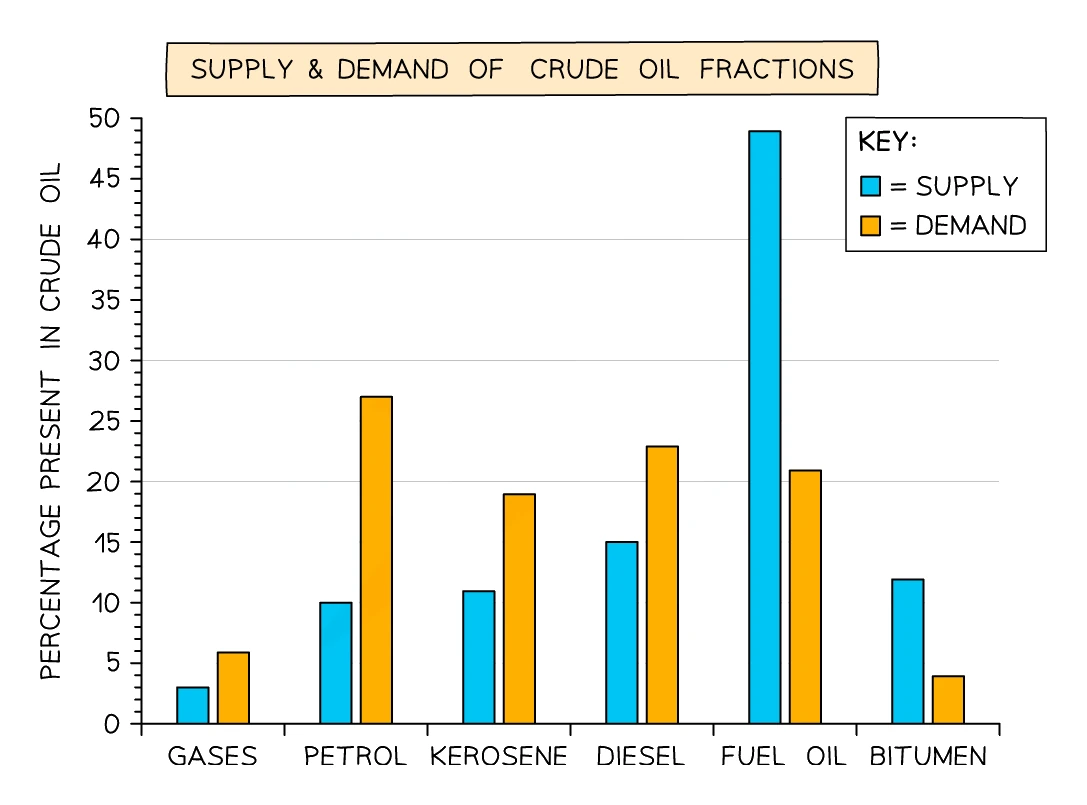
- The fractions from crude oil do not match consumer demand
- Demand is highest for short-chain fractions — petrol, kerosene, diesel — because these are the easiest fuels to burn in vehicles
- Supply from raw crude is heaviest in long-chain fractions — fuel oil, bitumen — which have fewer high-value uses
- balances this imbalance by breaking long-chain hydrocarbons down into shorter, more useful ones
What cracking is
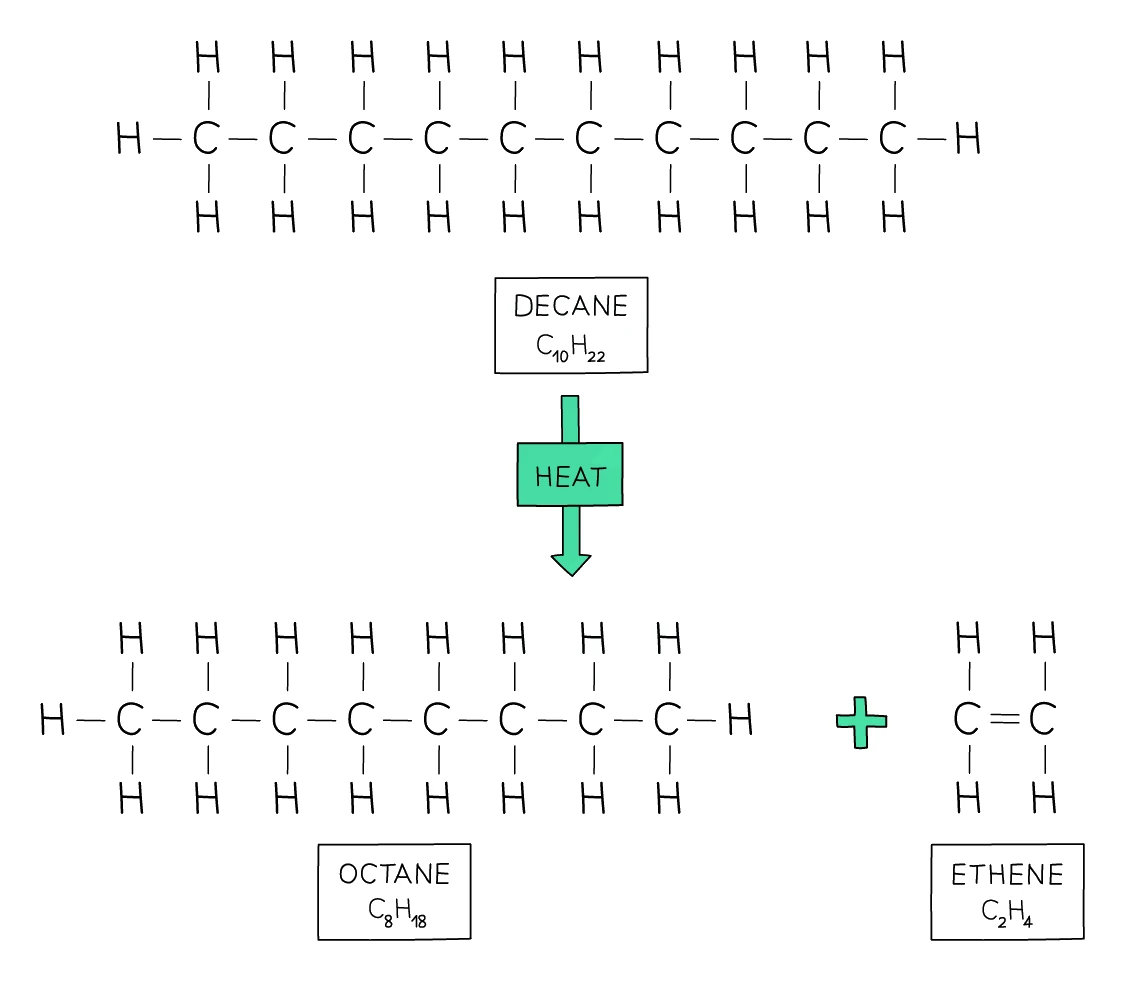
- Cracking is the breaking of long-chain alkanes into smaller hydrocarbon molecules
- Every cracking reaction produces:
- A shorter-chain alkane (still saturated, useful as fuel)
- One or more alkenes (unsaturated, useful as feedstock for plastics, alcohols, detergents)
- The process is endothermic — energy has to be put in to break the C–C single bonds in the long chain
Conditions for catalytic cracking
- The long-chain alkane vapour is heated to about 600–700 °C
- The hot vapour passes over a hot powdered catalyst, usually aluminium oxide (Al2O3) or zeolite
- Some C–C bonds break at random points along the chain; the resulting fragments leave as a blend of shorter alkanes plus one or more alkene molecules
Uses of the alkene products
- Ethene is polymerised industrially to make poly(ethene) — the plastic used in carrier bags, drink bottles and pipes
- Ethene also reacts with water to make ethanol for industrial solvent use
- Propene from cracking is polymerised to poly(propene), used in food containers and ropes
Alkanes versus alkenes — a useful contrast
- Alkanes are saturated — every carbon–carbon bond is a single bond
- Alkenes are unsaturated — they have at least one carbon–carbon double bond (C=C)
- The alkene's C=C double bond is the functional group that makes it useful for further reactions, including polymerisation (see topic 24 Alkenes)
Explaining why cracking is necessary and what it involves
What comes up: A multi-mark question asking you to explain why cracking is needed and to give its conditions and products.
Write: For why it is needed: crude oil produces more long-chain hydrocarbons than can be used directly, while short-chain hydrocarbons are in higher demand as fuels. Cracking converts long-chain hydrocarbons into short-chain alkanes (which are more flammable and useful as fuels) and alkenes (which are used to make polymers/plastics). For conditions: the long-chain vapour is heated to 600–700 °C and passed over a catalyst of aluminium oxide or silica (also accepts zeolites).
Watch out: The mark scheme accepts "aluminium oxide/Al₂O₃", "silicon dioxide/SiO₂", "silica/alumina", and "zeolites" for the catalyst — any of these gains credit. For the alkene products, just stating "alkenes" is credited; naming a specific alkene such as ethene is acceptable but not required. The mark that alkenes are used to make polymers depends on correctly identifying alkenes first.