Alkenes
Organic Chemistry
The Alkenes
What an alkene is
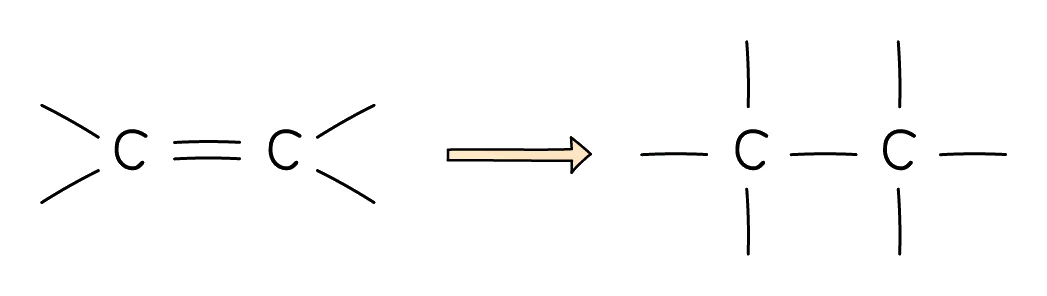
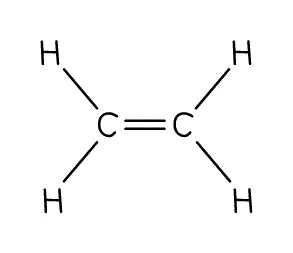
- Alkenes are a family of hydrocarbons that contain at least one , written as C=C and drawn as two parallel lines between two adjacent carbons
- The C=C double bond is the alkenes' functional group — the feature that fixes their chemistry and tells them apart from alkanes
- A molecule with a C=C double bond is described as unsaturated: the two carbons of the double bond are not joined to as many hydrogens as they possibly could be. Open the double bond and each carbon could accept one extra atom
General formula
- The general formula of the alkene series (with one C=C double bond) is:
CnH2n
- where n is the number of carbon atoms (n ≥ 2; methene does not exist because one carbon cannot form a double bond with itself)
- Compare with alkanes (CnH2n+2): an alkene has two fewer hydrogen atoms than its alkane of the same chain length, because two of the bonds that would have held hydrogens now sit between the two C=C carbons
State or use the general formula of alkenes
What comes up: questions ask you to state the general formula of the alkene series, or to use it to find the molecular formula of a named alkene.
Write: the general formula is CₙH₂ₙ (where n is the number of carbon atoms). Substitute n to find any member: ethene n = 2 gives C₂H₄, propene n = 3 gives C₃H₆, and so on.
Watch out: the mark scheme also accepts the statement "there are twice as many hydrogen atoms as carbon atoms in every alkene" as an equivalent answer. Do not confuse with the alkane formula CₙH₂ₙ₊₂, which has two extra hydrogens.
The first four alkenes
The smallest four members of the series are the ones tested most often:
| n | Name | Molecular formula | State at room temperature |
|---|---|---|---|
| 2 | Ethene | C2H4 | Gas |
| 3 | Propene | C3H6 | Gas |
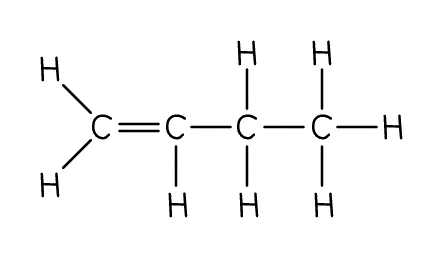
| 4 | Butene | C4H8 | Gas |
| 5 | Pentene | C5H10 | Liquid |
The naming pattern is the same as the alkanes (eth-, prop-, but-, pent- for the carbon count) but the ending changes to -ene to signal the presence of a C=C double bond.
Naming alkenes with the C=C position
- For ethene and propene the C=C can only sit in one place, so no number is needed
- From butene onward, the position of the C=C must be shown with a number — counting from whichever end gives the lowest possible number
- But-1-ene: C=C between carbons 1 and 2 (CH2=CH−CH2−CH3)
- But-2-ene: C=C between carbons 2 and 3 (CH3−CH=CH−CH3)
- A 5-carbon chain therefore gives two main alkenes — pent-1-ene and pent-2-ene — depending on where the double bond sits
Why alkenes are reactive
- The C=C double bond can break open: one of the two bonds between the carbons breaks, leaving a single bond between them and two spare bonds (one on each carbon) free to accept incoming atoms
- Each carbon now ends with four single bonds, which is the most stable arrangement for carbon
- This is why alkenes undergo (section 2) so readily, while alkanes — with all single bonds already in place — do not