Introduction to Organic Chemistry
Organic Chemistry
Organic Compounds and How We Represent Them
What organic chemistry is
- Organic chemistry is the chemistry of compounds containing the element carbon
- By long-standing convention, a handful of carbon-containing substances are treated as inorganic and not studied as part of organic chemistry: carbon monoxide (CO), carbon dioxide (CO2) and the metal carbonates (e.g. CaCO3)
- Carbon is uniquely able to form four covalent bonds and to chain with itself, which is why organic compounds span tens of millions of known molecules — from methane to DNA
Hydrocarbons
- A hydrocarbon is an organic compound that contains only hydrogen and carbon atoms — no other element
- Methane (CH4), ethane (C2H6), petrol (a mixture of C5–C10 alkanes) and natural rubber are all hydrocarbons
- An alcohol such as ethanol (C2H5OH) is an organic compound but not a hydrocarbon because it contains an oxygen atom
Common exam question
Explaining why a compound is or is not a hydrocarbon
Question: State what is meant by a hydrocarbon, explain why a named compound is not one, or explain why an alkene is described as an unsaturated hydrocarbon (1–3 marks).
Asked in 6 of the 23 papers. A hydrocarbon is a compound of carbon and hydrogen atoms, and it contains those two elements only. When the question asks what the term means, or why an alkene is an unsaturated hydrocarbon, those are two separate marks, and "only" (or "no other elements") scores only once you have named carbon and hydrogen; in the two-mark "why is it not a hydrocarbon" version the whole definition is one mark and "it contains oxygen" is the other. Say "atoms": "carbon and hydrogen molecules" is rejected, and so is calling a hydrocarbon an element.
To explain why a compound is not one, add the point that it contains oxygen as well (or whatever extra element its formula shows). For an unsaturated hydrocarbon the third mark is the carbon–carbon double bond; give the definition marks too, because the question is worth three.
Five ways to write the same molecule
- The same organic molecule can be drawn in several different forms; each form throws away or keeps different amounts of detail. Using ethanol as the running example:
| Type of formula | What it shows | Ethanol |
|---|---|---|
| Empirical formula | Simplest whole-number ratio of atoms | C2H6O |
| Molecular formula | Actual number of each kind of atom in one molecule | C2H6O |
| General formula | Pattern for the whole homologous series | CnH2n+1OH (n = 1, 2, 3 …) |
| Structural formula | Carbon-by-carbon backbone with key bonds shown | CH3CH2OH |
| Displayed (graphical) formula | Every atom and every bond drawn out, in 2-D | see figure below |
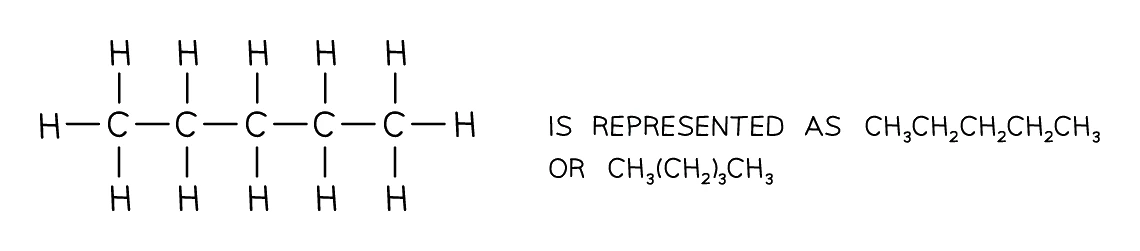
- The displayed formula spells out every atom and bond, while the structural formula condenses the same molecule onto one line. Pentane, for example, can be drawn in full or written as CH3CH2CH2CH2CH3 (or CH3(CH2)3CH3):
Common exam question
Giving the molecular, empirical or structural formula
Question: Give the molecular formula and the empirical formula of a compound from its displayed or structural formula, or pick out which type of formula is shown (1 mark each).
Asked in 12 of the 23 papers. Count every atom for the molecular formula, then divide by the highest common factor for the empirical formula: C₄H₆ becomes C₂H₃, while C₃H₈ is the same in both because 3 and 8 share no factor. If asked what "empirical formula" means, say it is the simplest whole-number ratio of the atoms and show it on the compound given.
Keep the types apart: CH₃CH₂OH is a structural formula, and as a molecular formula ethanol is C₂H₆O (one scheme rejected C₂H₅OH there). Every alkene with one C=C (the CₙH₂ₙ series) has the empirical formula CH₂, because it has twice as many hydrogens as carbons, whereas CₙH₂ₙ₊₂ cannot be divided through by n, so each alkane has its own: C₂H₆ gives CH₃ and C₄H₁₀ gives C₂H₅.
Exam tip
A displayed formula shows every atom and every bond
When a question says "displayed formula", draw the molecule out in full: every atom as its symbol and every bond as a line, including the bond between the O and the H of an alcohol or a carboxylic acid. Every scheme that asked for an alcohol's or an acid's displayed formula (four of them) refused a bare –OH written as a group, and the scheme for the isomers of butane rejected a structure with part of it written as a formula rather than drawn. A structural formula is the opposite habit: condensed onto one line, such as CH₃CH₂OH or CH₂=CHCH₃, with only a double bond written in.
Homologous series
- A homologous series is a family of organic compounds that all share the same and a common general formula
- Members of a homologous series:
- Share the same
- Carry the same functional group, so they react in the same chemical way
- Show a steady gradation in physical properties (boiling point, density, viscosity) as the chain length grows
- Differ from one neighbour to the next by a single CH2 unit
Common exam question
Giving the characteristics of a homologous series
Question: Give two characteristics (or properties) of a homologous series (2 marks).
Asked in 3 of the 23 papers, always as any two from the same list: same general formula, same functional group, neighbouring members differ by one CH₂ unit, similar chemical properties (they undergo the same reactions), and a trend in physical properties such as boiling point. Any two score, so pick the two you can word exactly.
The wording that fails is "same" or "similar" physical properties: physical properties change steadily along the series, and two schemes reject that phrase. "Similar reactivity" was not accepted for the chemical-properties mark either. One question gave "same general formula" in the stem and asked for two others, so read the stem before you write, and naming a particular series instead of describing the family is ignored.
Functional groups
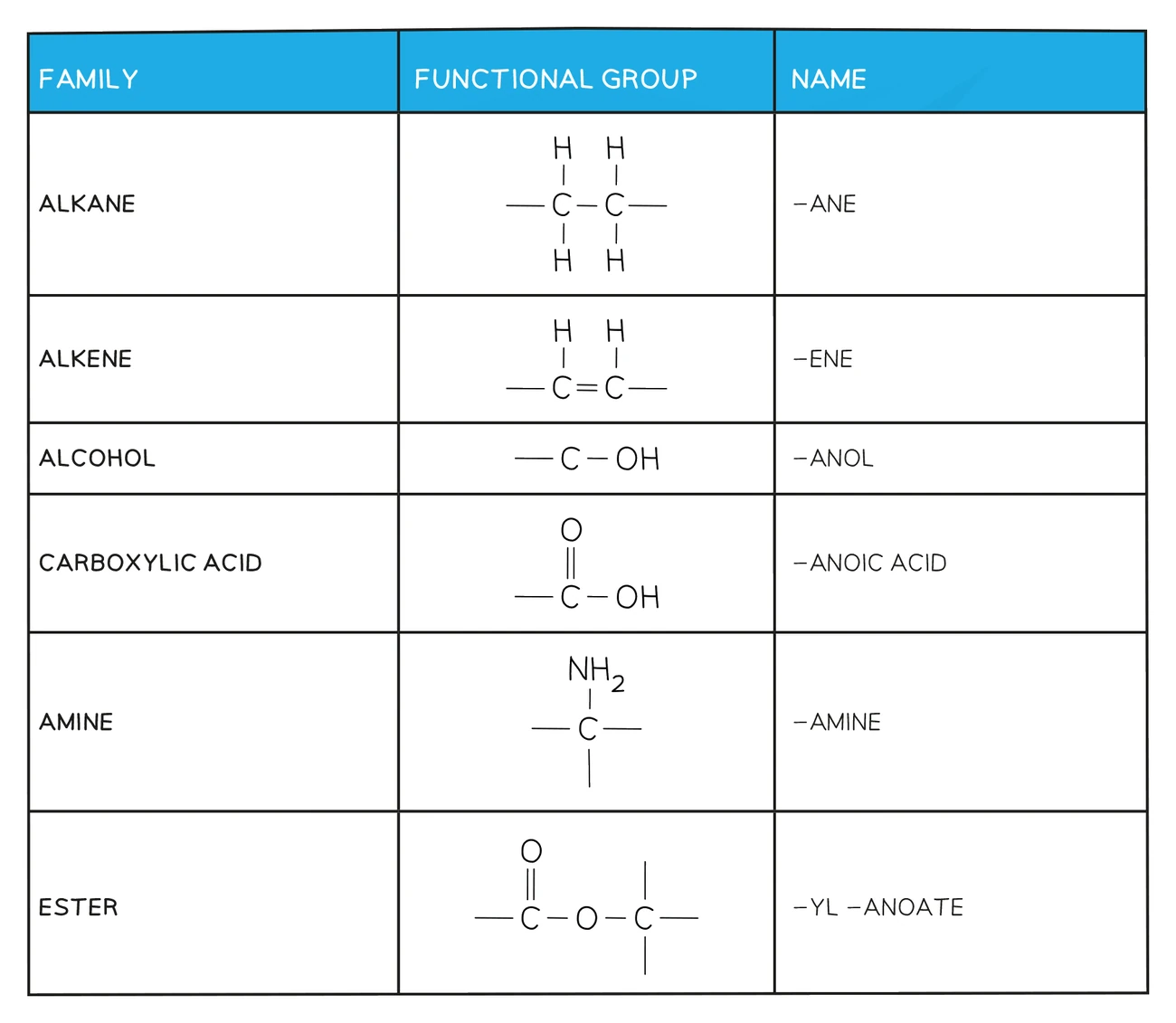
- A functional group is a particular arrangement of atoms within a molecule that gives it its characteristic chemistry
- Two molecules in the same homologous series react in the same way precisely because they share the same functional group
Isomers
- Isomers are different compounds that share the same but whose atoms are joined together differently — they therefore have different structural (and often different displayed) formulae
- Isomers can have similar physical and chemical properties if they are in the same homologous series, or quite different properties if their atoms are arranged into different functional groups
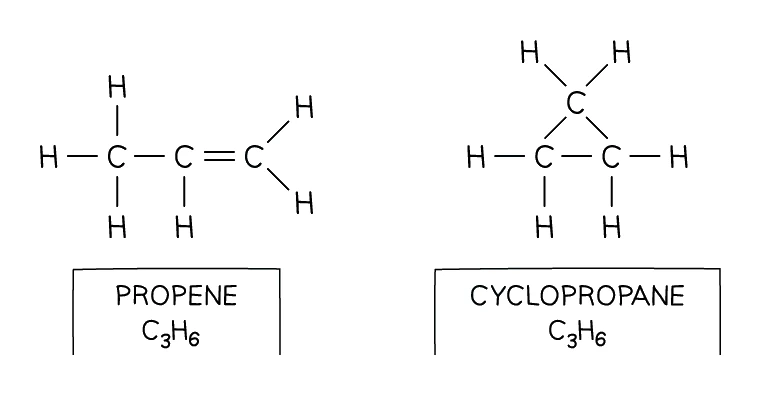
- A clean example: the molecular formula C3H6 describes two unrelated compounds
- Propene: a straight-chain alkene with a C=C double bond — CH2=CH−CH3
- Cyclopropane: a closed three-carbon ring of single bonds — no C=C double bond, no functional group
- Propene reacts with bromine water and decolourises it (because of its C=C); cyclopropane does not. Same molecular formula, very different chemistry
Common exam question
Defining isomers
Question: State the meaning of the term isomers, or explain why two given compounds are isomers (2 marks).
Asked in 7 of the 23 papers, so learn the two marks word for word: isomers are compounds with the same molecular formula but different structural (or displayed) formulae. "The same number of atoms of each element" earns the first mark and "a different arrangement of atoms" the second, and one scheme marks the two independently, so a correct second half still scores if the first is wrong.
The first mark is where answers fail. "The same empirical formula" or "the same general formula" is not credited (every alkene shares CH₂ and CₙH₂ₙ without being an isomer of the others), "the same chemical formula" is rejected as too vague, and isomers are compounds, not elements.
Common exam question
Drawing the isomers of a molecular formula
Question: Draw the displayed formulae of the two isomers of C₄H₁₀, of the other two isomers of C₅H₁₂, or of other alkene isomers of C₄H₈ (1–2 marks).
Set in 5 of the 23 papers, one mark per correct isomer. Start from the straight chain, then shorten it and attach the spare carbons as branches: C₄H₁₀ is butane and methylpropane (three carbons in a row with a CH₃ on the middle one), and C₅H₁₂ adds methylbutane and dimethylpropane (a central carbon carrying four CH₃ groups) to pentane. Draw every bond and check that each carbon has four.
For alkene isomers, either move the double bond along the chain (but-1-ene to but-2-ene) or branch the chain (methylpropene). But-2-ene drawn with its two CH₃ groups on the same side of the C=C, and drawn with them on opposite sides, both scored, but a ring such as cyclobutane was rejected because the question asked for alkenes.