Alcohols
Organic Chemistry
The Alcohols
What an alcohol is
- Alcohols are a homologous series of organic compounds that contain the hydroxyl functional group, −OH
- The hydroxyl group is what fixes the chemistry of every alcohol — it can be oxidised, react with carboxylic acids to form esters, and is responsible for the alcohol being a polar molecule that dissolves in water
- The short alcohols are colourless liquids at room temperature; they mix fully with water and the resulting solution is neutral on the pH scale
- Methanol, ethanol, propanol and butanol — the first four members of the series — are all used either as fuels or as solvents
- General formula of the alcohol homologous series:
CnH2n+1OH
- The naming rule is the standard stem-plus-ending convention from topic 21: replace the final "-e" of the parent alkane with "-ol"
- meth-an-e + -ol → methanol
- eth-an-e + -ol → ethanol
- prop-an-e + -ol → propanol (numbered as propan-1-ol or propan-2-ol when the position of −OH matters)
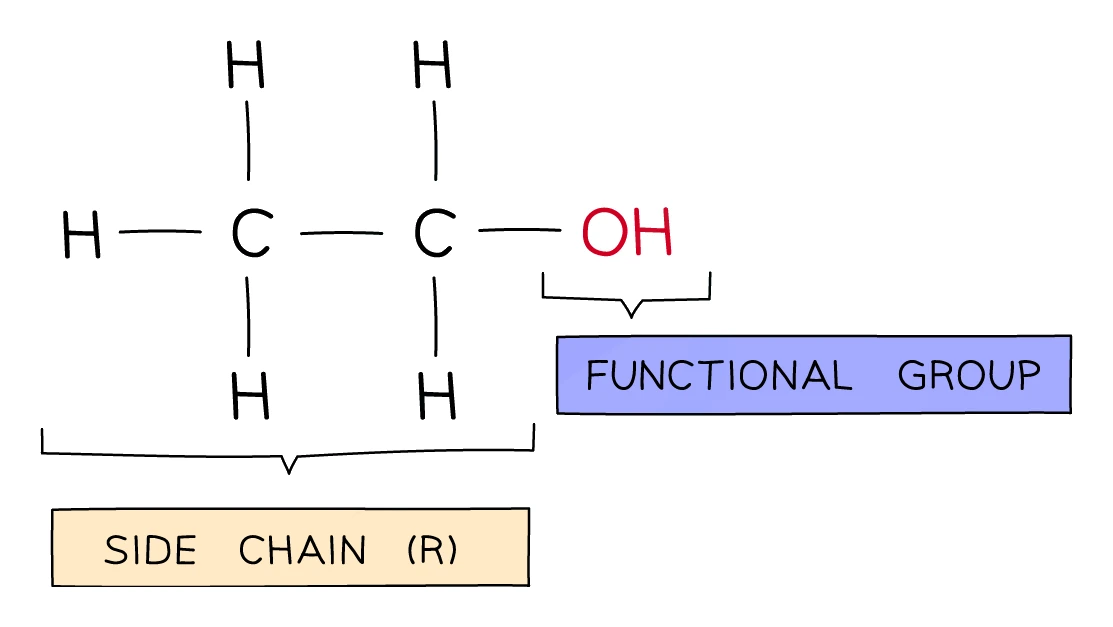
The first four alcohols
The members of the series most commonly tested:
| n | Name | Formula | State at room temperature |
|---|---|---|---|
| 1 | Methanol | CH3OH | Liquid |
| 2 | Ethanol | C2H5OH | Liquid |
| 3 | Propan-1-ol | C3H7OH | Liquid |
| 4 | Butan-1-ol | C4H9OH | Liquid |
All four are liquids at room temperature, unlike the smaller alkanes which are gases. The extra −OH group lets each molecule form with its neighbours, which raises the boiling point well above the equivalent-length alkane.
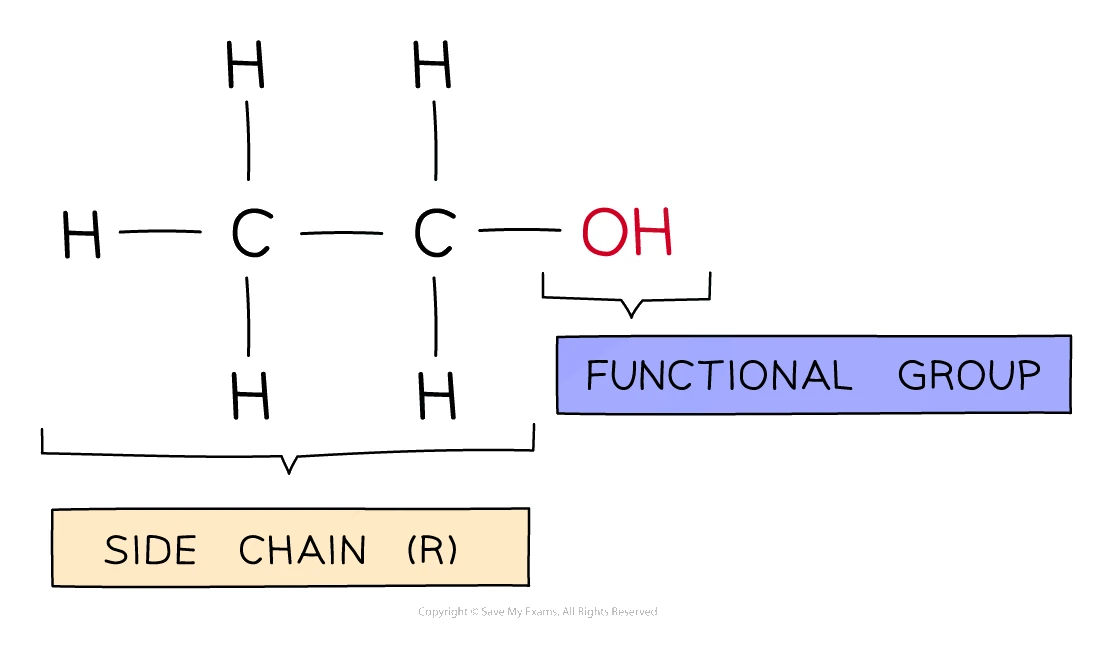
Exam tip
Which formula of ethanol a question wants
The table above writes each alcohol with its −OH group shown, the way equations do. A question that asks for the molecular formula wants the atoms counted instead: ethanol is C₂H₆O, and when a paper asked for it the scheme rejected C₂H₅OH. CH₃CH₂OH is a structural formula, which is the answer when a multiple-choice question asks what kind of formula it is; a displayed formula is the one that draws every bond.
Position of the −OH on longer alcohols
- For propanol and onwards, the hydroxyl group can sit on different carbons in the chain; a number between the stem and the "-ol" shows which carbon
- Propan-1-ol has the −OH on carbon 1 (the end of the chain): CH3CH2CH2OH
- Propan-2-ol has the −OH on carbon 2 (the middle): CH3CH(OH)CH3
- In exam answers, "propanol" and "butanol" without a number always mean the propan-1-ol and butan-1-ol isomers
Common exam question
Naming an alcohol and drawing its displayed formula
Question: Name the alcohol whose structural or displayed formula is shown, or draw the displayed formula of propanol (1 mark each).
Asked in 3 of the 23 papers, and the alcohol was propanol each time. When the formula puts the OH on an end carbon, as in CH₃CH₂CH₂OH, the name is propan-1-ol; plain "propanol" is accepted, but "propan-2-ol" is rejected because that would put the OH on the middle carbon.
For the drawing, the mark depends on the bond between O and H being drawn: a chain that ends in an "–OH" written as a group scores nothing. When the question says only "propanol", a correct drawing of either isomer is accepted.