Alcohols
Organic Chemistry
Ethanol is made on an industrial scale by two completely different routes; one is fast and continuous, the other slow and batch-based. Both are important in different parts of the world.
Route A — Hydration of ethene
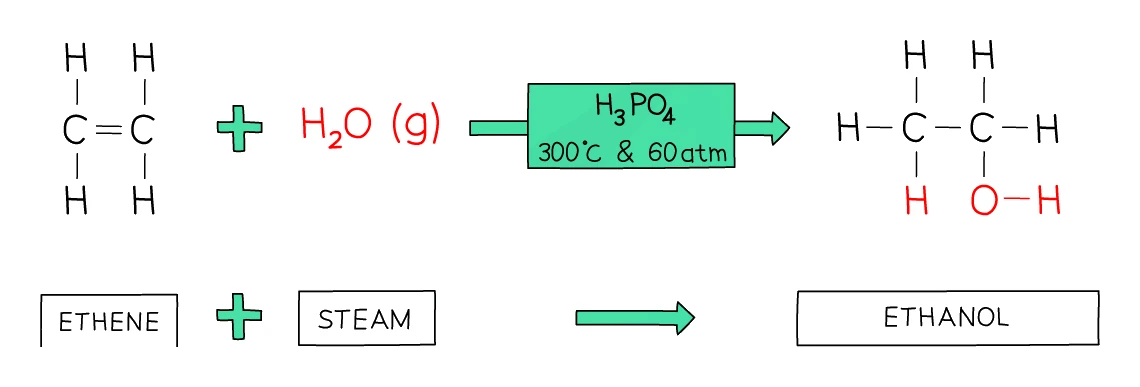
- Ethene from cracking is reacted with water (as steam) in the presence of a catalyst:
C2H4(g) + H2O(g) → C2H5OH(g)
- An addition reaction across the C=C: H and OH from a water molecule attach to the two carbons of the double bond, leaving an ethanol molecule
- Conditions:
- Temperature about 300 °C
- Pressure about 60–70 atm
- Catalyst: concentrated phosphoric acid, H3PO4
- The reaction does not finish in a single pass: the gas mixture leaving the reactor still contains some ethene along with the ethanol and the water. The unreacted ethene condenses at a much lower temperature (boiling point −104 °C) than the other two and is separated off and pumped back into the reactor; the ethanol-and-water mixture is then split by fractional distillation
- Hydration is a continuous industrial process — feedstock flows in, products flow out, around the clock
- The route depends on having a cheap supply of ethene from cracking oil, so it dominates ethanol manufacture in oil-rich countries
Route B — Fermentation of sugar
- Glucose or sucrose (in fruit juice, sugar-cane syrup or molasses) is dissolved in water with and left to react in the absence of air:
C6H12O6(aq) → 2 C2H5OH(aq) + 2 CO2(g)
- The yeast contains enzymes that catalyse the breakdown of glucose into ethanol and carbon dioxide
- Conditions:
- Temperature kept at about 25–35 °C (optimum near 30 °C)
- Below 25 °C the enzymes work too slowly
- Above 35 °C the enzymes start to (lose their shape and stop functioning)
- No oxygen — fermentation is an anaerobic process. If air is allowed in, Acetobacter would oxidise the ethanol back to vinegar (see section 2 part b)
- Temperature kept at about 25–35 °C (optimum near 30 °C)
- The yeast keeps fermenting until the ethanol concentration reaches around 14–15%, at which point the alcohol kills the yeast and the reaction stops
- The fermented mixture is then fractionally distilled to give purer ethanol (up to about 96%)
- Fermentation is a batch process — each fermenter is filled, run, drained and refilled separately
- The route depends only on plant material (a renewable source), so it dominates ethanol manufacture in countries with large agricultural surpluses such as Brazil
Conditions for fermentation
What comes up: "State two conditions needed for fermentation" (the absence of air is often given for you in the question stem, so you must name the other two).
Write (two marks): (1) a temperature of approximately 30 °C (the mark scheme accepts any value from 20 °C to 40 °C inclusive); (2) yeast (the mark scheme accepts "zymase" as an alternative name for the enzyme).
Watch out: simply writing "anaerobic" or "no oxygen" scores nothing when absence of air is already stated in the question — the examiner explicitly ignores those answers in that context. "Room temperature" is also ignored; you must give a numerical value or the 20–40 °C range.
Why fermentation must be anaerobic
What comes up: "Explain why fermentation needs to be carried out in the absence of air" (2 marks — needs a linked explanation, not just a fact).
Write (two marks): (M1) oxygen in the air would react with (oxidise) the ethanol; (M2) converting it into ethanoic acid (the mark scheme also accepts "carboxylic acid" or "vinegar"). Alternatively: (M1) the fermentation process is anaerobic; (M2) so without excluding air, only carbon dioxide and water would form instead of ethanol.
Watch out: stating only that "air would spoil the fermentation" without naming the specific product (ethanoic acid) drops the second mark.
Comparison
| Feature | Hydration of ethene | Fermentation of sugar |
|---|---|---|
| Raw material | Ethene from cracking crude oil (non-renewable) | Glucose from plants (renewable) |
| Mode | Continuous, fast | Batch, slow (takes days) |
| Conditions | 300 °C, 60–70 atm, H3PO4 catalyst | 25–35 °C, yeast enzymes, no oxygen |
| Energy cost | High (heating, compressing) | Low |
| Purity of product | Very high after a single fractional distillation | Limited by enzyme denaturing; mixture is dilute and needs more separation work |
| Sustainability | Dependent on finite oil reserves | Renewable as long as crops can be grown |
Advantage and disadvantage of fermentation over hydration
What comes up: "Give one advantage and one disadvantage of using fermentation rather than hydration to produce ethanol" (4 marks — each point needs a reason to earn both marks).
Write (four marks): Advantage: (M1) the raw material, glucose from plants, is renewable; (M2) whereas ethene is obtained from crude oil, which is a finite (non-renewable) resource. Disadvantage: (M3) fermentation is slower than hydration (or: fermentation is a batch process whereas hydration is continuous); (M4) so hydration is more efficient (or: the ethanol produced by fermentation is impure and requires further purification).
Watch out: just writing "cheaper" or "less costly" without linking to the reason (lower temperature/pressure) is ignored by the mark scheme. Similarly, a reference to yield alone ("higher yield") is explicitly ignored — you must link the point to a named difference (speed, purity, or raw-material sustainability) and give the consequence for the second mark.