Carboxylic Acids
Organic Chemistry
What a carboxylic acid is
- Carboxylic acids are a homologous series of organic compounds containing the carboxyl functional group, −COOH
- The carboxyl group is what makes these compounds acidic — it is the proton-donor end of the molecule (compare with acids in topic 16)
- Common examples include vinegar (an aqueous solution of ethanoic acid, about 5% by volume), the methanoic acid in nettle stings, and the long-chain fatty acids that make up animal and plant fats
The carboxyl group up close
- The −COOH group consists of:
- A central carbon
- A C=O double bond to one oxygen
- A single bond to a separate O−H group
- The whole group is written as −COOH for short, or drawn out as −C(=O)−O−H when every bond is shown
- The hydrogen of the O−H is the acidic hydrogen — it is the proton released into solution that gives a carboxylic acid its acid character
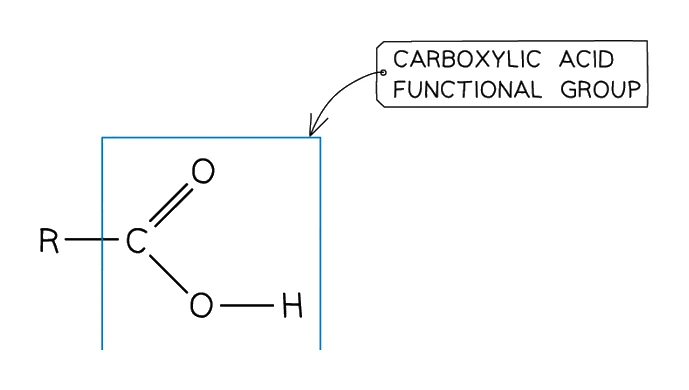
General formula
- The general formula of the carboxylic acid series is:
CnH2n+1COOH
- where n counts only the carbons sitting in the alkyl chain bonded to the −COOH group — it does not count the carbon already inside the carboxyl group itself
- A molecule with n alkyl carbons therefore has (n + 1) carbon atoms in total, including the one in the −COOH
- Special case: when n = 0, the alkyl chain is just a single hydrogen atom and the formula reduces to HCOOH (methanoic acid). This is the smallest member of the series
Naming carboxylic acids
- The name follows the standard stem-plus-ending convention from topic 21, with the ending "-anoic acid":
- 1 carbon → methan- + oic acid →
- 2 carbons → ethan- + oic acid →
- 3 carbons → propan- + oic acid → propanoic acid
- 4 carbons → butan- + oic acid → butanoic acid
The first four carboxylic acids
The four shortest members of the series, all liquids at room temperature with sharp, vinegar-like smells:
| n | Name | Molecular formula | Found in |
|---|---|---|---|
| 1 | Methanoic acid | HCOOH | Ant and bee stings |
| 2 | Ethanoic acid | CH3COOH | Vinegar |
| 3 | Propanoic acid | C2H5COOH | Used as a food preservative |
| 4 | Butanoic acid | C3H7COOH | Rancid butter |
Every formula in this table contains the −COOH group. That group is what gives the molecules their acidic behaviour: in water the O–H end releases a hydrogen ion (H+), leaving a negatively-charged carboxylate ion behind.
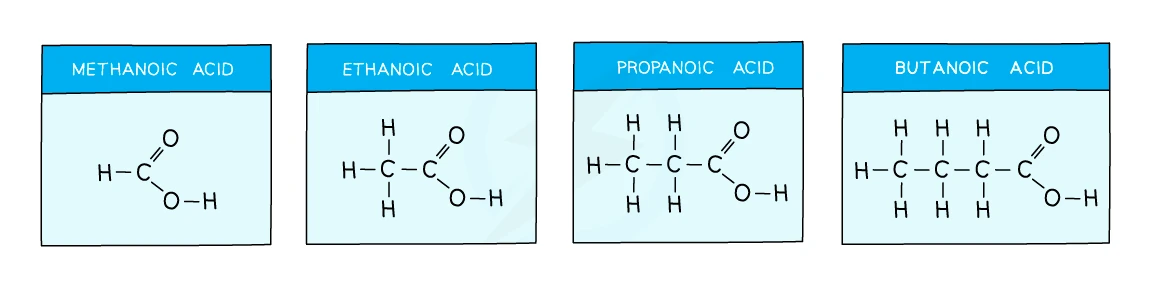
Naming a carboxylic acid and giving its structural formula
What comes up: a table with one cell filled in (e.g. the structural formula CH3COOH) and asks you to complete the remaining cells — name, empirical formula, or displayed formula.
Write (three marks): (1) name — ethanoic acid (count the carbons including the one in −COOH, then apply the stem + "-anoic acid" ending); (2) structural formula — CH3COOH (write the alkyl chain then attach the full −COOH group, not just −CO2H); (3) displayed formula — show the O−H bond explicitly on the carboxyl group (an O−H that is missing scores zero for that cell).
Watch out: writing only −CO2H or forgetting to draw the O−H bond in a displayed formula loses the mark for that cell. Spelling of the name must be correct.