Carboxylic Acids
Organic Chemistry
The Carboxylic Acids
What a carboxylic acid is
- Carboxylic acids are a homologous series of organic compounds containing the carboxyl functional group, −COOH
- The carboxyl group is what makes these compounds acidic — it is the proton-donor end of the molecule (compare with acids in topic 16)
- Common examples include vinegar (an aqueous solution of ethanoic acid, about 5% by volume), the methanoic acid in nettle stings, and the long-chain fatty acids that make up animal and plant fats
The carboxyl group up close
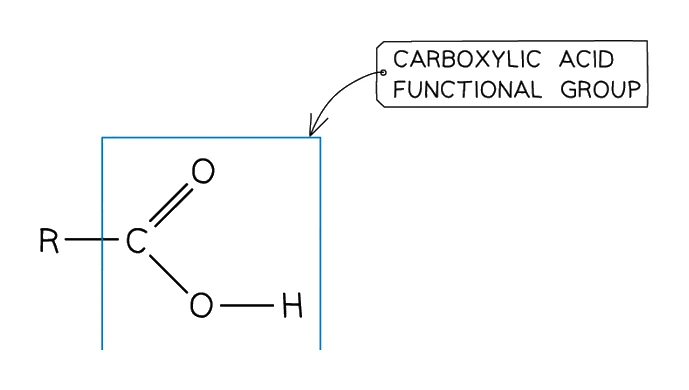
- The −COOH group consists of:
- A central carbon
- A C=O double bond to one oxygen
- A single bond to a separate O−H group
- The whole group is written as −COOH for short, or drawn out as −C(=O)−O−H when every bond is shown
- The hydrogen of the O−H is the acidic hydrogen — it is the proton released into solution that gives a carboxylic acid its acid character
Common exam question
Circling the carboxylic acid functional group
Question: Draw a circle around the functional group in the displayed formula of ethanoic acid, or around the carboxylic acid group in a larger molecule that also contains an ester group (1 mark).
Asked in 2 of the 23 papers. Circle the whole −COOH unit: the carbon, its C=O oxygen, the second oxygen and the hydrogen on it. Ring one group in one molecule only: when the acid is drawn in an equation beside an alcohol, also ringing the alcohol's O−H is rejected, and so is ringing more than one group. The carbon chain next to the group stays outside the circle.
When the molecule also contains an ester link, tell the two apart by the hydrogen: the ester's carbon and oxygens continue to another carbon atom, while the acid group ends in O−H. Circle the group that ends in O−H.
General formula
- The general formula of the carboxylic acid series is:
CnH2n+1COOH
- where n counts only the carbons sitting in the alkyl chain bonded to the −COOH group — it does not count the carbon already inside the carboxyl group itself
- A molecule with n alkyl carbons therefore has (n + 1) carbon atoms in total, including the one in the −COOH
- Special case: when n = 0, the alkyl chain is just a single hydrogen atom and the formula reduces to HCOOH (methanoic acid). This is the smallest member of the series
Naming carboxylic acids
- The name follows the standard stem-plus-ending convention from topic 21, with the ending "-anoic acid":
- 1 carbon → methan- + oic acid →
- 2 carbons → ethan- + oic acid →
- 3 carbons → propan- + oic acid → propanoic acid
- 4 carbons → butan- + oic acid → butanoic acid
The first four carboxylic acids
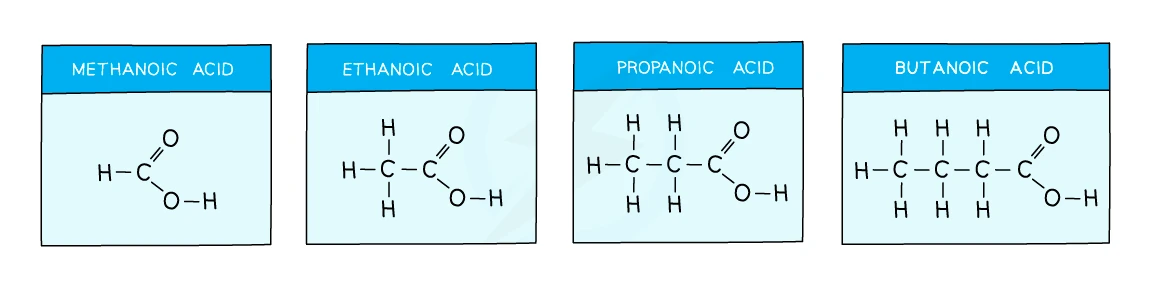
The four shortest members of the series, all liquids at room temperature with sharp, vinegar-like smells:
| n | Name | Molecular formula | Found in |
|---|---|---|---|
| 1 | Methanoic acid | HCOOH | Ant and bee stings |
| 2 | Ethanoic acid | CH3COOH | Vinegar |
| 3 | Propanoic acid | C2H5COOH | Used as a food preservative |
| 4 | Butanoic acid | C3H7COOH | Rancid butter |
Every formula in this table contains the −COOH group. That group is what gives the molecules their acidic behaviour: in water the O–H end releases a hydrogen ion (H+), leaving a negatively-charged carboxylate ion behind.
Common exam question
Naming a carboxylic acid and drawing its displayed formula
Question: Complete a table for an acid whose structural formula is shown: give its name, say what type of formula CH2O is and draw its displayed formula; or draw the displayed formula of the acid that made a given ester (1–3 marks).
Asked in 3 of the 23 papers: twice as a displayed formula, and once as a structural formula for any compound C2H4O2, where CH3COOH is the expected answer (methyl methanoate also scored). Draw every bond, especially the O−H of the carboxyl group: one scheme requires that bond and another rejects a formula that leaves "−OH" undrawn. For the name, count every carbon including the one in −COOH: CH3COOH is ethanoic acid (acetic acid is also accepted). The table also prints CH2O and wants its type named: it is the empirical formula, the simplest whole-number ratio, half of C2H4O2.
To recover the acid from an ester, split it at the single C−O bond of the ester link: the fragment with the C=O is the acid, and it gets its O−H back, so methyl propanoate came from propanoic acid. Copy its carbon chain exactly as drawn, branches included.