Crude Oil
Organic Chemistry · 1 question type
Fractional Distillation of Crude Oil
What crude oil is
- (petroleum) is a thick black mixture of many different hydrocarbons formed over millions of years from the remains of ancient marine organisms
- It is a finite resource — the supply cannot be replaced on a human timescale
- In its raw state crude oil is not directly useful; it has to be separated into groups of hydrocarbons with similar properties, called
Fractional distillation
- Fractional distillation is the industrial process used to separate crude oil into its fractions
- It is carried out in a tall in which the temperature falls continuously from the bottom (very hot, about 350 °C) to the top (cooler, about 25 °C) — a vertical temperature gradient
- The process step-by-step:
- Crude oil is heated until it vaporises
- The hot vapours enter the column near the bottom
- As the vapours rise, they cool steadily
- Each hydrocarbon condenses back to liquid when its temperature reaches its own boiling point — long-chain hydrocarbons condense first, near the hot bottom; short-chain hydrocarbons condense further up, where it is cooler
- The condensed liquids are tapped off at different levels of the column as separate fractions
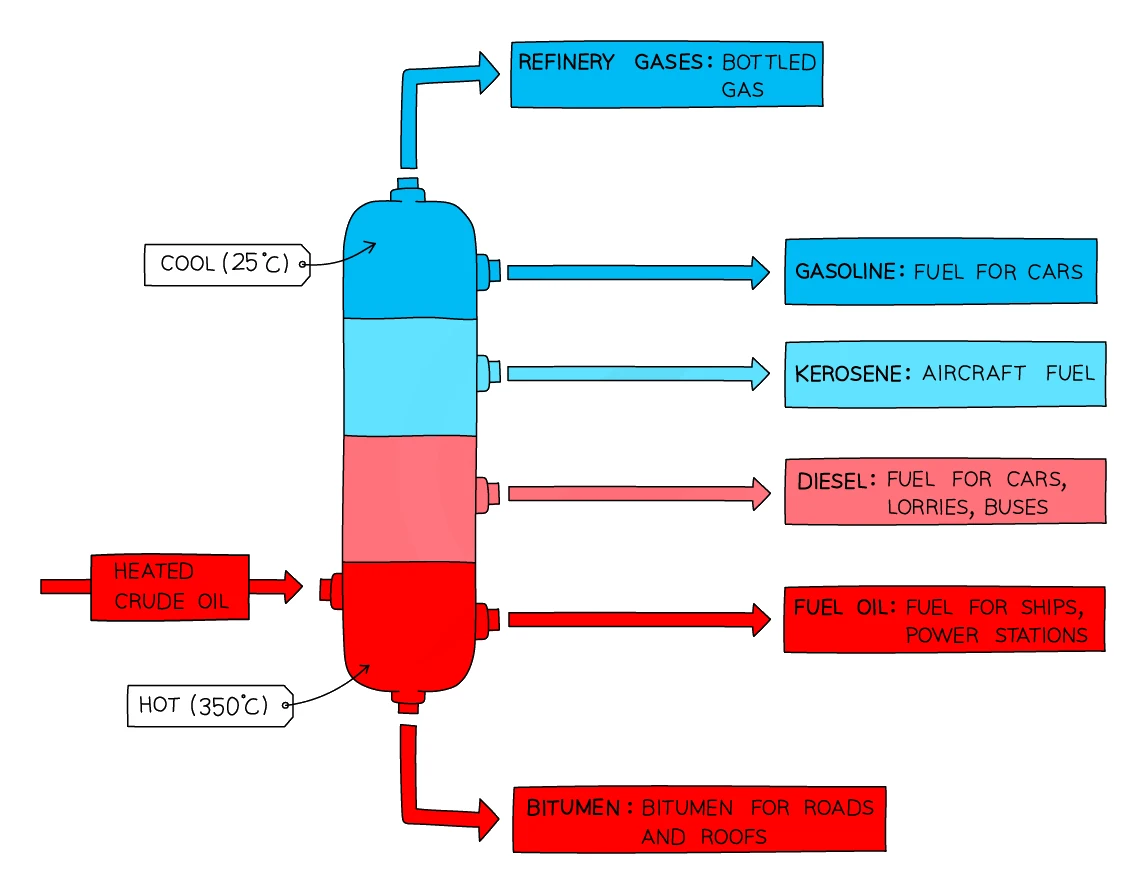
Explaining how fractional distillation separates crude oil
What comes up: A 4-mark "explain how" question asking you to describe the separation process step by step.
Write (four marks): (1) Crude oil is heated until it vaporises. (2) The vapours rise up the column. (3) The column is hotter at the bottom than at the top (a vertical temperature gradient). (4) Each hydrocarbon vapour condenses back to a liquid at its own boiling point, so different fractions condense at different heights and are collected separately.
Watch out: Do not write that crude oil is "burned" — the mark scheme rejects this. The oil must be heated/vaporised, not combusted. Also, writing "evaporated" instead of "vaporised/heated/boiled" is ignored (not credited), so use the precise terms.
Main fractions and what each one is used for
| Fraction | Chain length (C atoms) | Approximate boiling range / °C | Main use |
|---|---|---|---|
| Refinery gas | 1–4 | < 25 | Bottled gas; domestic heating and cooking |
| Gasoline (petrol) | 4–12 | 40–100 | Fuel for cars |
| Kerosene (paraffin) | 12–16 | 150–240 | Fuel for jet aircraft |
| Diesel (gas oil) | 14–18 | 220–300 | Fuel for lorries, trains, some cars |
| Fuel oil | 19–25 | 250–320 | Fuel for ships and power stations |
| Bitumen | > 70 | > 350 | Surfacing roads and roofs |
How properties change down the column
- As chain length increases:
- Boiling point rises — bigger molecules have stronger intermolecular forces to overcome
- rises — the liquid flows less readily (bitumen is tar-thick; petrol is runny)
- falls — bigger molecules evaporate less readily
- Colour darkens — the heaviest fractions are deep brown to black
- Flammability falls — long-chain hydrocarbons are harder to ignite
Why a heavier fraction has a higher boiling point
What comes up: A 3-mark "explain why" question comparing two fractions, asking you to link chain length, intermolecular forces, and boiling point.
Write (three marks): (1) The heavier fraction has longer hydrocarbon chains/molecules. (2) Longer chains have stronger intermolecular forces between molecules. (3) More energy is needed to overcome those intermolecular forces, so the boiling point is higher.
Watch out: The mark scheme explicitly rejects any mention of breaking covalent bonds — the boiling point rises because intermolecular forces between molecules are stronger, not because the covalent bonds inside the molecules change. Also, writing "intermolecular forces between atoms" is rejected; it must be forces between molecules.