4CH1
Crude Oil
Organic Chemistry · 1 question type
What a fuel is
- A fuel is a substance that releases heat when burned
- All combustion reactions are exothermic, and combustion is the most common way of releasing the energy stored in hydrocarbons
- All hydrocarbon combustion gives carbon-containing oxide products plus water; which oxides form depends on how much oxygen is available
Complete combustion
- Complete combustion happens when there is plenty of oxygen around the burning fuel
- The only products are carbon dioxide and water
- General word equation:
hydrocarbon + oxygen → carbon dioxide + water
- Worked equation for butane (C4H10), the fuel in a camping stove:
2 C4H10(g) + 13 O2(g) → 8 CO2(g) + 10 H2O(l)
- Complete combustion releases the maximum energy per gram of fuel because every carbon atom finishes as CO2
Incomplete combustion
- happens whenever the oxygen supply is restricted — a blocked vent, a clogged burner, or a poorly tuned engine all cause it
- The products may include any of: water, carbon monoxide (CO), unburnt carbon (soot) and unburnt hydrocarbons
- A characteristic clue: a smoky yellow flame instead of the clean blue flame of complete combustion
- Worked equation for propane with restricted oxygen:
2 C3H8(g) + 7 O2(g) → 6 CO(g) + 8 H2O(l)
- Less energy is released per gram of fuel because the carbon has not been fully oxidised
- Soot (unburnt carbon) blackens the underside of saucepans and the inside of chimneys
Why carbon monoxide is so dangerous
- Carbon monoxide is a particularly hazardous product of incomplete combustion because it is:
- Colourless
- Odourless
- Tasteless
- A person breathing CO has no warning until the symptoms (headache, dizziness, nausea, drowsiness) begin
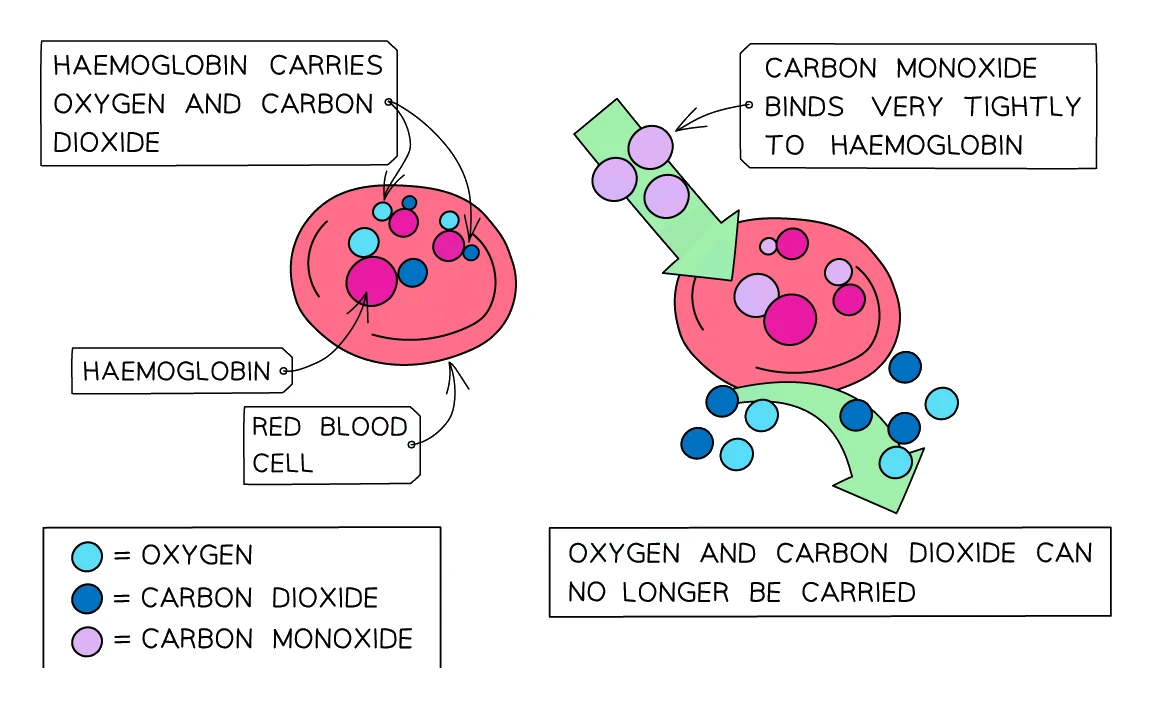
- Once in the bloodstream, CO binds tightly and almost irreversibly to the oxygen-carrying molecules in the red blood cells
- This reduces the capacity of the blood to carry oxygen to the body's tissues
- Severe CO poisoning starves vital organs of oxygen and can cause unconsciousness and death
- This is why gas heaters and boilers must be ventilated and serviced — a faulty burner can produce CO without any visible smoke
Exam tip
Why carbon monoxide is dangerous to health
What comes up: A 1-mark question asking why CO produced by incomplete combustion is harmful.
Write: Carbon monoxide reduces the ability of the blood to carry oxygen around the body.
Watch out: The mark scheme also accepts references to haemoglobin (CO binds to it forming carboxyhaemoglobin), so mentioning haemoglobin gains credit, but you do not need it for the basic mark. The key credited idea is reduced oxygen transport in the blood — do not just say "it is toxic" without linking it to oxygen transport.