Alcohols
Organic Chemistry
Ethanol — the alcohol in alcoholic drinks — can be oxidised in three ways. Complete combustion converts every carbon atom all the way to carbon dioxide, whereas the other two routes attack the hydroxyl carbon in particular, turning it into a carbonyl (C=O) carbon.
(a) Combustion of ethanol
- Ethanol burns in a plentiful supply of oxygen with an almost invisible pale-blue flame, giving carbon dioxide and water:
C2H5OH(l) + 3 O2(g) → 2 CO2(g) + 3 H2O(l)
- The reaction is strongly exothermic, which is why ethanol is used as a fuel — for laboratory spirit burners, in cooking burners (methylated spirit), and as an additive to motor fuel (E10 petrol)
- A common mistake when balancing this equation is forgetting that ethanol already contains one oxygen atom of its own
(b) Aerobic oxidation by bacteria
- Bacteria in the genus Acetobacter can use atmospheric oxygen to oxidise ethanol to (the acid in vinegar):
ethanol + oxygen → ethanoic acid + water
C2H5OH(aq) + O2(g) → CH3COOH(aq) + H2O(l)
- A bottle of wine left uncorked on the kitchen counter for a few days develops a sharp vinegary taste because of exactly this microbial oxidation
- The same reaction is the industrial route to vinegar — wine or cider is left open to Acetobacter-rich air on purpose to sour it
(c) Oxidation with potassium dichromate
- In the school lab, ethanol is oxidised by heating it with (VI) solution (orange K2Cr2O7 in dilute H2SO4) — the dichromate provides the oxygen
- The reaction is written as:
CH3CH2OH(l) + 2[O] → CH3COOH(aq) + H2O(l)
- The square-bracketed [O] is shorthand for "an atom of oxygen supplied by the oxidising agent"
- Observation: the orange potassium dichromate solution turns green as the dichromate ion is reduced to chromium(III) (Cr3+) while the ethanol is oxidised
- The orange-to-green colour change is the test result: a positive result for an alcohol being oxidised
- Apparatus: the ethanol–dichromate mixture is heated under (with a vertical condenser fitted to the flask) so that volatile ethanol and ethanoic acid do not escape as they boil over
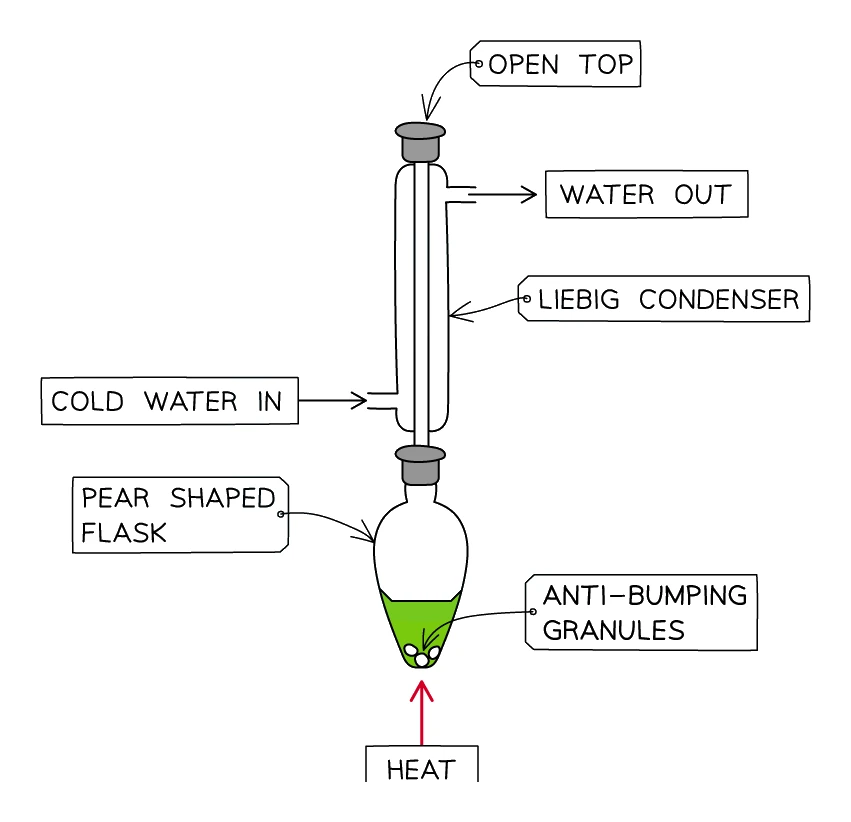
Oxidising ethanol in the laboratory — reagents and colour change
What comes up: "Give the names of the two reagents used to oxidise ethanol in the laboratory" (2 marks), or an MCQ asking which colour change occurs.
Write (two marks): (M1) potassium dichromate(VI) (the mark scheme also accepts sodium dichromate(VI) or the formula K₂Cr₂O₇); (M2) dilute sulfuric acid (concentrated sulfuric acid is also accepted). For the colour-change question: the solution changes from orange to green — not green to orange, not red to yellow.
Watch out: naming only one reagent (e.g. just "potassium dichromate" without the acid) loses the second mark, because both components of the acidified solution are separately creditworthy. Confusing the direction of the colour change (writing "green to orange") is a common distractor in MCQs.