Alkenes
Organic Chemistry
What an addition reaction is
- An combines a small molecule with the C=C of an alkene to give one larger product molecule and nothing else
- Each atom of the small molecule attaches to one of the two C=C carbons; the C=C double bond becomes a C–C single bond
- Several useful addition reactions to know:
- With hydrogen (over a nickel catalyst, 150 °C) to make the corresponding alkane (the basis of hardening vegetable oils into margarine)
- With steam (catalysed by phosphoric acid, 300 °C, 60 atm) to make an alcohol (industrial route to ethanol from ethene — see topic 25)
- With halogens to make a dihalogenoalkane
Give the conditions for making ethanol from ethene
What comes up: questions give the industrial route to ethanol and ask for the reagents, catalyst, temperature, or pressure — sometimes as a table comparing hydration with fermentation.
Write (two marks): (1) reagents are ethene and steam; catalyst is phosphoric acid. (2) conditions are approximately 300 °C and 60–70 atm pressure.
Watch out: the mark scheme accepts sulfuric acid as an alternative catalyst. Do not write "yeast" or "enzymes" — those belong to fermentation, not hydration.
The bromine water test for unsaturation
- Bromine water is an orange solution of bromine dissolved in water
- It is the standard laboratory test for distinguishing an alkene from an alkane:
- Shake a sample of the unknown hydrocarbon with bromine water in a test tube
- If the orange colour decolourises (turns colourless), a C=C double bond is present — the substance is an
- If the orange colour stays the same, no C=C is present — the substance is an (saturated)
- Why it works:
- With an alkene, bromine atoms add across the C=C to make a colourless dihalogenoalkane in solution — the free Br2 is consumed by the reaction, and the orange colour disappears
- With an alkane, there is no C=C for the bromine to react with, so the bromine stays dissolved and the solution remains orange
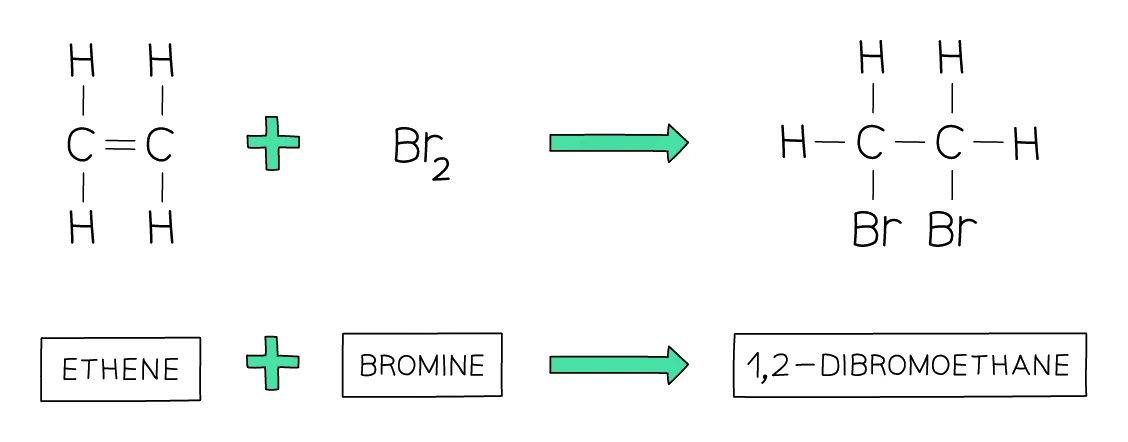
Why this test matters
- Bromine water (an aqueous bromine solution) is safer to handle and easier to see colour-change with than liquid bromine itself
- The test is the simplest way to identify whether a hydrocarbon contains a C=C double bond — i.e. whether it is unsaturated
- The same test will give a positive result for any alkene of any chain length, because the C=C is the reactive functional group rather than the chain length being the key feature
Describe the bromine water test to distinguish an alkene from an alkane
What comes up: the classic 2-mark question — describe the test and the result that shows an alkene is present, or compare results with both an alkene and an alkane.
Write (two marks): (1) add bromine water to the sample. (2) with an alkene, the bromine water decolourises (turns from orange/yellow to colourless); with an alkane, the orange colour stays the same.
Watch out: the mark scheme rejects writing just "bromine" for mark 1 — you must specify bromine water. For mark 2, the required word is "colourless" — writing "clear" is ignored by the mark scheme, as is any other colour change (e.g. red, pink). Also, saying that UV light is needed for the reaction to occur loses the mark, because UV is only needed for the alkane substitution reaction, not for alkene addition.