Introduction to Organic Chemistry
Organic Chemistry · 2 question types
What organic chemistry is
- Organic chemistry is the chemistry of compounds containing the element carbon
- By long-standing convention, a handful of carbon-containing substances are treated as inorganic and not studied as part of organic chemistry: carbon monoxide (CO), carbon dioxide (CO2) and the metal carbonates (e.g. CaCO3)
- Carbon is uniquely able to form four covalent bonds and to chain with itself, which is why organic compounds span tens of millions of known molecules — from methane to DNA
Hydrocarbons
- A hydrocarbon is an organic compound that contains only hydrogen and carbon atoms — no other element
- Methane (CH4), ethane (C2H6), petrol (a mixture of C5–C10 alkanes) and natural rubber are all hydrocarbons
- An alcohol such as ethanol (C2H5OH) is an organic compound but not a hydrocarbon because it contains an oxygen atom
Define a hydrocarbon
What comes up: "State what is meant by a hydrocarbon" or "Explain why compound X is/is not a hydrocarbon."
Write (two marks): (1) contains only carbon and hydrogen atoms; (2) no other element present. Saying it contains carbon and hydrogen alone scores M1; adding "only" (or "no other elements") secures M2.
Watch out: Writing "molecules" instead of "atoms" is rejected. For the two-mark version, you must explicitly say "only" — the mark scheme awards a dependent mark for that word.
Five ways to write the same molecule
- The same organic molecule can be drawn in several different forms; each form throws away or keeps different amounts of detail. Using ethanol as the running example:
| Type of formula | What it shows | Ethanol |
|---|---|---|
| Empirical formula | Simplest whole-number ratio of atoms | C2H6O |
| Molecular formula | Actual number of each kind of atom in one molecule | C2H6O |
| General formula | Pattern for the whole homologous series | CnH2n+1OH (n = 1, 2, 3 …) |
| Structural formula | Carbon-by-carbon backbone with key bonds shown | CH3CH2OH |
| Displayed (graphical) formula | Every atom and every bond drawn out, in 2-D | see figure below |
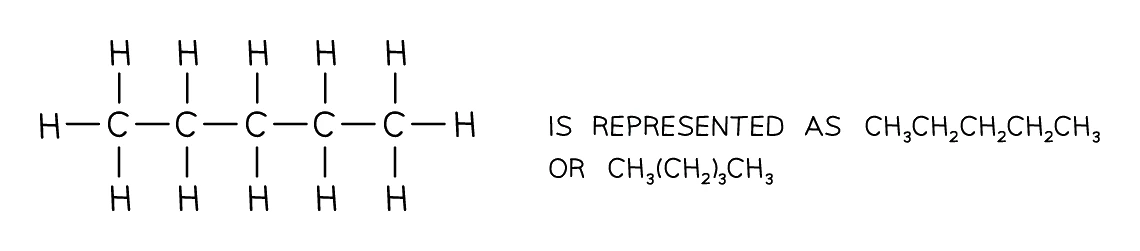
- The displayed formula spells out every atom and bond, while the structural formula condenses the same molecule onto one line. Pentane, for example, can be drawn in full or written as CH3CH2CH2CH2CH3 (or CH3(CH2)3CH3):
Homologous series
- A homologous series is a family of organic compounds that all share the same and a common general formula
- Members of a homologous series:
- Share the same
- Carry the same functional group, so they react in the same chemical way
- Show a steady gradation in physical properties (boiling point, density, viscosity) as the chain length grows
- Differ from one neighbour to the next by a single CH2 unit
Features of a homologous series
Stating features of a homologous series comes up (2–3 marks), so you need to know them: same general formula, same functional group, consecutive members differ by CH₂, similar chemical properties, and a trend in physical properties (e.g. boiling point). Say "trend in physical properties", not "same physical properties" (which is rejected).
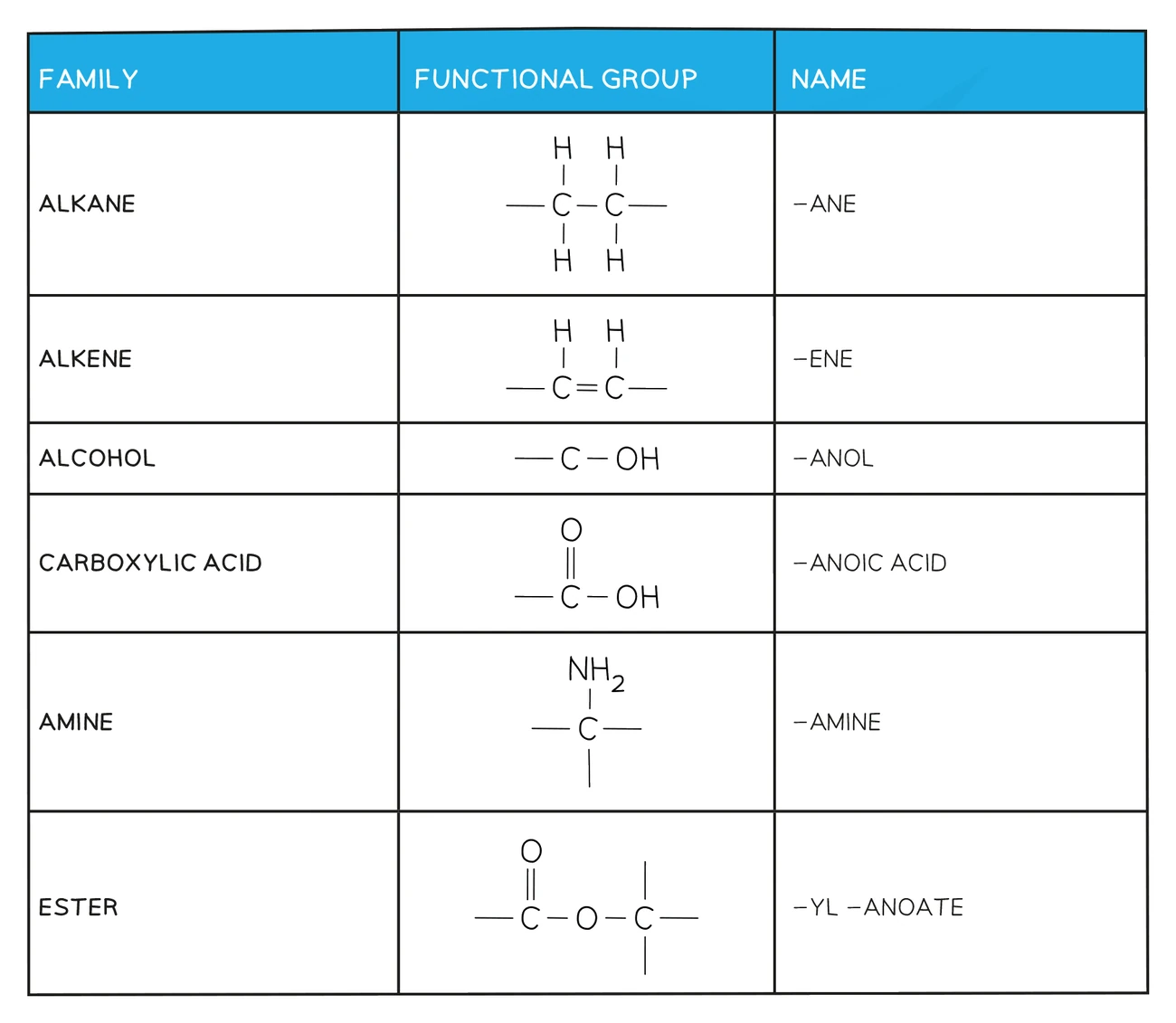
Functional groups
- A functional group is a particular arrangement of atoms within a molecule that gives it its characteristic chemistry
- Two molecules in the same homologous series react in the same way precisely because they share the same functional group
Isomers
- Isomers are different compounds that share the same but whose atoms are joined together differently — they therefore have different structural (and often different displayed) formulae
- Isomers can have similar physical and chemical properties if they are in the same homologous series, or quite different properties if their atoms are arranged into different functional groups
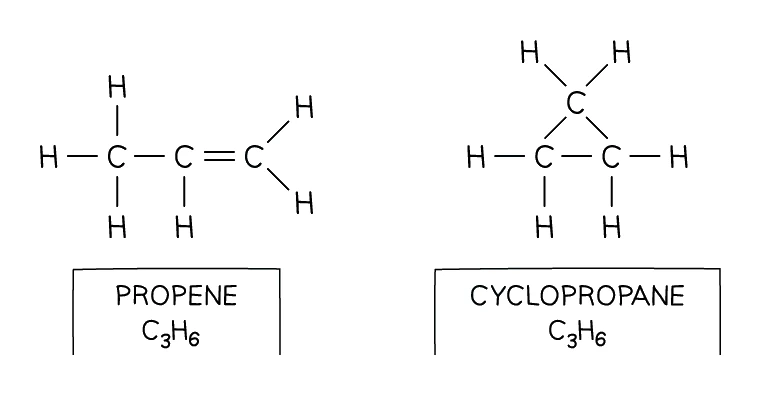
- A clean example: the molecular formula C3H6 describes two unrelated compounds
- Propene: a straight-chain alkene with a C=C double bond — CH2=CH−CH3
- Cyclopropane: a closed three-carbon ring of single bonds — no C=C double bond, no functional group
- Propene reacts with bromine water and decolourises it (because of its C=C); cyclopropane does not. Same molecular formula, very different chemistry
Define isomers
Defining isomers comes up, so you need to know they have the same molecular formula but different structural formulae (atoms arranged differently). "Same empirical formula" or "same general formula" is rejected, and isomers are compounds, not elements.