Reversible Reactions and Equilibria
Physical Chemistry
What "position of equilibrium" means
- The position of equilibrium describes how much of each species is present once dynamic equilibrium has been reached
- The position lies "to the right" if products are favoured (more product, less reactant at equilibrium)
- The position lies "to the left" if reactants are favoured (less product, more reactant)
- Changing the conditions of the system shifts where this balance sits
Le Chatelier's principle
- states that if a closed system at equilibrium is disturbed, the equilibrium position shifts so as to oppose the change imposed on it
- Le Chatelier's principle predicts the shift direction caused by:
- Changing the temperature
- Changing the pressure (gases)
- Changing the concentration of a species (not assessed numerically, but the direction is)
Get the yield direction right before the reason
In the two-mark questions on the effect of a change on the yield, the first mark is for the direction and the second for the reason. In three of the four papers that set these, the reason mark depends on the direction being correct or left blank: a wrong direction loses both marks, while a reason alone can still earn one.
Naming Le Chatelier's principle earns nothing: three schemes ignore it explicitly, and two ignore remarks about rate. Give the direction, then the specific reason: the sign of ΔH, the moles of gas, or equal rates for a catalyst.
Effect of temperature
- Identify whether the forward reaction is exothermic or endothermic; the reverse direction is then the opposite
- Increasing temperature shifts the equilibrium in the direction of the reaction (the system "absorbs" the extra heat to oppose the rise)
- Decreasing temperature shifts the equilibrium in the direction of the reaction (the system releases heat to oppose the fall)
- Worked example. In the Haber process N2(g) + 3 H2(g) ⇌ 2 NH3(g), the forward reaction is exothermic.
- Raising the temperature drives the equilibrium to the left — ammonia decomposes — so the yield of NH3 falls
- Industry compromises by running the reaction at about 450 °C: hot enough for a fast rate, cool enough that the yield is still useful
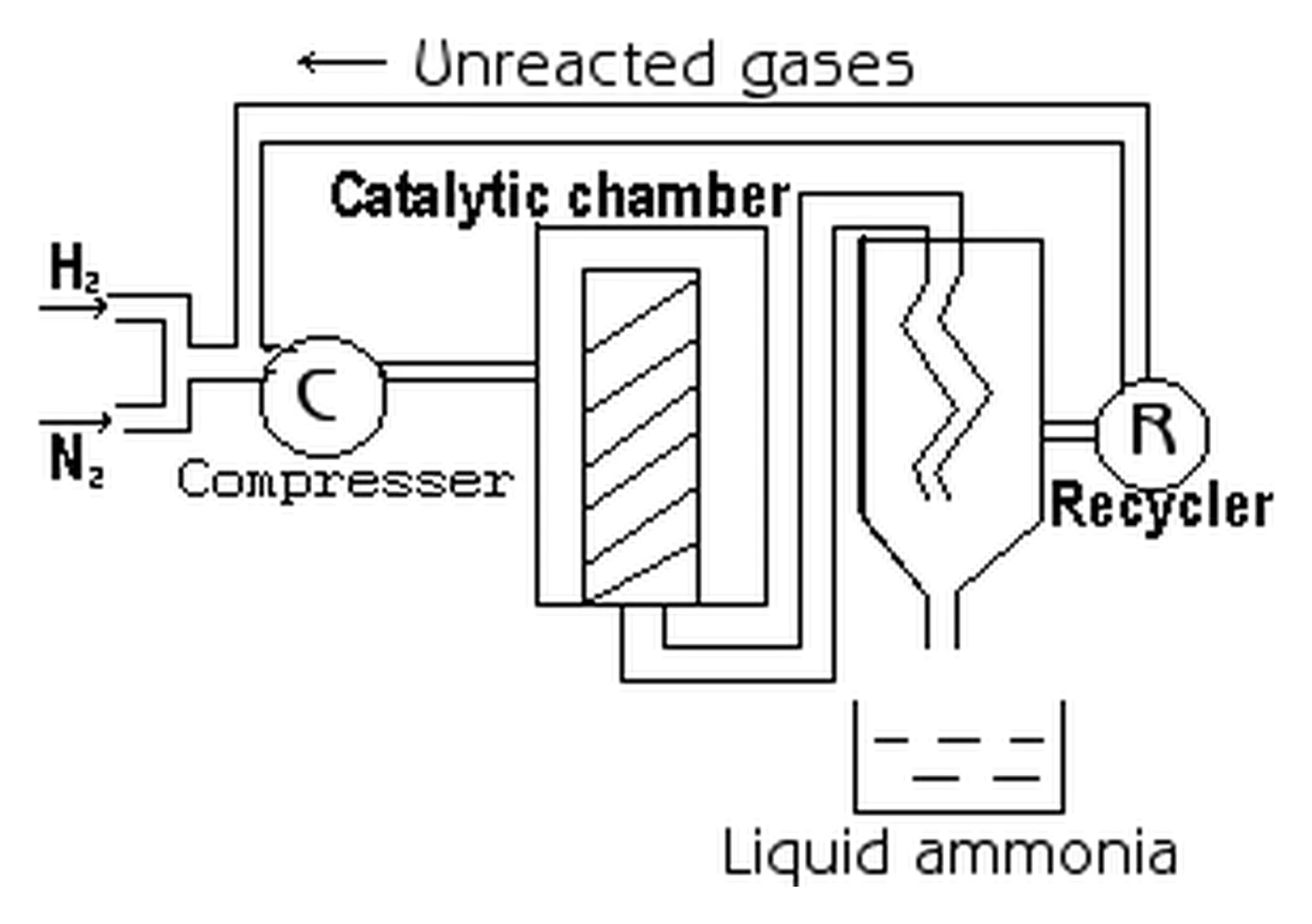
Effect of temperature on the yield at equilibrium
Question: Explain the effect on the yield of the product at equilibrium when the temperature is raised or lowered at constant pressure (2 marks).
Asked in 3 of the 23 papers, all on Paper 2, and each time the equation is printed with its ΔH. The first mark is for the direction of the yield change. The second is for the reason: that the forward reaction is exothermic (or endothermic), which you read straight from the sign of ΔH. Saying instead that the reverse reaction is endothermic (or exothermic) is accepted, and you may add that the equilibrium shifts in the endothermic direction on heating.
So a negative ΔH means the forward reaction is exothermic: raising the temperature moves the equilibrium in the endothermic, reverse direction and the yield falls, while lowering it raises the yield. A positive ΔH reverses both conclusions.
Effect of pressure (gaseous reactions only)
- Count the number of moles of gas on each side of the equation; only species in the gaseous state count
- Increasing pressure shifts the equilibrium toward the side with fewer moles of gas — that side occupies a smaller volume, opposing the pressure rise
- Decreasing pressure shifts the equilibrium toward the side with more moles of gas
- If the two sides have the same number of moles of gas, changing the pressure has no effect on the position of equilibrium (it does still alter the rate at which equilibrium is reached)
- Worked example. In the Contact process 2 SO2(g) + O2(g) ⇌ 2 SO3(g):
- Left side has 3 mol of gas (2 SO2 + 1 O2); right side has 2 mol of gas (2 SO3)
- Raising the pressure shifts the equilibrium to the right, producing more SO3
- The industrial reaction runs at slightly above atmospheric pressure because the yield is already high; the extra cost of higher-pressure equipment is not worth the small gain
Effect of pressure on the yield at equilibrium
Question: Explain, give a reason for, or predict with a reason the effect on the yield of the product at equilibrium when the pressure is increased or decreased at constant temperature (1–2 marks).
Asked in 5 of the 23 papers, all on Paper 2. For two marks the first is for the direction of the yield change and the second for the reason, a count of the moles of gas on each side; when the paper states the direction itself and asks only for a reason, the moles comparison alone earns the single mark. The comparison ("fewer moles of gas on the right") or the actual numbers are both credited, and "molecules" is accepted for moles.
Raising the pressure favours the side with fewer moles of gas; lowering it favours the side with more. One scheme wants the direction of the shift alongside the yield change for the first mark, so for a pressure decrease the safe answer reads: the yield falls, because the equilibrium shifts to the left, the side with more moles of gas (for an increase, reverse both halves).
Effect of concentration
- Adding more of a reactant shifts the equilibrium toward the products to consume the added material — position shifts to the right
- Adding more of a product shifts the equilibrium toward the reactants — position shifts to the left
- Removing a product as it forms (e.g. condensing it out of a gas mixture) drains material from the right side, so the system makes more product to compensate — equilibrium keeps shifting to the right
- This last trick is heavily used in industry: continuously removing the product is a way to push reactions that would otherwise stop at a moderate yield
Effect of a catalyst
- A speeds up both the forward and the reverse reactions by the same factor
- It lets equilibrium be reached faster, but it does not change the position once equilibrium has been reached
- The amounts of reactant and product at equilibrium are the same with or without the catalyst
- Industrially, catalysts are still used because reaching a useful yield in minutes instead of hours saves enormous amounts of energy
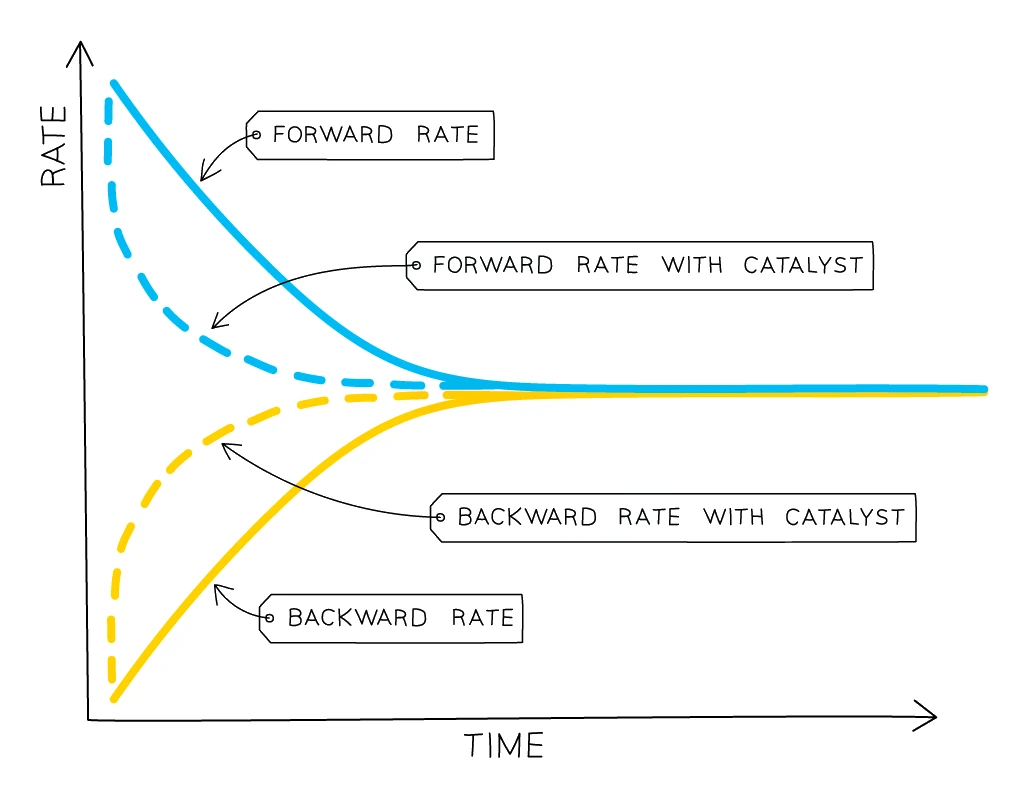
Effect of a catalyst on the yield at equilibrium
Question: Explain the effect, if any, of adding a catalyst on the yield at equilibrium, or give the reason why a catalyst is used (1–2 marks).
Asked in 5 of the 23 papers, all on Paper 2: four ask for its effect on the yield or the position of equilibrium, one for the reason it is used. The credited reason is that a catalyst speeds up the forward and the reverse reaction equally. For two marks, the first is usually for no effect on the yield and the second for that reason; one scheme gives its second mark for the word "equally" alone. Name both directions and say equally, or that both rates are affected the same.
Asked why a catalyst is used, say that it increases the rate, or lets equilibrium be reached sooner. "To increase the yield" was rejected, and the explanation about an alternative pathway with a lower activation energy was ignored.
| Change made | Position of equilibrium shifts | Why |
|---|---|---|
| Increase temperature | Toward the endothermic side | System absorbs the added heat |
| Decrease temperature | Toward the exothermic side | System releases heat to oppose the fall |
| Increase pressure (gases) | Toward the side with fewer moles of gas | Reduces total moles → reduces pressure |
| Decrease pressure (gases) | Toward the side with more moles of gas | Increases total moles → opposes the drop |
| Add more reactant | To the right (products) | Consumes the excess reactant |
| Remove a product | To the right (products) | Replaces the missing product |
| Add a catalyst | No change in position; equilibrium reached faster | Catalyst speeds both rates equally |