Reversible Reactions and Equilibria
Physical Chemistry
What equilibrium looks like
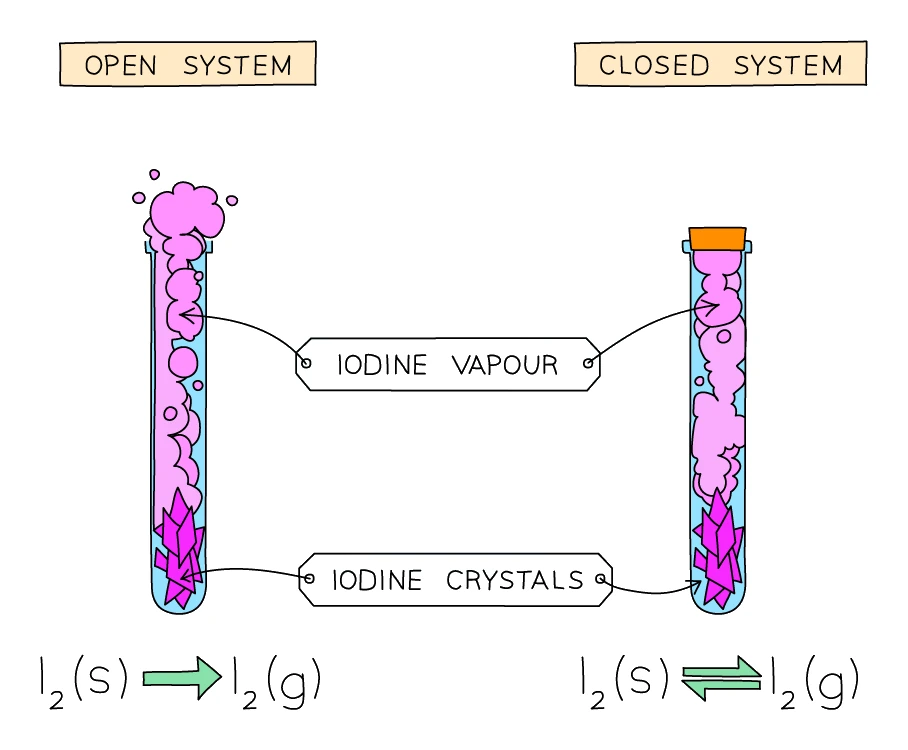
- Place a reversible reaction in a sealed container with no escape route for any chemical — a
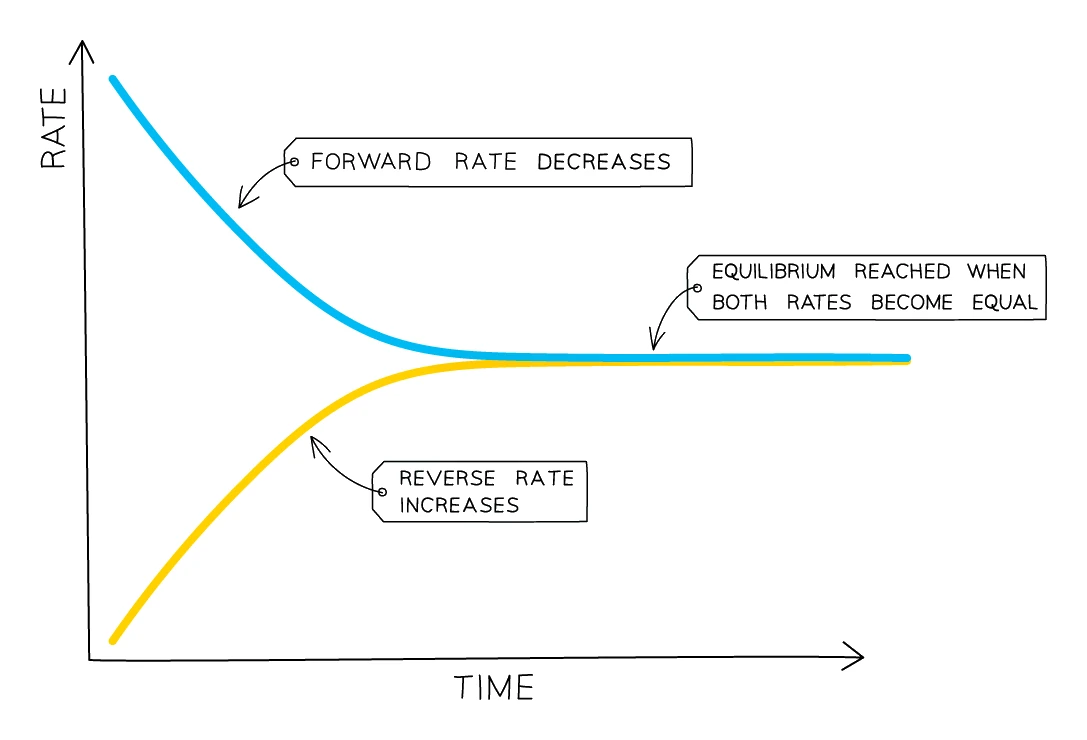
- At first only the forward reaction occurs (no products to react in the reverse direction yet); its rate is highest
- As the products build up, the reverse reaction starts and speeds up
- The forward rate falls (reactants becoming scarcer) and the reverse rate rises (products becoming more abundant)
- Eventually the two rates become equal: the system is at
Two defining features
- The rate of the equals the rate of the
- The concentrations of reactants and products stay constant from this point onward (provided temperature and pressure do not change)
Common exam question
Stating the characteristics of dynamic equilibrium
Question: State what is meant by dynamic equilibrium, or give one or two characteristics of a reaction at dynamic equilibrium (1–2 marks).
Asked in 4 of the 23 papers, all on Paper 2. There are two credited points, one mark each: the forward and reverse reactions are taking place at the same rate, and the reactant and product concentrations stay constant. Three of the four schemes also accept amounts or moles in place of concentrations, and for a one-mark version either point on its own is enough.
The standard slip is to say the reactant and product concentrations are "the same" or "equal": every one of the four schemes rejects it. Constant means they stop changing over time, not that there is as much product as reactant. Nor have the reactions stopped; both keep running, which is what "dynamic" means.
Why "dynamic", not "static"
- At equilibrium the reactions have not stopped — both still happen at full speed
- Each forward conversion of a reactant into a product is matched by a reverse conversion of a product back into a reactant
- The chemicals interchange constantly; only the overall amounts stay fixed
Closed-system requirement
- Equilibrium can only be reached when nothing can leak out (or leak in)
- Open systems lose products as they form (a gas escaping into the air, for instance), so the reverse reaction never has enough material to keep up and equilibrium is never reached