ChemistryExam code: 4CH1
Reversible Reactions and Equilibria
Physical Chemistry
What "reversible" means
- A can proceed in both directions: the products can themselves combine, or break apart, to give the original reactants back again
- The turns reactants into products
- The reverse (backward) reaction turns products back into reactants
- A reversible equation uses a special two-headed arrow, ⇌, instead of the single arrow → used for one-way reactions
- The top half-arrow points right (forward); the bottom half-arrow points left (reverse)
- Whether the reaction settles toward the products side or toward the reactants side depends on the conditions — temperature, pressure, concentration
Common exam question
What the ⇌ symbol means
Question: State what the ⇌ symbol in an equation represents, or give its meaning (1 mark).
The mark is for reversible: the reaction can go in both directions, so the products can react to re-form the reactants. Writing that the reaction goes both ways is also accepted. Asked in 3 of the 23 papers, once on Paper 1 and twice on Paper 2, always attached to an equation that the later parts of the question then use.
Do not write "equilibrium" on its own: all three mark schemes ignore it. The symbol tells you the reaction is reversible; whether it has actually reached equilibrium depends on the container, not on the arrow.
Two reversible reactions to know
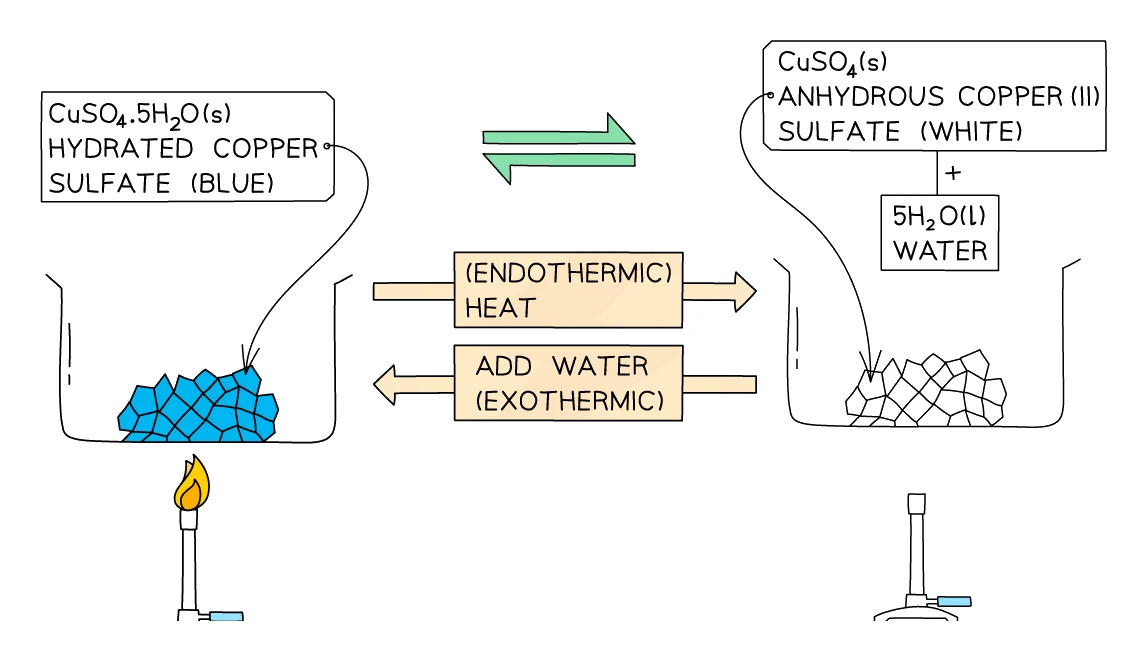
- Heating hydrated copper(II) sulfate drives off its water of crystallisation: the blue crystals turn white as CuSO4·5H2O becomes anhydrous CuSO4. Adding water reverses the change, turning the white solid blue again and releasing heat, which is why anhydrous copper(II) sulfate is used as a test for water: CuSO4·5H2O ⇌ CuSO4 + 5H2O
- Heating ammonium chloride decomposes the white solid into ammonia and hydrogen chloride gas; the two gases recombine on the cooler upper walls of the tube to reform solid ammonium chloride: NH4Cl ⇌ NH3 + HCl