4CH1
Rates of Reaction
Physical Chemistry · 3 question types
Practical: effect of surface area on the rate of reaction
- Aim: show that powdered marble reacts faster with hydrochloric acid than the same mass of large lumps
- Apparatus: conical flask, delivery tube with bung, water trough, 100 cm3 inverted measuring cylinder, stopwatch, balance, 1.0 mol dm−3 hydrochloric acid, three samples of calcium carbonate (large chips, small chips, powder), each weighed to the same fixed mass (e.g. 4.0 g)
- Method:
- Set up the gas-collection apparatus over the water trough with the inverted measuring cylinder filled with water
- Pour 50 cm3 of HCl into the conical flask
- Tip in the 4.0 g of large chips, immediately push in the bung, and start the stopwatch
- Read off the gas volume in the measuring cylinder every 15 seconds for 2 minutes
- Empty and dry the apparatus; repeat with 4.0 g of small chips and again with 4.0 g of powdered calcium carbonate
- Sample results (volume of CO2 collected, cm3):
| Time / s | Large chips | Small chips | Powder |
|---|---|---|---|
| 15 | 4 | 12 | 28 |
| 30 | 7 | 22 | 47 |
| 60 | 13 | 38 | 70 |
| 90 | 19 | 50 | 78 |
| 120 | 24 | 58 | 80 |
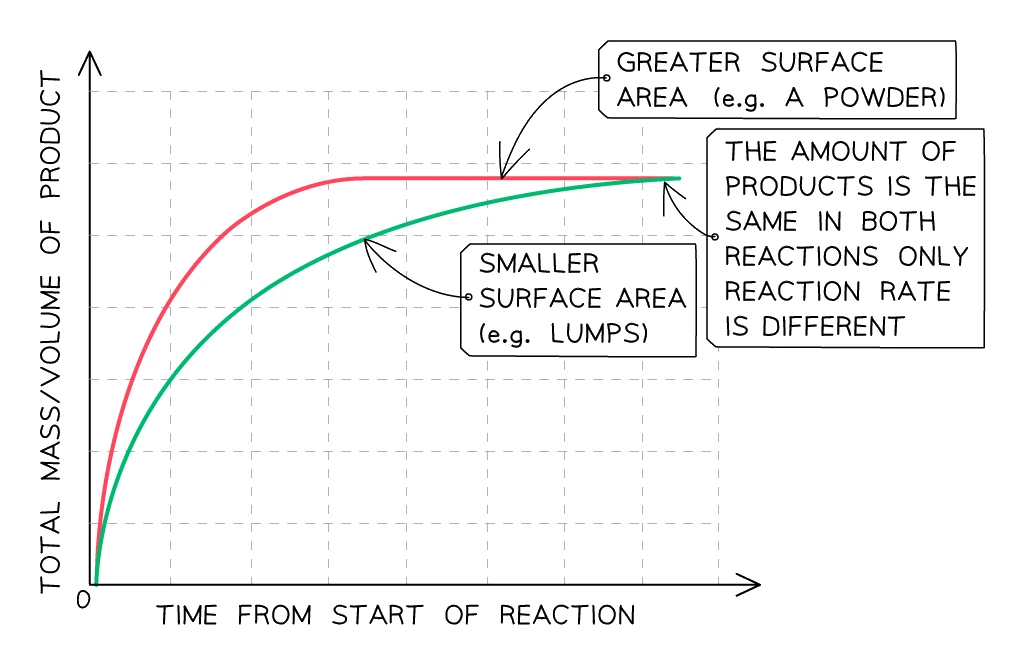
- Plot volume of CO2 (y) against time (x) for all three runs on the same axes
- The powder curve is the steepest at the start and levels off first, but every curve plateaus at the same final volume because the same total mass of CaCO3 was used in each run
Practical: effect of a catalyst on the rate of reaction
- Aim: compare the rate of hydrogen peroxide decomposition with several different solids to see which one is the best catalyst
- Apparatus: as above (gas collection over water), plus 20-vol H2O2 solution and a set of solid candidate catalysts measured out to the same mass (e.g. 0.5 g): manganese(IV) oxide, lead(II) oxide, iron(III) oxide, copper(II) oxide
- Method:
- Add 25 cm3 of H2O2(aq) to the conical flask
- Sprinkle in 0.5 g of the first solid, close the bung, start the stopwatch
- Read off the volume of O2 collected every 15 seconds for 90 seconds
- Repeat with each of the other solids in turn (fresh H2O2 solution each time)
- Plot volume of O2 (y) against time (x) on a single set of axes — the steepest curve identifies the most effective catalyst
- Manganese(IV) oxide gives by far the steepest line and is the standard school catalyst for this decomposition
Worked example
Calculate the rate of reaction from a volume–time graph
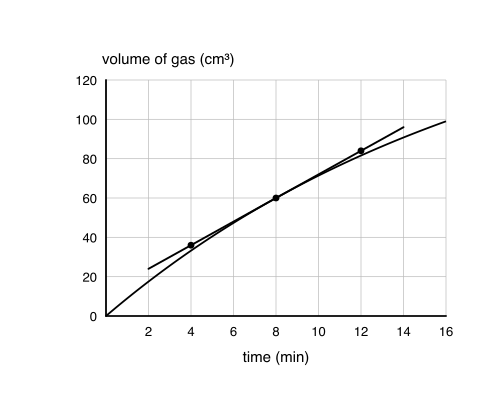
A volume–time graph shows 60 cm³ of gas collected over the first 8 minutes of a reaction. The curve is steepest at the start and levels off as the reaction slows. You are asked to find the rate of reaction at 8 minutes, in cm³/min.
Solution:
- Draw a tangent to the curve at the point where time = 8 minutes. The tangent must touch the curve at exactly that point and extend in a straight line on both sides.
- Read off two well-separated points on the tangent line, for example (4 min, 36 cm³) and (12 min, 84 cm³).
- Calculate the gradient: change in volume ÷ change in time = (84 − 36) ÷ (12 − 4) = 48 ÷ 8 = 6 cm³/min
Note: if you instead divide the total volume collected by the total time (60 ÷ 8 = 7.5 cm³/min), you get the average rate over the whole period — the mark scheme awards this only 1 mark because it does not give the instantaneous rate at the specified point.