4CH1
Rates of Reaction
Physical Chemistry · 3 question types
What rate of reaction means
- The rate of reaction is how quickly the reactants are used up, or how quickly the products are formed
- Practically, rate is measured by following one quantity that changes over time:
- Volume of gas given off, collected over water or in a gas syringe
- Mass lost from a flask sitting on a balance as a gas escapes
- Time taken for a visible change (a precipitate, a colour change, a cross becoming invisible)
- There are four factors to investigate experimentally: , , temperature, and the presence of a
Effect of surface area: marble chips with hydrochloric acid
- Place a fixed mass of marble chips (calcium carbonate) into a conical flask
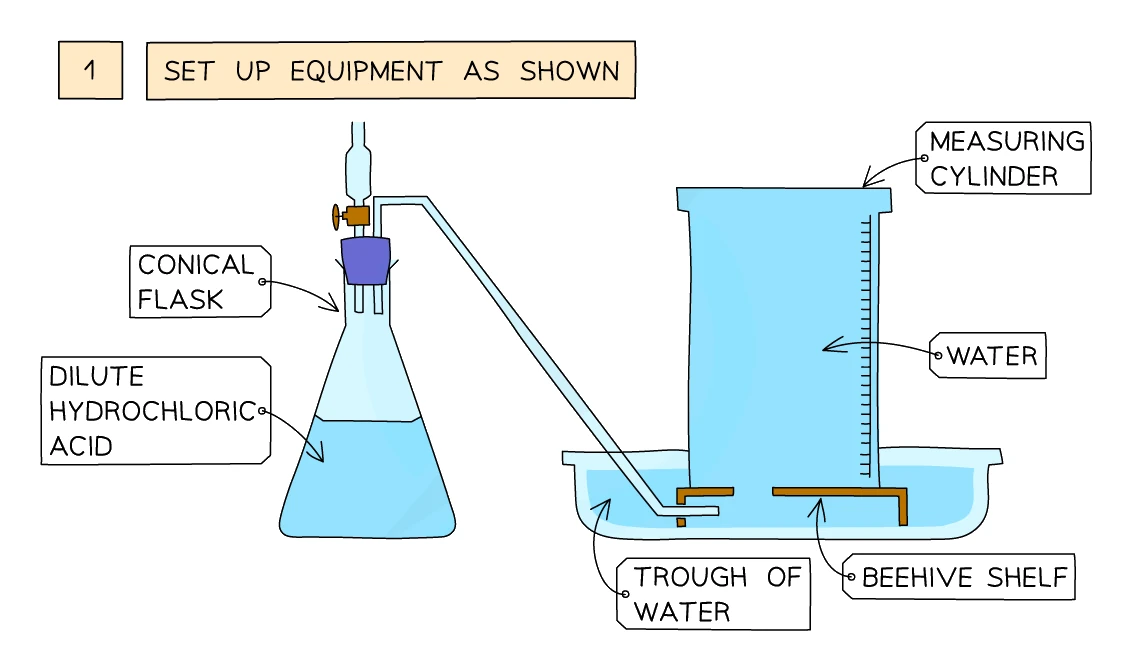
- Add a fixed volume of dilute hydrochloric acid and immediately close the flask with a bung connected by a delivery tube to an inverted measuring cylinder over a water trough
- Time how long it takes to collect a fixed volume of CO2, or read the volume collected after a fixed time
- Repeat with chips of a different size (small chips, medium chips, powdered) while keeping mass and acid concentration the same
- The smaller the chip, the larger the surface area exposed, so the reaction goes faster
Effect of concentration: the disappearing-cross experiment
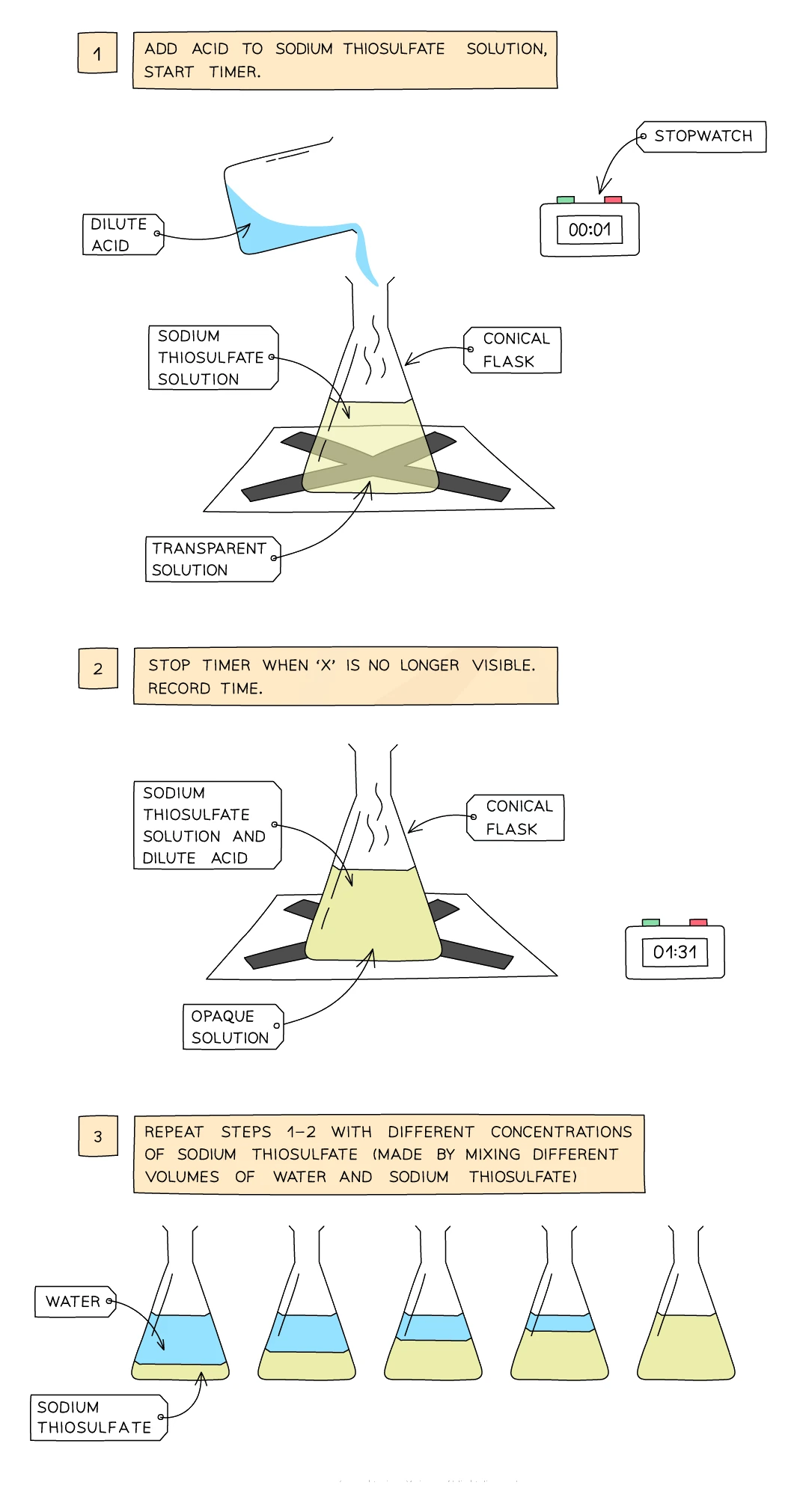
- Sodium thiosulfate solution reacts with dilute hydrochloric acid to produce a fine yellow sulfur precipitate that gradually clouds the mixture:
Na2S2O3(aq) + 2 HCl(aq) → 2 NaCl(aq) + S(s) + SO2(g) + H2O(l)
- Measure 40 cm3 of sodium thiosulfate solution into a conical flask placed on a piece of paper with a black cross drawn on it
- Look down through the flask at the cross from directly above
- Add 10 cm3 of dilute hydrochloric acid, start a stopwatch, and stop it when the cross is no longer visible through the cloudy mixture
- Repeat with sodium thiosulfate diluted with different volumes of water (keep total volume the same) to vary concentration
Effect of temperature: magnesium in dilute acid
- Place a measured volume of dilute hydrochloric acid into a conical flask sitting in a water bath set to a fixed temperature
- When the acid has reached temperature, drop in a 3 cm strip of clean magnesium ribbon and immediately begin timing
- Stop the clock when the last of the magnesium has dissolved (no more bubbling)
- Repeat at higher and lower temperatures (e.g. 20, 30, 40, 50 °C) while keeping all other variables constant
- The hotter the acid, the faster the magnesium dissolves
Effect of a catalyst: hydrogen peroxide decomposition
- Hydrogen peroxide solution slowly decomposes on its own:
2 H2O2(aq) → 2 H2O(l) + O2(g)
- Add a fixed volume of H2O2(aq) to a conical flask connected via a delivery tube to an inverted measuring cylinder over water
- Sprinkle in a measured mass of solid catalyst (manganese(IV) oxide, MnO2) and immediately replace the bung
- Read the volume of oxygen gas collected after, say, 30 s
- Repeat without the catalyst as a control; the difference shows the catalyst's effect
Why surface area depends on particle size
- A solid only reacts at its outer surface — the atoms or ions buried inside the lump cannot meet the other reactant until the outer layers have been used up
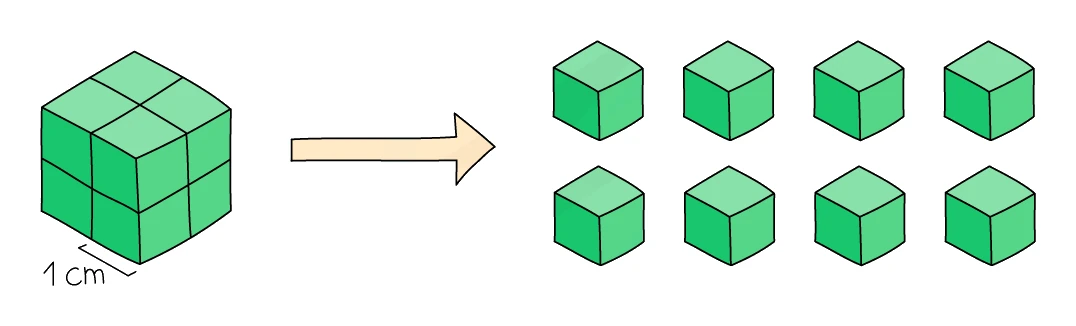
- Breaking a single lump into smaller pieces exposes the interior atoms; the total mass stays the same but the surface area exposed to the other reactant rises sharply
- A useful way to picture it: a 1 cm cube has six 1 cm × 1 cm faces (6 cm2 total). Slicing it into eight 0.5 cm cubes gives 8 × 6 × (0.5 × 0.5) = 12 cm2 of surface — the surface area has doubled even though the mass has not changed
- Powders therefore react much faster than chips of the same mass, and chips react much faster than a single lump
- This is why fine flour dust can cause explosions in mills: the surface area per gram is so large that the whole load can ignite almost instantly once a spark arrives