4CH1
Rates of Reaction
Physical Chemistry · 3 question types
What activation energy is
- Activation energy, Ea, is the minimum energy that colliding reactant particles must have in order to react
- Below Ea, even a head-on collision just bounces apart; above Ea, the existing bonds can start to break and new bonds form
- Different reactions have different activation energies: rusting has a small Ea (rust forms slowly at room temperature) while burning natural gas has a large Ea (needs a spark or flame to start)
Reaction profiles
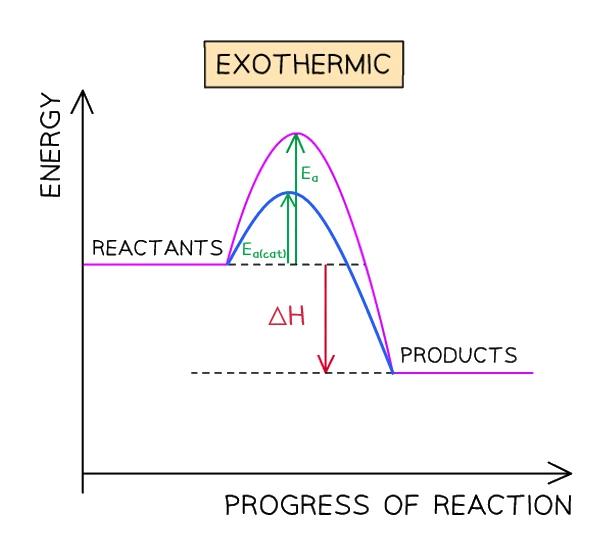
- A plots the energy of the reactants, the products, and the in between as the reaction progresses
- The horizontal axis is "progress of reaction"; the vertical axis is "energy"
- Two key features:
- The vertical distance from the reactants line up to the peak of the profile is the Ea
- The vertical distance from the reactants line to the products line is the overall enthalpy change ΔH
- For an exothermic reaction, products sit lower than reactants and ΔH is negative
- For an endothermic reaction, products sit higher than reactants and ΔH is positive
- In both cases the activation-energy hump rises above the starting energy of the reactants
Catalysts on the reaction profile
- A catalyst lowers the activation-energy hump without changing the energies of the reactants or the products
- On the reaction profile, the curve has a lower peak but the same starting and ending levels
- The overall ΔH is unchanged — a catalyst does not change how exothermic or endothermic a reaction is, only how fast it gets there