Rates of Reaction
Physical Chemistry · 3 question types
The collision theory model
- For two reactant particles to react, they must:
- Collide with each other
- Collide with at least the minimum kinetic energy needed to break the existing bonds, called the (Ea)
- Collide with the correct orientation so that bonds can rearrange
- A collision that meets all three conditions is a
- The rate of reaction is set by the number of successful collisions per second
- Anything that increases either the frequency of collisions or the proportion of collisions that have enough energy will speed the reaction up
How concentration changes the rate
- A higher concentration packs more reactant particles into the same volume
- More particles in a fixed volume means more collisions per second between the right kinds of particle
- More collisions → more successful collisions per second → faster reaction
- Doubling concentration roughly doubles the collision rate
Explaining concentration and rate using collision theory
What comes up: a 3-mark question asking you to explain, using collision theory, how decreasing (or increasing) concentration affects the rate of reaction.
Write (three marks): (1) Lower concentration means fewer particles in the same volume. (2) There are fewer collisions per unit time between reactant particles. (3) So the rate of reaction decreases.
Watch out: mentioning kinetic energy or particle movement when answering a concentration question. The mark scheme specifically rejects references to kinetic energy or particle speed in this context — energy ideas belong to the temperature explanation, not the concentration one.
How pressure changes the rate (for gases)
- Increasing the pressure of a gas means compressing the same number of particles into a smaller volume
- The result is the same as increasing concentration in solution — more particles per unit volume, more collisions per second, faster reaction
How temperature changes the rate
- Increasing the temperature has two effects, both of which speed the reaction up:
- Particles move faster and so collide more often
- More importantly, a larger fraction of particles now have kinetic energy at or above the activation energy, so a much larger proportion of collisions are successful
- The energy effect dominates: as a quick guide, the rate of many common reactions doubles for every 10 °C rise in temperature
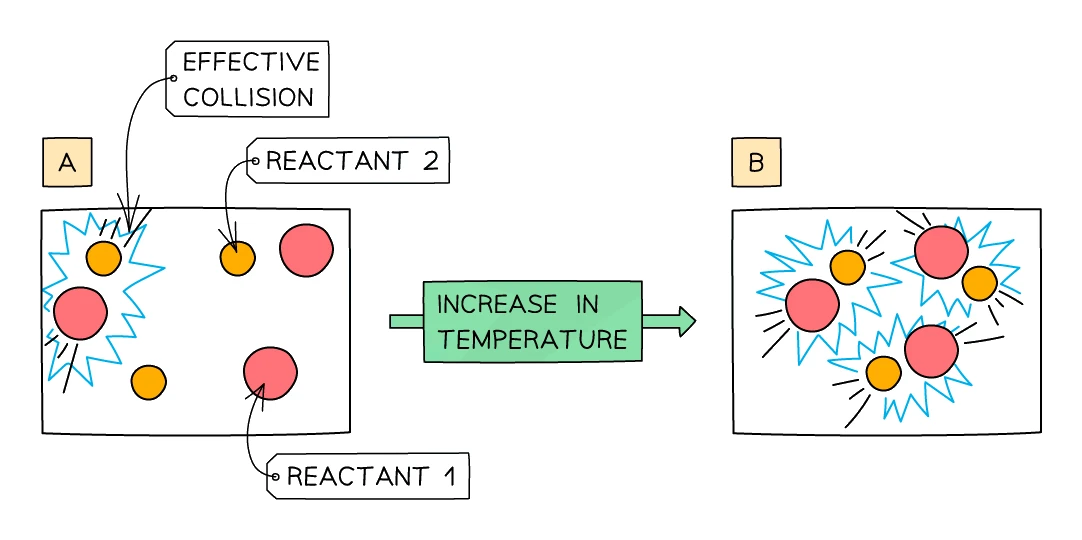
Explaining temperature and rate using collision theory
What comes up: a 3-mark question asking you to explain, in terms of collision theory, how increasing temperature affects the rate of reaction.
Write (three marks): (1) Particles have more (kinetic) energy, so they move faster. (2) A greater proportion of particles now have energy at or above the activation energy. (3) There are more successful collisions per unit time, so the rate increases.
Watch out: saying only "more collisions" — without the energy/activation-energy point — will drop a mark. The mark scheme treats the energy idea as a separate, credited point from the collision frequency idea. Both are needed for full marks.
How surface area changes the rate
- For a solid reacting with a liquid or gas, the reaction can only happen at the surface of the solid where the two phases meet
- Cutting the solid into smaller pieces exposes more of the underlying particles
- More exposed area = more collisions per second between the solid surface and the surrounding particles = faster reaction
- Same idea as crushing a sugar cube into powder — it dissolves much faster